Sunday, July 6, 2014

Al's Omniflick Spotlight: 1964


To celebrate my 75th posting (as I did for my 50th), I thought it would be fun to break from the ferocious flow of current cinema releases and focus on someone or some period or something else that demands our attention--and memory. Why not turn the clock back 50 years to 1964 to recall some gems from an extraordinary year in movies? I've chosen some films I thought significant (and of course like) but deliberately (and regretfully) left some films off the list. My selection should in no way be interpreted as the BEST of 1964 but merely a cross-section. Feel free to comment on my choices and add your own. I've listed them randomly so please do not read the list as a ranking. Hope you enjoy the list and I also hope it inspires you to revisit some or all of the films.

Ten from Sixty-Four:


1. Dr. Strangelove or: How I Learned to Stop Worrying and Love the Bomb

Kubrick's film isn't only funny but highly representative of the period's atomic bomb angst and the Cold War U.S./USSR internecine strife. Peter Sellers chameleon-like brilliance, George C. Scott's hilarious turn as General "Buck" Turgidson, and Slim Pickens bronco-busting warhead ride make Dr. Strangelove trippy and timeless fun. Kubrick's wideshot of the sparsely-lit, hyperbolic war-room is strangely beautiful and comic in an otherworldy way.

2. A Fistful of Dollars

Sergio Leone's first-in-a-trilogy western not only helped introduce spaghetti westerns to the world, but it transformed T.V. star Clint Eastwood into an international star. Ennio Morricone's score was also a musical icon of sorts and made the characteristic whistling sounds an integral part of the film and series. Though often critically vilified at the time, the spaghettis have since been copied, parodied and in Quentin Taratino's case, borrowed from. Who can resist the sight of Clint Eastwood's dusty serape and the climactic showdown involving a plate of metal armor?

3. Goldfinger

I found Goldfinger frightening when I was a kid. Seeing a murdered woman's body covered from head to toe in gold paint was not only aesthetically and criminally genius, it also reflected the methods of a scary, psychotic mind that made the killer's passion painfully clear. If that weren't enough, said fiend had an equally-frightening sidekick named Odd Job who could decapitate with his bowler hat. What's not to fear? Only 007 could face such an off-the-wall villain so memorable--and nightmare-inducing.

4. A Hard Day's Night

Director Richard Lester's film was one of those perfect collaborations that wed a comic, inventive mind and a musically-gifted band with Marx Brothers-like tendencies. The Can't Buy Me Love sequence is exhilarating and visually original; Lester used crane-shots, hand-held visuals and aerial cinematography for a breath-taking, hyperkinetic scene. Can't wait to see it again on the big-screen in its 50th anniversary re-release.

5. Band of Outsiders

And what would the Sixties (and modern film) have been without Godard's groundbreaking cinematic techniques? The anarchic spirit of his film and the times is captured beautifully in black and white. The Madison sequence is still one of my favorite dance scenes in film. One of these days I should learn those steps!

6. My Fair Lady

Aside from the humorous moments and melodic numbers, there is a subtle, tragic sadness to the story. Is anyone else bothered by the fact that Eliza Doolittle's father essentially abandons her to her own devices and cares little for his daughter? Sure, he's supposed to be a loveable, indolent slob but he's also selfish and given to mooching off his struggling daughter. Nevertheless, Cukor's directorial flare for staging musical numbers and the lovely sets and costumes leave one feeling a little light-headed, inebriated and wanting to dance all night.

7. The Umbrellas of Cherbourg

Catherine Deneuve was all over the 60s'; demonstrating her acting talents in films like Repulsion and Belle de Jour, but she proved she had a lighter, more romantic side. Jacques Demy's film is France's answer to a Hollywood-dominated genre and it leaves its mark indelibly.

8. Fail Safe

Sidney Lumet's film is Dr. Strangelove's dark and frightening evil twin. With terrific performances by Henry Fonda, Walter Matthau and in his finest moment-Larry Hagman, Fail Safe remains the apotheosis of nuclear war anxiety. That Lumet could film two men locked in a room, talking on a phone, desperately trying to avert a U.S./Soviet nuclear exchange and make it riveting, speaks volumes about his talent as a director. Still a chilling film.

9. Zulu

In Michael Caine's first real feature film, he evinced the charisma and talent we've come to recognize. Director Cy Endfield's dramatization of the the Battle of Rorke's Drift, where 150 British soldiers defended a fort against 3,000+ Zulu warriors is absolutely harrowing, exciting and unforgettable.

10. Red Desert

Antonioni's searing images of Monica Vitti wandering through a Bosch-like industrial hell make for a powerful indictment of the modern world where factory-littered landscapes reduce people to the status of an ant. Terrific performances by Vitti and Richard Harris. An underrated Antonioni film.

Just a few among many other notable 1964 releases: Hitchcock's Marnie, Bunuel's Diary of a Chambermaid, Mary Poppins, The Last Man on Earth and Pasolini's The Gospel According to St. Matthew. There you have it, folks. The list is proof-positive that 1964 was an exceptional year for film and one that should be explored further. I hope you enjoyed this stray-from-the highway adventure. See you soon.

Thursday, July 3, 2014

Begin Again


**Spoiler Alert**

Director: John Carney/Starring: Mark Ruffalo, Keira Knightley, Hailee Steinfeld, Mos Def, Catherine Keener, James Corden and Adam Levine

Director John Carney struck gold with Once some years back, with its charming leads and lovely, heartfelt songs. Begin Again hopes to recapture some of that magic but with a high-profile cast and a setting more American. Everything that made Once a sweet surprise is glaringly absent here as Mark Ruffalo and Keira Knightley try in vain to make what is essentially a re-worked and warmed-over version of Carney's better film hum. Unfortunately, its musical theme is mostly a thrum.

From Carney's own script is a story of a nearly washed-out, small record company executive named Dan (Ruffalo) who manages to lose his job as a partner at the label he helped found. He drinks excessively, is separated from his wife and infrequently sees his teenage daughter, who is mildly contemptuous of him whenever he arrives to pick her up. He is also broke and even involves his daughter in a drink-and-dash at a bar when he learns neither can foot the bill. Dan's pathetic, selfish and desperate nature comes through loud and clear.

Dan then meets Greta (Knightley), a singer-songwriter from London whose boyfriend Dave (Maroon 5's Adam Levine) has just broken into the music bigtime. Briefly sharing his success, she discovers an affair he's had with a record label staff member when he plays her a song that is all-too-revealing. Greta leaves Dave then seeks temporary shelter with her fellow countryman singer Steve (an amusing James Corden). After she is coaxed onstage by Steve at a local club, Greta's song meets an unreceptive audience and she leaves the stage dejected. Unbeknownst to Greta, her song manages to charm one patron--a liquored but appreciative Dan, who happens to be watching.

We first hear her perform the song, then later we see the performance from Dan's perspective. His fine-tuned musical experience allows him to hear the song with instrumental accompaniment. A piano, guitar, drums, violin and cello all play themselves; bringing a fuller, warmer sound to the composition. This segment was a nice touch; it was very musical and it gave Ruffalo's character some professional credibility.

Impressed with Greta's song, Dan approaches her afterward with an offer to record her music though he is up front about losing his job, being broke and drinking way too much. Greta is skeptical, citing her plans to return to London the next day and a natural aversion to recording her music.

The next day Greta agrees to his offer to record her music which inspires Dan to use various locations around the city rather than a studio to capture her sound. Dan also manages to find musicians hungry and eager enough to work for free. I liked the scenes where the band records in alleys, building-tops, Central Park, Chinatown and the subway. The natural settings allow Carney a natural visual palette from which to utilize the city's inherent charms and personality. The improvised locations are perfectly wed to the rag-tag group's guerilla recording tactics. Carney's directorial inventiveness comes through here and lends some color to the story.

As the recordings progress, Dan must deal with his fractured relationship with his daughter and his wife while Greta hopes to overcome her post-break-up despondence. A natural romantic bond blossoms between Dan and Greta though they resist its allure.

I wish the story had followed a less-predictable course but it seems the God of Neat Endings and Mended Loose Ends must be appeased--a filmmaker's typical pitfall--which cripples a film that occasionally strayed into interesting areas.

Catherine Keener's role as Mark Ruffalo's wife was shamefully underwritten. A fully-realized character in Keener's hands can be something wonderful, but here she behaves according to the script's dictates, which is a pity. Steinfeld can always be counted on for some quirkiness but her only vacation from her rigidly drawn character is a scene where she is invited to play guitar with the band. Ruffalo is always interesting, playing his character with ragged appeal and sprinkles of scoundrel thrown in. I'm afraid to say I found Keira Knightley spectacularly miscast. I couldn't buy her for a second as a singer/songwriter though she does have a pleasing singing voice. Even small details like the way she tentatively held her guitar made her unconvincing. Music doesn't radiate from her the way it does from say, a Joni Mitchell or a Neil Young; songwriters who play their guitars with authority and love. I'm also of the school that finds her mannerisms distracting and annoying, which makes it difficult to forget HER in her performance.

Greta's bland, generic songs also do no favors for the movie. Even with full-band accompaniment, they seem like any-song from anyone, with no real soul or passion. Even some of the CD demos Dan jettisons disgustedly from his car have more aural appeal than Greta's work.

Even though Carney may not have been conciously making Once II, I'm sure he was hoping the same spirits might be summoned for Begin Again. But among the many things that made Once irresistable was a story and characters that were so real because they essentially were. The actors wrote the songs; music so plaintive and beautiful but lived them as well. In a 2011 documentary (The Swell Season), which captured stars Glen Hansard and Marketa Irglova in their post Once relationship, we see people and a romance that wasn't unlike the film. Hansard and Irglova could inhabit their characters and could write lovely, melancholy songs in Once because they were their characters. Music is as necessary and vital to them as their skin and they express this beautifully and tragically in the film.

If only Begin Again had the same poetic urgency it might have been something better than a drama plotted by a clockmaker; with gears and cogs that turn according to design but only yield the modest musical chirps of a cuckoo.

Monday, June 30, 2014

Le Chef


**Spoiler Alert**

Director: Daniel Cohen/Starring: Jean Reno and Michael Youn

Not to be confused with Jon Favreau's Chef, Daniel Cohen's film is as light as the American counterpart but not as tasty. Le Chef falls into the French Farce genre, whose quality over the last decade has been very uneven. The French make such powerful dramas with complicated characters so it's puzzling when their comedies parrot the worst of Hollywood.

A film like Le Chef lives or dies with its cast, since the writing is rather tame and bland. An infant could plot a course through the storyline without error or much effort. It is fortunate that two actors with charm, Jean Reno and Michael Youn, help keep the film buoyant.

Michael Youn plays Jacky Bonnot, a chef whose lofty culinary standards often clash with various restaurant managers for whom he serves. The operative word is various, for Jacky can't seem to hold a job very long, which causes his pregnant wife much anxiety. Jean Reno plays Alexandre Lagarde; a chef of fame and high regard whose restaurant has enjoyed three-star status for fifteen years. Lagarde's ranking and job are threatened by the CEO of the group that owns the restaurant; who continually threatens to replace him with a chef who specializes in molecular gastronomy. In his private life, Lagarde's relationship with his beautiful daugher becomes brittle when he is unable to devote time or proper moral support for her during her oral literary thesis preparation.

Before long, the two chefs are thrown together by a chance meeting at the retirement home where Jacky paints window-frames. Lagarde offers Jacky an unpaid position as an assistant; a proposal he must keep from his wife. The Bonnot's forthcoming child and the couple's shaky financial predicament add some tension to the proceedings.

In awe of the famous chef, Jacky becomes Lagarde's assistant on a widely-watched T.V. cooking show and in his kitchen. Lagarde sees that Jacky can run his kitchen effectively; his leadership skills very much in evidence. The show is also given a boost when the two bicker about the finer points of food preparation, which goes over well with the viewers.

When the CEO learns that two prominent food critics who prefer molecular cooking plan to visit the restaurant, he threatens Lagarde with job-dismissal and the loss of his comfortable apartment if the restaurant loses a rating star. The CEO's threat is part of a ploy to bring in a younger chef who specializes in molecular cooking. It doesn't help that neither Lagarde nor Jacky show any enthusiasm or passion for the trendy cooking technique, which involves the use of chemicals in food preparation. The ubiquity of liquid nitrogen in cooking and eating--among other chemicals--is kind of a running gag in the film.

I didn't laugh once during the film, nor did anyone else who occupied the theater, which is too bad because the film is likeable, as are the two stars. It is miraculous that a lack of laughter didn't translate to an excruciating experience. Though Le Chef wants to be a light comedy, it never really tries hard enough for laughs, save for one scene in which the two chefs disguise themselves as Japanese royalty to infiltrate Lagarde's young rival's molecular-cuisine restaurant. While Jacky dons a geisha-girl get-up, Lagarde wears a samorai-like coif and robes. It isn't funny and stumbles ever-so-close to being offensive. It manages to be mildly-amusing but only mildly.

The film proceeds along as one would expect. No loose ends in this comedy, so no mysteries persist as to what becomes of both Jacky and Lagarde's familial troubles. The only surprise is the climax, but it's only a surprise if you've been asleep the previous hour and a half.

Michael Youn has a very likeable face, which enables him to accrue much sympathy while I wish someone would write a truly funny film for Jean Reno, whose comedic talents are very conspicuous. If I didn't laugh, I also wasn't bored the way one can be with so many inane Hollywood comedies. Le Chef, to risk using a cooking metaphor, is the promise of delicious cake that fails to rise when heated. One is left picking at the remains, hoping for something satisfying but regretting its unrealized potential.

Friday, June 27, 2014

Jersey Boys


**Spoiler Alert**

Director: Clint Eastwood/Starring: John Lloyd Young, Vincent Piazza and Christopher Walken

I never saw the stage production on which Jersey Boys is based but one can discern its theater origins from its tone and its lack of fidelity to biographical imperatives. It gives us enough history for us to care about the characters but not the deeper probing of life and times one might find in say, Walk the Line.

On first seeing the trailer for the film, I thought maybe I was hallucinating when I read Clint Eastwood's directorial credit. He is far from an obvious choice to direct a film about Franki Valli and the Four Seasons. Eastwood has always been a jazz devotee; films like Bird and Straight, No Chaser (which he produced), reflect his personal musical passion so I was intrigued with his latest directorial choice.

Jersey Boys is more than the story of how Franki Valli (born Francesco Stephen Castelluccio) and the Four Seasons rose to the top of the pop charts. It also gives us a glimpse of the rough and tumble world of New Jersey in the 50s' and 60s', specifically Franki Valli (John Lloyd Young) and fellow band member Tommy DeVito's (Vincent Piazza) connection to local mob man Gyp DeCarlo (Christopher Walken). Sharply captured is the tightly-knit Italian-American culture, where loyalty is all but a sacrament, even when strained.

The story begins in the 50s' as a sixteen-year old Francesco (Franki) Castelluccio divides his time between working as a hairdresser during the day and singing in the evenings; his voice already a local sensation. His best friend Tommy is the frontman for a band that gigs in local clubs.

Tommy and some of the locals involve themselves in all sorts of crimes, often with Franki as the lookout. A funny scene where Tommy and some associates rob an establishment of a large safe while Franki watches for police is wildly amusing. The over-sized safe is placed in the trunk, which causes the front of the car to rise absurdly off the ground. As an alarm is set off, Franki is forced to drive the car with the upraised front obstructing his view, which causes him to crash through a store front window.

Both Franki and Tommy are loyal to Gyp, a sort of father-figure to Franki, who he looks out for while Tommy is treated mostly as an afterthought. Later in the film, Gyp's powerful influence, which Franki calls upon as an enormous favor, saves Tommy from a sizeable $500,000 debt. The debt is mostly shouldered by Franki, who refuses to abandon his friend to unimaginable punitive measures. Such a sacrifice, as we hear in one character's aside, is part of the Jersey code-of-honor.

The story is really, in essence, Franki and Tommy's relationship. The close, fraternal bond the two share sometimes is challenged by Tommy's brushes with the law which unfortunately often implicate Franki. Their relationship is grievously tested later in the film, as we see a strong bond under seige by resentments and Tommy's dangerous debt.

Before long, Franki joins Tommy's group though stardom continues to elude the band. A brilliant singer/songwriter Bob Gaudio (Erich Bergen) joins the group but rather than finding immediate success, the group is forced to sing back-up in studio sessions until Bob pens the group's first hit Sherry. The song places them on the pop charts, lands them a gig on American Bandstand and lays the groundwork for what will ultimately be a successful run in the 60s'.

I've never been a fan of Franki Valli and the Four Seasons though it's difficult to ignore their impact on the pop-music scene in the 60s'. But no matter, Jersey Boys is fun though hardly a significant addition to Eastwood's 21st century oeuvre. The performances, particularly Lloyd Young's and Vincent Piazza's, are solid and affecting. Piazza almost steals the show; his charm and menace make the perfect contrast to Franki's more unassuming, non-confrontational disposition.

Eastwood's camera-compositions, never fussy nor demanding attention, mostly fix on actors rather than settings, making the story more character-driven. The characters' occasional asides to the camera provide some commentary or illuminate motivations--an idiosyncrasy one can easily imagine being retained from the stage production. Inter-band strife--members threatening to quit or forming secret agreements--always seems inevitable. Ultimately, Bob and and Franki become a team; landing a hit with the now classic Can't Take My Eyes off of You

Though entertaining, there is something vaguely unsatisfying about the film. The story lacks historical context; we see the band score hit after hit but we don't get a sense of when and how. We also don't get a sense of the importance of the band's music in rock history, as if it all happened in a vacuum. We see the band arriving at Radio City Music Hall to be inducted into the Rock and Roll Hall of Fame in a scene leaping forward to the early 90s' but so what? To whom did their music matter? In my high school days back in the early 80s', their music seemed Paleolithic though music from other bands and performers from the band's heyday were still heard on classic rock radio (and still are). Luckily the relationships between the bandmembers and the colorfully drawn Jersey personalities make us care about the people, if not the music.

I didn't leave the movie humming any of The Four Season's songs but I took note of the performances; enjoying the film in spite of its shortcomings. Jersey Boys might not dazzle, but it is a welcome change from the non-stop demolition seen on most Summer movie screens.

Wednesday, June 25, 2014

Violette


**Spoiler Alert**

Director: Martin Provost/Starring: Emmanuelle Devos and Sandrine Kiberlain

Director Martin Provost's Violette, could almost be a follow-up to his 2008 film Seraphine, as both films deal with French women whose art not only won them acclaim, but allowed them to abrade the near-impenetrable, chauvinistic social barriers maintained by the male-dominated cultural establishment.

Emmanuelle Devos (always excellent) plays Violette LeDuc, the emotionally-hungry and needy writer whose passionate, erotic, auto-biographical novels came to the attention of Simone de Beauvoir (Sandrine Kiberlain) after World War II. We first see Violette living in a stiflingly bucolic French village where her homosexual significant other struggles to bring his own writing to the attention of the literary world. Though he respects Violette's opinion of his work, he is anxious to leave their rustic life without his wife. Trailing after her husband in his desperate flight from the country, she is abandoned. But Violette's own writing burgeons and after relocating to Paris, her novel L'Asphyxie (In the Prison of Her Skin) is brought to the attention of a publisher via de Beauvoir's efforts.

In meeting de Beauvoir, a kindred spirit whose own erotic prose and feminist candor matched Leduc's, Violette begins to demand love and attention. de Beauvoir bristles at Violette's repeated advances and her jealous inquiries about her lovers. In spite of the conflict, de Beauvoir tirelessly and unselfishly champions Violette's extraordinary, beautiful work; often negotiating with the publisher for Leduc's artistic freedom. In one scene, de Beauvoir cites the double-standard practiced in publishing by which Jean Genet enjoyed almost censor-free consideration while Leduc was repeatedly edited by publishers who were uncomfortable with a woman's confessional writing.

Devos and Kiberlain are terrifc as Leduc and de Beauvoir. Devos captures the psychological stresses Leduc endured: the stigma as a bastard child; her overprotective mother's attentions, episodes of frail mental health, the torments of unrequited love and the oppressive sexism of the time. Kiberlain is a bit too-willowy to be a physical match for de Beauvoir, but she inhabits the spirit of the famous writer; conveying not only her struggles, but also her strength.

Provost appropriately maintains the narrative focus on the two women; for their up-hill struggles--in a world where Jean-Paul Sartre, Albert Camus and Jean Genet roamed freely, garnering awards and accolades--are no less than incredible.

Violette soon learns that the 25,000 francs she receives monthly from her publisher is actually from de Beauvoir. Again, this reflects not only de Beauvoir's generosity, but the resistance to Violette's sexually-liberated work in the publishing world at the time. But eventually, through persistence and the slowly evolving recognition of women's rights and equality in France, Violette becomes a celebrated author, embraced by the public and the publishing world. It is sad to think that her popularity isn't that of de Beauvoir (at least here in America) but her writing ultimately proved to be the equal of her more famous contemporaries.

It seems only natural that a film about two women of renown would be carried almost entirely by two women and that they do so effectively makes Violette something other than a just a movie about writers. Leduc and de Beauvoir had much to express and much to overcome. A film depicting their herculean efforts could do no less than make them compelling figures. And it does.

Monday, June 23, 2014

Obvious Child


**Spoiler Alert**

Director: Gillian Robespierre/Starring: Jenny Slate, Gaby Hoffman, Jake Lacy and Richard Kind

Some former Saturday Night Live alumni bear the stigma of leaving the show without ever having the opportunity to shine but later they manage to blossom on the stage, T.V. or film. Jenny Slate, a one-time SNL alumnus, may join the likes of Chris Rock and Sarah Silverman--other alumni who succeeded nicely after undistinguished stints on the show--by establishing her own comedic credentials with the feature Obvious Child.

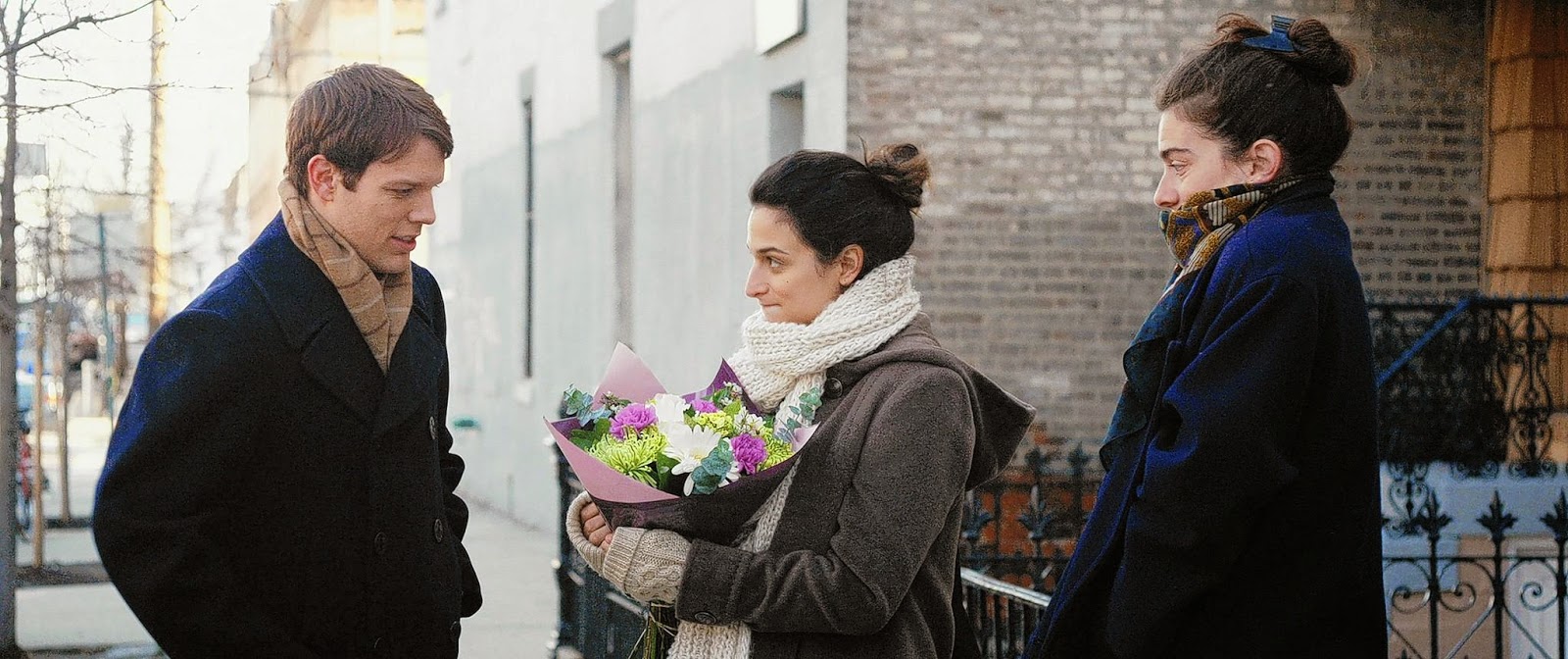
Slate plays Donna Stern, a woman in her twenties who does stand-up comedy in a local club while also holding down a job in a bookstore that is in its death throes. Her boyfriend has just dumped her for another woman and she medicates herself with excessive drinking. While not bemoaning her relationship status with her roommate and friend Nellie (Gaby Hoffman), she seeks moral support from her divorced parents; father Jacob Stern (Richard Kind) and mother Nancy (Polly Draper).

Early on I felt uneasy; thinking the film was going to be one more Lena Dunham-like, navel-ogling, mopy, comedy-drama with a character who can't seem to find Mr. Decent. The story mercifully veered from the well-worn into the unexpected.

Donna meets a handsome, twenty-something named Max (Jake Lacy), whose nice blandness seems to be a polar extreme to Donna's smart, hip, city-wit. But after a night of one-too-many, the two find themselves lying next to one another in bed the next morning. Donna, still smarting from her break-up and mildly stalking her ex, resists Max; avoiding him and ignoring his calls.

The story takes a significant turn when Donna learns she is pregnant with Max's child. I thought I could accurately plot the rest of the film from this point. But unlike Diablo Cody's Juno, with her character making a seemingly provocative but actually an audience-pleasing choice, Obvious Child blazes a more difficult, more controversial course by showing us a character who is resolute but emotionally unsure in her decision to have an abortion. It is all the more difficult when Max's determined pursuit of Donna leaves her feeling the guilt of removing him from the decision.

It's to first feature director Gillian Robespierre's credit that the film doesn't degenerate into predictable, ABC Family-like drama but maintains its sharp humor, sometimes subversively so. One example is some Donna/Nellie repartee that includes some jokes about abortion, which are funny without trivializing the issue.

I particularly liked the scene where Donna confides in her mother Nancy, with whom she has had a tempestuous relationship. Providing solace and some solidarity, Nancy relates her own experience with abortion in the 60s', which sheds light on a darker time when a woman had more rigid legal and societal obstacles (which haven't vanished altogether).

Jenny Slate is quite amusing and does much with her character while the supporting cast members like Gaby Hoffman, Gabe Liedman and David Cross offer their own funny witticisms and performances to keep the movie humming. Jake Lacy is the film's nice, white-toasty, almost impossibly nice and supportive love-interest but he seems plausibly so and manages to even exude a subtle magnetism.

Obvious Child is a film whose charms take a while to emerge and when they do, they satisfy. For Robespierre and Slate, it is a fine start to what I hope will be a series of fruitful collaborations.

Sunday, June 22, 2014

The Rover


**Spoiler Alert**

Director: David Michot/Starring: Guy Pearce and Robert Pattinson

David Michot follows up his terrific, gritty Animal Kingdom with an equally gritty and violent The Rover, which he co-wrote with actor/writer Joel Edgerton.

Following a global catastrophe, known to the audience as the Collapse, we find denizens of rural Australia surviving in a lawless, economically-ravaged environment where basic necessities are scarce and pricey and law-enforcement is almost a rumor. Michot's near-future Australia is an amoral, vicious, dirty, and unforgiving place. The story takes place 10 years after said disaster and the world we see looks much like the post-apocalyptic decay and rot seen previously in films like The Road Warrior and A Boy and His Dog but with a generous serving of Cormac McCarthy's The Road to darken the proceedings. We never see urban Australia, only deserty, dusty villages and citizens who are the socially and economically marginalized.

In this savage milieu is Eric (the always terrific Guy Pearce), a man who looks haggard and unwashed, with a Sisyphean boulder-size chip on his shoulder though we don't know how it got there. He stops at a decrepit bar for a drink, only to have his car stolen by three men with guns. Seeing his car receding in the dusty distance, he manages to extricate the truck the men left behind from tangled cables and junk. In pursuit of the men, he tries to bump them off the road but is unsuccessful. After the men stop, he demands his vehicle be returned then attacks one of the men, only to get knocked out in the process. He wakes to find the truck and himself abandoned in a field but after a scan of the immediate area, he finds the keys. His obsessive pursuit of the vehicle continues as he makes stops along the way, questioning people who look as ragged as he--and sometimes worse--as to the men's whereabouts.

Michot's pointed allegory on the current global, economic decline couldn't be more obtrusive. We even see the economic fallout from the Collapse; all transactions are conducted in American currency.

Among the characters Eric encounters, it is interesting to see not only Caucasians, but Asians, Aborigines, Africans and even Texans, whose peculiar prescence in the outback will be addressed shortly.

Eric stops at what is a sort of a brothel of young men. In questioning the odd madame about the the men who stole his vehicle, he receives little but enigmatic, useless information. Shortly thereafter, he tries to buy a gun from a diminutive man but when he balks at the little man's asking price, Eric shoots him in the head--a very shocking and disturbing development, to say the least. Eric's determination to achieve his goal, by whatever aggressive means necessary, becomes conspicuously clear.

It is also clear that the authorities' response to the violence is ineffectual or remote or both. Or so it seems. Hot on Eric's tail is what looks like military law enforcement in Humvees and camouflage.

Along the way, Eric happens upon the brother of one of the men who stole his car, named Rey (an excellent Robert Pattinson). Rey is bleeding in his side from a gunshot wound sustained in a shoot-out, after which he was left behind by his brother. When Eric discovers Rey's brother was involved in the car-theft, he takes him along as a kind of hostage, pressing him for his brother's whereabouts.

Eric has little time or inclination to be chatty in his pursuit of the three men while Rey, a slow-witted man with a Texan accent, is more prone to idle talk. Hearing Pattinson's accent is unusual but he executes it with some authenticity. When the taciturn, taut-jawed Eric asks Rey why he happens to be in Australia, the latter mumbles something about 'mining,' which speaks volumes about how the economic collapse has left many desperate and itinerant.

Eric's mysterious obsession with recovering his car isn't revealed until the end, which makes his single-minded pursuit all the more puzzling. What fuels his rage? Is it his disgust with everything the world has become? It might be tempting to dismiss Eric as a nihilist but that would be an oversimplification of his worldview. A clue emerges later but I'll refrain from revealing it here.

I was a big fan of Michot's Animal Kingdom, with its often gruesome and unsentimental look at the criminal underbelly of Australian society and I'm drawn to his world again. It isn't often we see a place depicted with such despair, where compassion is mostly a liability and violence always a means to an end. Michot doesn't give us the desolate beauty of Nicolas Roeg's Walkabout or the sinister, surreal loveliness of Peter Weir's Picnic at Hanging Rock but deserty decay and waste that wants to devour home and human alike. To match Michot's stygian imagery, we have Antony Partos' dark, haunting score as the film's ideal companion; understated and edgy.

Pearce can always be counted on to assume a fascinating character and play the hell out of it, which he does here while Pattinson shows us he is distancing himself further from his teen-dream Twilight character. Rey's bodily tics and slow, halting speech are characteristics Pattinson wears rather than merely affects.

I find Michot's dark, violent worlds worthy of exploration. In The Rover he doesn't shy away from making a political statement about a place and time we might inhabit if we can't avert self-destructive tendencies. I hope the world has the wisdom and compassion to avoid a condition that looks and feels like Michot's nightmare.