Showing posts with label Liam Neeson. Show all posts

Saturday, March 14, 2015

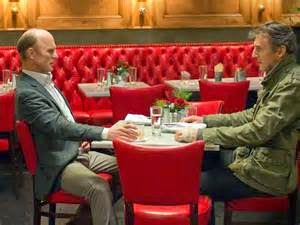
Run All Night


**Spoiler Alert**

Director: Jaume Collet-Serra/Starring: Liam Neeson, Ed Harris, Joel Kinnaman, Boyd Holbrook, Bruce McGill, Vincent D'Onofrio, Common and Nick Nolte

Liam Neeson scans his never-too-old-to-play-Mr. Badass character and faxes it to theaters in director Jaume Collet-Serra's Run All Night. Watching the nonsense unfold on-screen left me struggling to recall a role where Neeson hasn't played a former CIA operative or cop who is nigh unstoppable as an avenging angel or a tough on the run who can beat the hell out of everything that isn't nailed down or in Collet-Serra's last film Non-Stop, an Air-Marshall with kick-butt credentials. But his character Jimmy Conlon in Run All Night is different from the last half dozen, leather-jacket clad heroes he's played. How? Well, in this film he...let's see...uh...wait a minute, I know: he doesn't wear a leather jacket. See...startling contrast, right?

Sarcasm aside, Neeson hasn't exactly been too discerning with his choice of roles the last decade. Is it entirely his fault? Are there many interesting roles for middle-age men these days? Given the fact that Pierce Brosnan, Denzel Washington, Neeson, Keanu Reeves and now Sean Penn have made or are set to release films featuring themselves playing aging action figures, the pickings must be alarmingly slim.

In Collet-Serra's film, Neeson plays not a cop or a former CIA agent, but a mob hit-man who is beggining to hear the creak of his advancing years. His boss, Shawn Maguire (Ed Harris) is an old friend from his youth. Maguire's hot-headed, impetuous son Danny (Boyd Holbrook) is the Sonny Corleone of the Maguire family.

In an early scene, Jimmy watches Danny dole out cash to two New York City cops. When Jimmy enters the office to borrow $800 for a home repair, Danny doesn't disguise his disdain when he says "I don't know why my dad keeps you around." And to further humiliate Jimmy, he makes it a condition that he play Santa Claus at his father's Christmas party. When Jimmy begs Danny to spare him the indignity, the offer becomes a take it or leave it proposition.

While Jimmy performs less than admirably as Santa at the party by drinking and making passes at a fellow mob member's wife, Danny is busy negotiating a drug deal with an Albanian drug lord. The Albanians want the Maguires to exert their influence on the dock unions to facilitate the shipping and receiving of their heroin.

After Danny organizes a meeting between his father and the Albanian, the elder Maguire informs the drug dealer that his business is legitimate, which leads to his firm and prompt dismissal from the premises. Question: if the Maguire business is indeed legitimate, then why the shake-down payments to the cops?

Events take a violent turn when the miffed Albanians come to collect advanced money from Danny. Coincidentally, the Albanians are driven to the meeting by Jimmy's estranged son Mike (Joel Kinnaman), who moonlights as a livery driver but is in no way connected to the underworld. The coincidence seems a bit much but it isn't a major transgression against plausibility.

After the Albanians forcefully demand their money, Danny responds in kind; brutally dispatching both Albanians. When Mike witnesses the murders, Danny gives chase and before he meets the same fate, Jimmy arrives to plug his boss/friend's son. Of course it isn't long before Maguire uses his far-reaching resources to discover (though erroneously) Mike was behind his son's murder. Recognizing the threat to his son, Jimmy meets with Maguire to petition for his life, only to be told he will come after Mike with everything he has, with the threat extended to Jimmy. So begins the hunt and evade plot that only becomes more ridiculous with every passing minute.

Naturally the movie is also about Jimmy reconciling with his son and assuaging Mike's anger for having left the family when he was young. We learn Jimmy left the family to spare them his rough and tumble way of life; a move he sees as some sort of compassionate gesture.

Taking place during one night (hence the title), it is fairly apparent where the story will go; the father and son play hide and seek with Maguire's thugs while protecting Mike's wife and children.

But Jimmy is no tulip; he manages to fight off and kill everyone on his trail until Maguire calls for another hitman named Andrew Price (Common) to finish off his nemesis.

Did I mention the stock character, Detective Harding (Vincent D'Onofrio), who has devoted part of his career to bringing down Jimmy for his prodigious body count, and who is also hot on his trail? In a strange and yet another comical plot development, Jimmy beseeches Harding for help in bringing down Maguire; offering up the list of men he's rubbed out as compensation.

Sillier and sillier the story becomes. Why Maguire would hire a purported crack assassin, who proves to be nothing more than a clumsy oaf with little cunning or finesse, is a perplexing conundrum.

Another eye-roller is the scene where Jimmy chases Maguire through a train-yard. The sequence is troubling for many reasons. The setting is such a action movie chestnut and doesn't add a crumb of suspense or tension to the story. As Jimmy and Maguire stalk one another around the yard, I wondered why didn't one or the other merely look under the carts to locate and shoot or wound his foe. And if Maguire was so enraged by his son's death that he was willing to kill his old friend and his son alike, while sacrificing nearly all his crew in the process, why does he run and hide from Jimmy at all? Why not stand his ground and avenge his son?

I didn't care much what happened to any of the characters, even Jimmy. I guess the screenplay deity presiding over this film demanded that every character adhere to time-honored cliches and not stray from a rigid story outline. I can't hold the cast responsible. At times, Harris and Neeson manage to free their lines from must have read as vacuous on the page. Harris can make a compelling bad guy if he's given solid dialogue and a character to work with. D'Onofrio and Nick Nolte are mostly wasted. It's almost as if both their characters were penned into the script after the final draft was submitted. Another talent wasted is the terrific character actor Bruce McGill, who is reduced to playing what must have read in the screenplay as Tough Guy #1.

Collet-Serra's directorial tic in his new film is the series of stylish, pull, pan and zoom shots that play throughout the film. The camera pulls up from one setting to an aerial shot of the city then pans to another location before zooming in on another. It's a gimmicky, visual quirk that becomes quickly irritating after it's employed a few times.

As the film wound down, I found myself often chuckling and sighing heavily at the nonsense on-screen until the mess mercifully ended.

I think President Obama should devote a State of the Union Address to Liam Neeson's career rut.

Please Mr. Neeson, I think you're a terrific, charismatic actor; no more tough guys with guns for awhile, okay? Give some other actors an opportunity to play these clowns for a change. Hollywood, I implore you too to cast against type in these roles. Why not let Lena Dunham play the badass for once? I know, it's dumb, but it could it be any worse?

Monday, July 14, 2014

Third Person


**Spoiler Alert**

Director: Paul Haggis/Starring: Liam Neeson, Olivia Wilde, Adrian Brody, Mila Kunis, James Franco, Maria Bello, Kim Basinger, Loan Chabanol and Moran Atias

I wasn't a fan of Haggis' Oscar-winning film Crash; I found it overrated, over-cooked and underwritten and I have to say I had the same reaction to Third Person. Both boast show-offy multiple character plots which occasionally intersect but seem forced and often phony. His new film has an impressive cast and exciting locations: Rome, Paris and New York. Beautiful people in beautiful locations. Should be enough, right?

Liam Neeson plays Michael, a Pulitzer-prize winning author who is having an affair with a beautiful, younger woman named Anna (Olivia Wilde) who is both repelled by and attracted to the writer. As a writer herself, her interest in Michael isn't relegated to romance; she also seeks his authorial approbation, which he is reluctant to give after reading a short story she has submitted to him. Meanwhile, Michael is estranged from his wife Elaine (Kim Basinger) though he talks to her almost daily. She is well-aware of his affair with Anna but refuses to abandoned the marriage.

Another story is set in Rome, where a shady businessman Scott (Adrian Brody) steals fashion designs from top Italian designers for knock-offs manufactured in sweat-shops. He becomes involved with a gypsy woman (a culture known more appropriately as Roma) named Monika (Moran Atias), whose daughter is being held by Romanians. To get her daughter back, she must come up with 5,000 euros or risk her 8 year-old becoming a prostitute. Scott offers to help and in doing so, becomes hopelessly entangled in the dangerous effort to recover her daughter. As the story develops, it becomes increasingly clear Scott may be the target of an elaborate scam though he has fallen in love with Monika.

In yet another story, Mila Kunis' Julia is battling James Franco's Rick for visitation rights for her son, whose life she unintentionally imperiled when she demonstrated how he could possibly suffocate playing with a sleeping-bag. Though Rick is adamant about Julia not seeing the boy, Rick's girlfriend Sam sympathizes with the mother and eventually aids in her attempt to see him. Julia is her own worst enemy, as she can't hold a job for any period of time and is generally a mess. Assisting her legally is Theresa (Maria Bello); a tough, pragmatic lawyer who has little patience for Julia's irresponsibility.

You know Haggis will somehow have the various storylines and characters mingle in many contrived, unnatural ways. When Julia, working as a maid, scribbles an important address of where she is to meet her lawyer and Rick for a custody hearing, she accidentally leaves the paper in the hotel room, which just happens to be Michael's. He uses the same paper to write down his wife's phone number, which falls into Anna's hands then ultimately, back into Julia's later. Haggis works hard to make all this seem seamless, but like Crash, it screams overwrought plotting.

It also becomes strange when we know Julia is working in the Parisian hotel where Michael and Anna are keeping rooms though her custody hearing is in New York. This isn't a filmmaker's embarassing flub but another plot device too clever for its own good. How she can be in two places at once becomes clear later in the film, as does the other oddities in the story. What also is brought to light is why the stories all share a common theme of children in extremis.

It is Michael and Anna's story that serves as the sun in this solar system. Michael's head-games, in which Anna is a willing participant, begin to grow tiresome as the two lovers are on again, off again while his wife pleads for his return. We also learn Anna has been hiding a secret; one that offers a cliched explanation as to why she prefers older men like Michael. It comes off as cheap Freudian fallback and is an eye-roller.

Eventually everything and everyone is absorbed in the denouement which is one more Haggis-ism I couldn't endure. I guess I give him points for the attempt.

Because the stories are labored, many of the actor's performances appear over-boiled, but the the final scenes may explain that as well. Noone in the cast comes off as all that sincere though they try hard to sell their characters. Neeson, a very skilled actor, has trouble playing a convincing writer. Though his publisher informs him the quality of his writing has declined and finds his latest work unpublishable, he writes a chapter of new novel, which shamelessly co-opts his lover's personal life as content. This is all fine and good, but Michael's prose is so hackneyed, it couldn't even pose a qualitative challenge to Judith Krantz, though his publisher doesn't seem to notice.

I think Haggis would like to manage the multiple character/storylines with the skill, precision and power Altman once did in films like Nashville or Short Cuts. Unfortunately he lacks that directors unerring instinct for character and plausible, multiple plot streams.

When everything wrapped and the credits scrolled, I left the theater thinking how stunning Olivia Wilde looked, then I thought about what I needed from the A&P.

Sunday, June 1, 2014

A Million Ways to Die in the West


**Spoiler Alert**

Director: Seth MacFarlane, Charlize Theron, Liam Neeson, Amanda Seyfried, Giovanni Ribisi, Sarah Silverman, Neil Patrick Harris, and Wes Studi

One wouldn't see Seth MacFarlane's A Million Ways to Die in the West for the sweeping vistas or characters with contradictions and dark, ulterior motives usually found in John Ford westerns. But if you happened to be looking for a film that lampoons westerns with crudely-served scatalogical humor, or skewers the prevailing myths of the old west in the same manner, then A Million Ways to Die in the West is what you're looking for.

From an original script by MacFarlane, Alec Sulkin and Wellesley Wild, A Million Ways to Die in the West tells a revisionist, deconstructive story of the west that is gleefully anachronistic. One knows what one is in for with Seth MacFarlane, particularly from the theatrical trailer, so no illusions about sophisticated humor, please.

Set in Arizona in the 1880s', Seth MacFarlane plays a cowardly sheep-farmer named Albert who detests everything about living in the frontier and says so in a soliloquy itemizing the kind of things that can kill you in the west in a way that is more perspective-from-the-future. It is a running gag in the film that Albert is a terrible sheep-farmer, as his herd is usually scattered all about, including the roof of his home.

Albert is in love with his sweetheart Louise (Amanda Seyfried) but the relationship sours when she grows tired of his character flaws and his inability to be a competent sheep-farmer. She falls in love with the town dandy, Foy (Neil Patrick Harris) who owns a shop that serves men with mustaches. Albert's lack of facial hair is a subtle jab at his lack of masculinity, which Foy exploits one day when Albert wanders in the mustache shop. MacFarlane always cuts a strange figure in movies with his bizarre, blemishless, alabaster complexion but it serves him well here; his smooth skin a comic reminder that a hairless face is something to be avoided in the frontier west

Unable to win Louise back, Albert is helped by a tough, tall, beautiful blonde named Anna who enters the town to rescue her brother from the jailhouse. Anna is married to the most ruthless, intimidating gunfighter named Clinch (Liam Neeson) who discovers his wife has kissed Albert, which leads to a High Noon-like confrontation later in the story. In the meantime, Anna helps Albert to overcome his love for Louise.

The story is secondary, most of the time, to the sight gags and jokes about the old west and the culture. One of them-and an amusing one-is the talk about having one's picture taken and how noone is supposed to smile. Albert shares a story about how he heard someone in Texas actually smiled during a photo, which seems outlandish and unbelievable to Anna and Albert. Another involves Albert's best friend Edward (Giovanni Ribisi), a morally upstanding young man who refuses to bed his fiancee Ruth (Sarah Silverman) before their wedding though she is a town prostitute who is visited at least ten times a day by clients--a fact known to everyone and Edward alike. It is quite funny to listen to Edward and Ruth talk wholesomely about saving themselves for marriage then hear her called gruffly by a saloon patron upstairs for sex, to which she promptly and dutifully complies; leaving Edward sitting pathetically at the table. The jokes are hit and miss and for the latter half of the movie, the story's almost serious narrative kills the momentum of the comedy as if MacFarlane forgot the movie is supposed to be a raunchy farce.

A Million Ways to Die in the West has its inspired moments but they seem too scarce. I'm not averse to humor dealing with bodily functions but films like MacFarlane's seem to use it as a crutch; betraying the famine of ideas that must have beset the screenwriting. A scene involving a duel between Foy and Albert, which ends up with the former defecating in the street seems borrowed by scores of gross-out comedies, including the recent Bridesmaids.

The cast rides along with the raunch and silliness. Sarah Silverman is quite amusing, as is Wes Studi's Cochise and Neil Patrick Harris with his foppish, annoying, handlebar mustache.

The film does have its John Ford, sweeping vistas of the desert southwest, which are breathtaking and unusual for a farce like MacFarlane's.

It made me chuckle at times but not enough. The film is one more missed opportunity but I've seen worse, which isn't exactly olympian praise but hardly a categorical dismissal. I'd like to see him try again, but next time remember to be more generous doling out the gags.