Sunday, July 12, 2015

Infinitely Polar Bear


**Spoiler Alert**

Director: Maya Forbes/Starring: Mark Ruffalo, Zoe Saldana, Keir Dullea, Imogene Wolodarsky and Ashley Aufderheide

There are two types of characters in film that can be insufferable if not given proper dimension; drunks and manic-depressives. Director Maya Forbes' Infinitely Polar Bear may be the first film to feature both. Mark Ruffalo; an actor of considerable talent, is given the daunting task of making Cameron Stuart; the protagonist, someone real and of this Earth. Though the supporting cast have their own acting challenges, much rests on Ruffalo's performance.
Playing a manic-depressive is tricky; the precarious balancing act requires the actor capture the ecstatic flights of messy chaos that govern the mind of a bi-polar without the performance becoming incoherent. But the actor must also find the character's essence beneath the all the histrionics, lest the performance become Barnum and Bailey. As an unwritten rule, the character need not be charming or likeable, just watchable.

Unfortunately, Ruffalo's performance is susceptible to every aforementioned acting pitfall. Fortunately for the movie-goer, his performance is only vexing for half the movie until it becomes a bit more settled in the second half and hence, a bit more tolerable.

The time is the early 1970s' and the place is Boston. Mark Ruffalo plays Cameron, a manic-depressive father of two girls and a husband to Maggie (Zoe Saldana); who is thrust into the role of family breadwinner, for obvious reasons. Living on family money controlled and doled out by Cameron's grandmother and Maggie's modest library pay, the family's economic situation is kept buoyant, if not viable. While Maggie holds down her job, Cameron's bipolar condition prevents him from maintaining steady work, which makes parenting his daughters Amelia (Imogene Wolodarksy) and Faith (Ashley Aufderheide) a necessity.

The family's situation becomes complicated when Maggie is accepted to Columbia. The development entails being away from Cameron and her daughters but it also means leaving her volatile husband in charge. Unable to bring the girls to New York City, Maggie sees no alternative but to entrust the care of her daughters to Cameron.

The situation becomes predictably problem-laden as Cameron's over-the-top behavior becomes a source of embarrassment to the girls. His around-the-house projects, though useful and often creative, begin to consume every available space. The clutter becomes so overpowering the girls refuse to let the neighborhood into their home.

But Cameron's fanciful flights sometimes have a salutary effect; his daughters are often as likely to be amused and entertained by his whimsy as they are vexed by his hysterics. Sometimes Cameron seems remarkably focused, as when he manages to impress the girls by taking the initiative to tidy the apartment. Order is short-lived as tidiness becomes prey to his his scattered, chaotic thinking and his messy pursuits.

But Cameron's more troubling behavior resides in his highly irresponsible drinking, where all-night binges at a local watering hole mean leaving his daughters unattended at home. We see Cameron arrive home after one such outing, only to find the front door chained by his angry daughters, who we know are well-acquainted with his irresponsible drinking.

Maggie's weekend visits become an exciting weekend ritual for the family but also serve as ballast for Cameron's erratic behavior. In spite of Cameron's behavioral excesses, he manages not to alienate his family or lose their affection.

With her family firmly rooted in Boston, Maggie contends with problems of her own as she begins interviewing at investment firms in New York City. The prejudices and sexist views of the time are thrown into sharp relief when we see prospective employers recoil from Maggie's disclosure that she has kids.

While I found Mark Ruffalo's depiction of manic-depression unconvincing and hyperbolized, Zoe Saldana's performance proved to be more affecting and real. I found Maggie and her plights to be more compelling than Cameron's struggles with manic-depression and drinking. Maggie's story could have been the subject of a better movie; a black woman trying to raise two children in the bigoted, sexist seventies. But what we have instead is one more film about manic-depression; a topic I would prefer became extinct (unless someone can pen a more moving story).

If I can offer any honorific praise, it is in the production design. The 1970s' looked remarkably authentic but other than my selective praise, I'm afraid I can recommend little else about the film. Though we can give Forbes credit from steering the film away from cutesy-ness the title suggests the film might succumb to, we can only wonder why the story ignores the dark, antipodal moods that contrast the emotional highs in a bipolar's life. If the film's title doesn't put you off, the film itself may. For a story about a manic-depressive alcoholic, the film seems astonishingly free of gravitas. Cameron's bipolar histrionics and boozing forays often seem more like idiosyncratic flights rather than potentially harmful behavior that might test a family's emotional stamina.

As far as films about bipolars go, I have always preferred Richard Gere's manic-depressive in Mr. Jones. At least we got the lows with the highs in that film. Infinitely Polar Bear is all highs and mid-range. But as far as a movie-going experience goes, it's definitely a low; one unalleviated by any proper prescription or script.

Sunday, July 5, 2015

The Overnight


**Spoiler Alert**

Director: Patrick Brice/Starring: Adam Scott, Taylor Schilling, Jason Schwartzman and Judith Godreche

The Overnight tells the story of a couple newly transplanted to L.A. from their former Seattle home who are eager to make friends in their new surroundings, only to find their endeavor comes with complications. Penned and directed by Patrick Brice, the story's tone shifts slightly from comedy to drama midway through the film and becomes progressively weirder as the narrative unfolds. The psychosexual hang-ups that surface at a get-to-know-you dinner become something to explore rather than lampoon, which the film accomplishes with a light but respectful earnestness.

Adam Scott and Taylor Schilling (Orange is the New Black) play Alex and Emily; former Seattle residents who have just occupied new digs in Los Angeles with their young son. When we first see them, Alex and Emily are in a coital embrace and near climax. She urges him on; directing his pelvic movements but before the act can be consummated, the couple stop to stimulate themselves (for reasons that become clearer later). Their son chooses this moment to barge into the room to humorously interrupt the couple's auto-stimulation.

Anxious about making friends in their new community, we see Alex and Emily discuss the possibilities of meeting new people.
In a subsequent scene, we see Alex watching over his son at a playground. While Alex makes friendly eye contact with other adults, he finds his amiable overtures go unreciprocated. He is relieved when Emily shows up to provide company. While watching their son play with another boy, they see the father approach the two kids. They become puzzled when the father make his way to them while holding up a gummy worm their son offered to the other boy. The father, Kurt (Jason Schwartzman) is indignant about the dietary transgression until he assures Alex and Emily he is only joking. A friendly conversation is struck as Kurt's son plays happily with Alex and Emily's boy. Before long, Kurt invites Alex and Emily for dinner. Seeing it as a opportunity to make friends, they accept.

Alex and Emily show up at Kurt's home, only to find it more luxurious than they anticipated. Alex and Emily meet Kurt's lovely French wife, Charlotte (Judith Godreche) and the evening proceeds swimmingly at first. After pleasant dinner chit chat, Kurt and Charlotte persuade Alex and Emily to allow their son to stay the night to allow the adults children-free time.

We know instinctively that the evening will veer into stranger territory and it does. After Charlotte mentions her dual professions of masseuse and actress, Alex asks if they might have seen her in anything they might know. Eager to show his wife's acting, Kurt plays a DVD of Charlotte in a room with another woman. The woman asks her to remove her shirt and when she does, we also see her pull down her bra while a breast pump is applied. Alex and Emily's stunned reaction is one of the highlights of the film and is quite funny. The evening becomes stranger when Kurt shows Alex his paintings of anuses while Charlotte and Emily chat in the bedroom.

The audience can easily guess at this point where this all might lead, especially after the following scene of the two couples sitting around the pool. A bong is brought out and shared by all, which only intensifies Alex and Emily's suspicion that Kurt and Charlotte may have a swinging agenda, which induces much anxiety. When Kurt decides to swim in the nude, he is joined soon after by Charlotte, who also shares her husband's unselfconscious attitude about swimming naked. Alex and Emily are naturally reluctant and employ several excuses about not wanting to join them. Alex calls Emily inside briefly to discuss the situation and reveals his hang-up about what he feels is an inadequately sized member, which is made more acute when Kurt's prodigiously-sized version is seen by all. When Kurt feels insulted by what he perceives as the couple's disdain for being in the pool with them, Alex explains to everyone present how self-conscious and ashamed he is about his feelings of proportional inadequacy. Feeling reassured by Kurt and Charlotte, Alex strips off his clothes and exuberantly jumps into the pool, while Emily remains in her underwear.

As a strange evening slowly evolves into something bizarre, Kurt coaxes Alex into posing for one of his paintings, albeit with his pants on. Meanwhile, Charlotte and Emily drive to what is presumably a spa-like establishment. Emily discovers to her horror that the place (in the wee hours of the morning, what else could it be?) is more dubious than she thought, particularly after she witness Charlotte perform an act on a stranger.

On returning home, all the doubts and suspicions come to a head when Alex discovers Emily has been concealing dark secrets of her own while he levels accusations at Kurt for wanting sleep with his wife. The truth that emerges is quite surprising, and just when the roil of the evening looks to be dispelled by rapprochement, the film takes another unexpected turn.

The Overnight is hardly spellbinding cinema, but it is funny and daring in a way that few films care to be. It doesn't treat everyone's issues, which are all sex-related, as excuses for adolescent tittering. It instead finds the humor in situations and hopes the audience can commiserate with the character's psychological frailties rather than see them as something to be glibly ridiculed.

The success of any chamber piece is always contingent on the performances, which this quartet delivers expertly. Adam Scott is an actor that can elicit one's sympathy and irritation at the same time. Alex is a nice challenge for him, for many reasons; one being his willingness to appear as an un-endowed man. It's been awhile since I've seen Judith Godreche in any movie but she makes the most of her time here, as does Jason Schwartzman, who in a way plays against type.

I can only give credit to the producers--one of them being Mark Duplass--for having the brass to release the film during the blockbuster-laden summer season. It certainly is welcome relief.

The Overnight isn't a great film, but it is quite satisfying and often funny. A chamber drama is hard to pull off; Brice has managed to mostly succeed with his own. The story suggests that hang-ups are common though diverse in many fascinating ways, even if we may think otherwise.

What might have become a tedious farce is instead a light romp. As the mid-summer movie mark rapidly recedes, it is nice to know that films like Brice's can still be found where we least expect them.

Friday, July 3, 2015

Magic Mike XXL


**Spoiler Alert**

Director: Gregory Jacobs/Starring: Channing Tatum, Joe Manganiello, Jada Pinkett-Smith, Elizabeth Banks, Andie MacDowell, Amber Heard, Adam Rodriguez, Kevin Nash, Gabriel Iglesias and Matt Bomer

If you were expecting Magic Mike XXL, the sequel to Steven Soderbergh's Magic Mike to be a psychological exploration of its protagonist, you might be disappointed. On the other hand, if you expected to see dazzling dance moves and chiseled torsos, then director Gregory Jacobs' film has his finger on your pulse. I must admit, I felt very out of place; the lone male in a distaff audience, but since I had already seen the first film, which I found to be surprisingly entertaining, I thought I'd give the follow-up a go.

For the life of me, I could barely make out a story in this gimmicky flick. The narrative, or what one can discern as one, can be summed up in one or two sentences. Mike (Channing Tatum) is back at his job as a furniture designer, when he discovers his old male revue chums are planning one last show at a stripper convention in Myrtle Beach, South Carolina. Feeling the urge to spin, grind and strip, he decides to join them. You see; a synopsis in two sentences. How this taffy-thin story was stretched to 115 minutes is a feat beyond my ken.

But, in spite of its very modest ambitions, it manages to be a painless lark. For those who want their fill of stripping males, the film doesn't stint. For those who don't (like myself), there is ample female eye-candy and unsurprisingly, some extraordinary dancing, particularly by Channing Tatum.

Having been a male revue dancer in the past, it was hardly necessary for Tatum to research his role. He definitely came prepared for his dancing scenes and he handled them with professional aplomb. If I may make bold statement, the moves I watched Tatum execute in the film rival anything Gene Kelly ever did onscreen. If that praise seems outlandish and guffaw-inducing, I suggest you see the film for yourself. In an early scene, where we see Tatum alone his workshop, he hears Ginuwine's Pony on his radio, which he can't help but move his body to. The scene is a Flashdance moment and an impressive performance by Tatum, who uses his workbench and work space as an improvised dance stage.

Mike joins the dance troupe as they make their way to Myrtle Beach in the van owned by their DJ, Tobias (comedian Gabriel Iglesias). His former dance partners; Tito (Adam Rodriguez), Big Dick Richie (Joe Manganiello), Tarzan (Kevin Nash) and Ken (Matt Bomer) share the van space. Not much in the way of interpersonal conflict is seen or heard among the dancers. Other than a few moments of bickering, the group interacts harmoniously.

Out on the highway, Tobias loses control of the van, causing a crash. His hospitalization means the dancers will be without his MC services at the stripper convention. Finding an alternative mode of transportation, the guys stop off at a house run by an old flame of Mike's named Rome (Jada Pinkett-Smith), whose place doubles as a male strip club. She also acts as an MC in her own establishment.

Old boyfriend/girlfriend strife between Mike and Rome surfaces and past-grievances get aired out. While the troupe wanders among the rooms, they see ladies lining the walls as strippers dance and gyrate against women randomly selected from the crowd. Before long, Rome challenges Mike to perform, with predictable results. Mike electrifies the female audience, inciting them to rain dollar bills down upon his shirtless body.

As Mike and the troupe set back on the road, they use Rome's connections to coax lodgings from her friend Nancy Davidson (Andie MacDowell; ever-ravishing); a southern belle living lavishly in a palatial spread. When the men arrive and avail themselves of the place, they happen upon Nancy, who is conveniently keeping company with a group of lovely friends. Though the meeting threatens to morph into an orgy, conversation breaks out; which is an occasion for the men and women to trade stories of relationship woe. The setting is also a pretext for Mike to revisit a woman he met in earlier scenes named Zoe (an underwhelming Amber Heard), who just happens to be an associate of Nancy's. Zoe is a drifter who is always one misfortune away from "the pole," as Mike refers to the female stripper's life.

Nothing much happens at Nancy's house though she and Big Dick Richie manage to hook-up.
Later, when the group reaches the convention, they find they have to wheedle a spot on the convention itinerary from one of Rome's old friends; Paris (Elizabeth Banks). Spot secured, the men set about building props and designing costumes for their show. The show itself serves as the film's narrative zenith and allows us to see each member of the troupe perform solo for what is supposed to be their stripping swan song.

I don't know that the film has any message or is really about anything other than male strippers titillating women. The few shoddy back stories and the under-conceived, undercooked romance between Mike and Zoe are feeble attempts at drama or romance or something. The story itself is as flimsy as the cheesy costumes and characters the men affect onstage. Without the dance numbers and Tatum's inspired dance routines, the film readily evaporates like tissue paper in seething magma. Too bad. The first film was able to make Mike's and the lives of his colleagues be about something a a little more than dancing. This film is pure pecs, pelvic thrusts and women in the throes of intense arousal. What could I or anyone else really expect? But it does its job and women looking for a spicy night at the movies can experience male revue without bleeding dollar bills. For the heterosexual male audience (all two of us); well, you have Elizabeth Banks, Jada Pinkett-Smith and Andie MacDowell to ogle. Be content with that.

Don't expect a third installment. I can't imagine Channing Tatum would entertain the idea. But never dismiss the possibility either. You know it isn't beyond some misguided soul in Hollywood to keep all of this going. They haven't tried Magic Mike in 3D. Could it happen? I don't want to know.

Tuesday, June 30, 2015

Flickread: Keepers: The Greatest Films-and Personal Favorites-of a Moviegoing Lifetime


By Richard Schickel

Former film critic for the magazines Life and more recently Time, Richard Schickel is also a prolific author, film historian and documentarian. Having penned twenty-four books on film and film history, Schickel's new book: Keepers: The Greatest Films-and Personal Favorites-of a Moviegoing Lifetime is a stimulating tour of 20th Century cinema, which includes reminiscences and reflections on movies that have moved him in his life. In a decade by decade review of significant films, directors and actors, Schickel also touches upon personal, movie-going experiences. Supplementing his views on cinema are his brushes with some of movie history's greatest talents, as well as his friendship with many notables, like Clint Eastwood and Martin Scorsese.

But the main attraction is Schickel's perspective on films and his assessments and reassessments of bodies of work, including both directors and actors.

Why should we care what Schickel thinks about film? Answer: his passion for cinema and his 40 years as one of the printed media's premier critics. Does he need more bona fides?

Keepers is prefaced with Schickel's speculation about the number of films he may have seen in his 82 years on the planet. The sum he arrives at is quite astonishing: 22,000. That number should impress even the most seasoned cinephiles (it certainly impresses me). His estimate is prompted by the question he is often asked: how many films do you think you've seen?
Schickel shares biographical information about his formative years in Milwaukee and his first film experience--Snow White and the Seven Dwarfs. His father feared the 5 year-old Richard might be frightened by the evil witch but Schickel assures us his dad need not have fretted; he found the experience intoxicating. It seems many elder critics developed a love for cinema by way of a first encounter with a classic Disney film. Schickel says it was common for his mother to send him off alone to the cinema for a long afternoon with money for candy and popcorn. What would seem unseemly today was actually a safe practice then. Schickel is quick to remind us the theaters then were well staffed with ushers.

Though his love for film remained constant, it wasn't until the 1960s' that Schickel secured a position as film critic with Life Magazine. An editor asked him one day if he might write a critique, which lead to a full-time position as a reviewer. When Life went belly-up in the early 1970s, Schickel was recruited for the staff at Time magazine; a position he held until 2009.

Keepers might have--should have--been a two volume book. His book is concise but given his decade-by-decade survey of film and film movements, its svelte 284 pages isn't enough to encompass the decades from the 1960s' to the present. After the 70s', Schickel only touches upon a few films and directors in each subsequent decade. One could almost say the book is really an ode to the first 70 years of cinema. But in spite of the book's lean chapters, ample page space is always reserved for Schickel's favorite films.

A critic is only as interesting as his/her hyperbolic claims about who and what is the best, greatest, most significant, etc. Though Schickel isn't one of those critics who is ever sharpening an axe; like Pauline Kael, he nevertheless harbors his own adamantine convictions. On re-assessing the Marx Brothers:
They seemed to me have slipped down history's page in recent decades. Chico is never really funny with his lame Italian accent. Harpo works his mime pretty well, but his innocence wears less well. Groucho is, of course, the wiseguy supreme... ...They managed some sublime bits, but somehow our (maybe I should say "my") affection for them is now muted. The three of them do not add up to one great comedian, try as they might, and God knows they tried.
The statement appears in a chapter on the comics of the films of the first decades of the talkies; a period he expresses a singular affection for.

In the chapters prior to the talkies, Schickel offers a bracing comparison/contrast of Charlie Chaplin and Buster Keaton. Though Schickel expresses his admiration for Keaton, he finds it difficult to include any one of his films in his book, for various reasons.

Leaving no cinematic stone unturned, Schickel is keen to devote time and attention to foreign films of the period; powerful convictions intact:

On Fritz Lang:
I think both Metropolis and M are overrated, movies that are running now on their reputations rather than on re-engagement with their merits.
And on early Russian Cinema:
We were taught to revere the Russian cinema, and justifiably so. There was, at least in the films exported to the United States, an epic quality--and a technical skill--that was largely unmatched in our native cinema. Yet I don't particularly want to see those movies again.
Agree or disagree, it is difficult to be indifferent to Schickel's comments. One expects; nay, demands a critic have strong opinions. Thank goodness Schickel isn't timid. Though I myself am hardly simpatico with all his opinions, I expect someone who loves film to be opinionated and stand by their likes and dislikes. Schickel is no shrinking daisy.

Incidental or serendipitous encounters with Hollywood luminaries make for indispensable reading. Schickel regales the reader with a story about the time he found himself at a New York dinner gathering where Greta Garbo was an attendee. Having heard about Garbo's alleged reclusiveness, Schickel finds, to his and our surprise, that she socializes with a circle of friends. Though he acknowledges her shyness, he also finds she is quite talkative at the dinner table.

Further along in the book, Schickel reassesses Welles work. His sobering view of Welles' contribution to cinema could easily spark an all-night debate among film lovers:
Not wishing to take anything away from Kane, I'm inclined to judge directors by all their work, where Welles comes up short. Hawks, Hitchcock, Renoir, Bergman, De Sica, Ford and so on--their contributions to film history are far larger than those of Welles.
...But at the end of the day, I think the contributions of someone like Hawks or Hitchcock are more important than Citizen Kane.
Quite exciting and provocative comments, for sure.

The book glides from one period to the next, never overlooking the major movements or major stars; German Expressionism, Humphrey Bogart, Marlon Brando, Italian Neo-realism, et al. Through it all, we have Schickel's incisive thoughts to keep us mentally and emotionally engaged.

As he mentions his friendships with actors and filmmakers, it is hard not to think that his hobnobbing with the likes of Clint Eastwood or Bette Davis is a huge conflict of interest. Having mentioned his friendly dinners with Eastwood and their warm, mutual regard, how can Schickel then write a book about his friend with any degree of objectivity? How can we expect an impartial film review of Outlaw Josey Wales or Unforgiven? Somehow Schickel is able to remain critically detached. In recounting his friendship with Martin Scorsese, he talks about how he expressed his dislike for Mean Streets. In subsequent time together, Schickel says he and Scorsese were unable to ever have a "meeting of the minds" on the film.

He does express his high regard for Scorsese's other works and believes Raging Bull and Taxi Driver to be the director's masterpieces but doesn't include Goodfellas in his canon. Very interesting.

The book does become thinner as we edge ever closer to the 21st century. The 70s' earn more page time than the 80s', whose films rate a passing mention. Babette's Feast, Wings of Desire and Blue Velvet all garner Schickel's high esteem.

Schickel's book reminds me of last year's Not to Be Missed, by L.A. Times film critic Kenneth Turan, which earns a mention in Keepers. And like Turan's terrific book, Schickel's refreshingly sidesteps the tiresome, amateurish lists we so often find on Amazon and IMDB. Instead, we have intelligent writing and informed opinions and maybe most importantly; a sense of the critic's love for cinema.

Nowhere in Schickel's book is his love for movies better articulated than in the final paragraph:
Where the movies are concerned, I'm obviously a lifer. They haunt my reveries. I never had a choice in this matter. Movies dominate more of our dream space than we care to admit. There is no phenomenon that does so in quite the way they do. There are people who are impervious to them, of course. I am clearly not one of them. I do not expect to become one of them. I expect, in fact, to be going to a movie the day before I die. Why not? They are a harmless addiction. Except when they are not; then they are instructive in ways that can be wondrous. I am grateful to them--let's leave it at that.
Yeah, let's leave it at that.

Keepers: The Greatest Films-and Personal Favorites-of a Moviegoing Lifetime

Sunday, June 28, 2015

Ted 2


**Spoiler Alert**

Director: Seth MacFarlane/Starring: Mark Wahlberg, Seth McFarlane (Voice), Amanda Seyfried, Jessica Barth, Morgan Freeman, Giovanni Ribisi and John Carroll Lynch

If you found the foul-mouthed, pot-smoking teddy bear from Ted amusing, Ted 2 will most likely be your creme brulee. I thought there was no way I would ever see a sequel after the gag response I had during the first movie. I really don't mind a bear who swears and tokes; the idea seems like fun but there was something revolting about Ted that I can't quite put my finger on. It isn't the crude, moronic humor--hell, most American movie comedies have that in common. At least this iteration was more gleeful in its pursuit of the obscene. I don't know if the sequel is better or I was better prepared to expect less, but Ted 2 seems less painful and bit more palatable than its predecessor. It's still imbecilic, mind you, but it manages to coax a few chuckles.

All you need to know about the story is that John (Mark Wahlberg) and his teddy bear chum Ted (Seth MacFarlane-voice) are still paling around, watching T.V. together and pulling sophomoric stunts, like pelting joggers and bicyclists with apples from a building rooftop. Their banter is often crude, as you might expect but they manage to be funny every so often.

Ted and his human wife Tami-Lynn (Jessica Barth) have set up a home in their modest apartment while earning a meager living as grocery store clerks. When the film begins, we see their marriage has hit a rough patch. Unsure of how to remedy marital strife, Ted seeks the counsel of a co-worker, who suggests the couple have a baby. Excited by the prospect of being parents, Ted and Tami-Lynn search for a sperm donor (Ted is unable to share procreative duties, for obvious reasons).

Ted hatches a hair-brained scheme to steal a sample of New England Patriots' quarterback Tom Brady's semen for his wife's fertilization. Ted and John break into Tom Brady's mansion, where they find the snoozing quarterback, only to be caught and literally thrown out. The scene is fairly amusing, as Brady's recent scandal also takes a satirical jab. Ted then approaches Sam Jones (he of Flash Gordon fame) to solicit his seed, only to be told his years of drug use have rendered him unable to comply. Further travails ensue when Ted learns Tami-Lynn's womb is overly stressed from years of drug use, which makes artificial insemination moot. Adoption becomes the logical alternative.

But Ted and Tami Lynn's problems only accrue when they learn the state refuses to recognize him as a human being, thus denying him the opportunity to adopt. Ted's diminished citizen status also means cancelled credit cards and terminated employment.

Undeterred, John and Ted hope to sue the state for his civil rights by seeking legal representation from a novice lawyer named Samantha L. Jackson (Amanda Seyfried); whose name becomes a source of merriment. Her woeful lack of pop culture knowledge also makes her a target for John and Ted's ridicule.

A trial by jury follows, which ends badly for Ted, as he is denied person status. Still determined to prove otherwise, Ted, John and Samantha seek out the legendary lawyer Patrick Meighan (Morgan Freeman) for more high-profile representation. Meighan's impassioned speech, which compares Ted's situation to the infamous Dred Scott case, tests the boundaries of good taste. Somehow it manages to not seem like a transgression in a film that often skirts the periphery of offensive, ethnic humor.
The film also comes close to being misogynistic but it manages to narrowly avoid that pitfall too.

While a smoldering romance between John and Samantha begins to blossom, Ted's fate hangs in the balance (not really, is it ever in doubt?).

The gags and jokes in the first half of the film wane in the second as the earnestness of Ted's civil rights case assumes center stage. As aforementioned, the jokes are mostly puerile but to quibble about that would be ridiculous. No one comes to a Ted movie expecting Moliere-like wit.

The numerous cameos are fun. One of my favorites involves an appearance by Liam Neeson as he queries Ted about buying a box of Trix cereal while standing in the checkout aisle.

Mark Wahlberg is a real sport for his willingness to muck about in a film that celebrates dumbness in all its incarnations. Ditto for Amanda Seyfried and Morgan Freeman, who manage to emerge with their dignity intact. Maybe I'm being too stodgy. Ted 2 is too harmless and inconsequential to be pilloried further.

It really isn't necessary for me to say more; the trailer says it all. Mr. MacFarlane, can we bury the teddy bear once and for all, please?

Thursday, June 25, 2015

Inside Out


**Spoiler Alert**

Director(s): Pete Docter, Ronaldo Del Carmen/Voices: Amy Poehler, Bill Hader, Phyllis Smith, Richard Kind, Lewis Black, Mindy Kaling, Kaitlyn Dias, Diane Lane and Kyle MacLachlan

It isn't often I post my impressions of a Disney/Pixar animated film, which is mostly due to my impatience I feel for most of the stories. It's been some time since I blogged about any animated release (Peabody and Sherman may have have been the last) but then Pete Docter and Ronaldo Del Carmen's excellent Inside Out came along last weekend and not only entertained me but inspired me to post something about the movie.

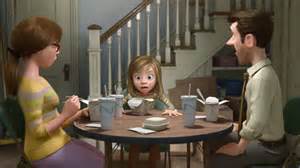
Inside Out tells the story of a little girl named Riley (voice:Kaitlyn Dias), who, with her her mother and father (voices: Diane Lane and Kyle MacLachlan, respectively), are on a move from their home in Minnesota to San Francisco. A trying enough experience for any child, we literally get to know how her emotions shape her impressions, which are personified as five entities: Joy (Amy Poehler), Anger (Lewis Black), Fear (Bill Hader), Sadness (Phyllis Smith) and Disgust (Mindy Kaling). The group presides from a command center inside Riley's mind. The ever effervescent Joy serves as a kind of leader; always aggressively pushing her agenda of happiness while the participation of the other emotions is highly regulated and subject to her intense but buoyant scrutiny. Allegorized further, Riley's memories are connected to each emotion and preserved as small spheres assigned a correlative color: Joy (bright yellow), Sadness (blue), Anger (red), Fear (lavender) and Disgust (green). The vast number of spheres are stored in either long term and permanent memory storage, or short term.

The emotional command center is connected to theme-park-like villages that represent vital functions in Riley's life, such as Family, Goofy land (all the goofy moments shared with her parents) and her passions, like hockey. The park-like places are separated from the command center by very narrow bridges and are nourished by Riley's experiences and emotions. In time, we see the theme-villages are only as sturdy and upright as their importance in Riley's life.

The whole allegory is such an intelligent way of communicating to children how crucial our emotions are in forming memories and determining how strong or fragile our relationships with family will be. I thought the film might make the egregious misstep of pushing a joy-only message but the story wisely veered away from this conceit.

But as Riley faces the uncertainty and fear of a new home and school, Joy finds her task of keeping her happy and positive exceedingly difficult. We see the new home from Riley's point-of-view, which initially appears dark and dismal. Fear and Disgust share some responsibility for her perspective. Riley becomes apprehensive when her parents inform her their belongings won't arrive for another week. Joy manages to regain control when she taps into Riley's imagination; helping her to form a mental picture of her dreary-looking room as it might be with furnishings and decorations, thus restoring a lighter mood.

The characters in animated movies are only as engaging as the actors who lend their voices. Inside Out fields an exceptional voice cast. We know Amy Poehler can be funny, but here she is able to show her dramatic side as Riley finds herself in less-than-joyous situations. Mindy Kaling is quite amusing as Disgust, as are Lewis Black as Anger and Phyllis Smith, whose Sadness plays a crucial role in the story.

As school proves to be a lonely ordeal and her favorite extracurricular activity--hockey--proves to be a source of frustration, Riley begins to lash out at her parents, much to the consternation of Joy, whose influence begins to decline.

The story takes a troubling turn when Joy and Sadness are accidentally sucked into the pneumatic tube reserved for emo-spheres then jettisoned from the command center and into the world of Riley's psyche. The film becomes very suspenseful and takes on a maddening sense of urgency as Joy and Sadness seem to encounter every obstacle en route to the command center. They eventually become separated. Joy is accidentally plunged into the abyss where Riley's faded memories accumulate. Escape seems impossible.

Desperate to regain the happiness she and her family established in Minnesota, Riley in-advisably buys a bus ticket for her old home while Anger, Fear and Disgust do everything in their power to upset her plans, only to find they lack the appropriate emotional response to deal with her problem. In an attempt to rescue Riley from a possible monumental blunder, Sadness, rather than Joy, becomes the heroine we didn't anticipate.

Docter, who also co-wrote the script, shows a sure hand in sustaining a high level of suspense and urgency. I found myself squirming; wondering how Joy would extricate herself in time to help Riley in her darkest hour.

Inside Out is rich in symbolism and psychological allegory. The story is an effective synthesis of light and dark and its lessons are quite compelling. I like the way the story stressed the importance of the less desirable emotions of Fear, Anger and Disgust and their role in Riley's self-preservation. Life can never be and will never be solely joyous. A healthy psyche integrates all the emotions in carefully calibrated proportions; or so the film seems to say.

The film isn't without humor. It is quite funny to see Riley's mother and father's own "control centers." The father's is especially amusing, which sometimes works hilariously at cross-purposes with the mother's.

The film also shows that some of what we carry around in youth warrants disposing, such as Riley's imaginary best friend, Bing Bong (Richard Kind). Useless but oblivion-resistant memories, like a chewing gum jingle, surface inappropriately but amusingly throughout the story.

The story seems so simple yet so much is at stake. A little girl coping with a move and a new school doesn't seem like a promising premise on which to build a story but any plot can be absorbing if the the director has the imagination to realize it. We can credit Docter being such a filmmaker. But he isn't only creative; he also asks that his young audience be alert and attentive to his mildly cerebral story.

One can gauge the failure or success of Disney or children's cinema by the restless energy of the audience. I was pleased to say the audience was mostly rapt; silence reigned supreme.

The film is at once a crowd-pleaser and a good animated film. But it will no doubt charm a more mature audience too. Thank goodness. Another afternoon of Tomorrowland would have been excruciating.

Inside Out should enjoy a healthy run at the multiplex. Give it a chance; you might find it enchanting.

Monday, June 22, 2015

Me and Earl and the Dying Girl


**Spoiler Alert**

Director: Alfonso Gomez-Rejon/Starring: Thomas Mann, RJ Cyler, Olivia Cooke, Connie Britton, Nick Offerman, Molly Shannon and John Bernthal

Director Alfonso Gomez-Rejon's Me and Earl and the Dying Girl, based on a novel by the same name by screenwriter Jesse Andrews, is an uneven effort, unfortunately. Original in some moments, it is less so in others. When it goes right, it's very right and when it doesn't, it doesn't exactly stumble but it doesn't step gracefully either. Its poignance and power arrives late in the third act, while the first half of the film is a mosaic of hit and miss moments.

The story begins as any teen-angsty, independent film might, as Greg (Thomas Mann, in a career-elevating role), the film's unreliable narrator and main subject, tells us in voice-over about his senior year of high school, which was also the worst year of his life. But Greg isn't always a suspect narrator, for his self-assessments can be objective, as when he talks about where he fits in the high school social hierarchy. Belonging to none of the cliques we recognize from personal experience: jocks, drama geeks, etc., Greg informs us he has survived high school by gaining acceptance by all the various factions. But though he maintains some kind of detente with the myriad social groups, he is also is a loner; though partly by design.

Greg's mother (Connie Britton), informs him one day that his classmate, Rachel, has been diagnosed with Leukemia. She suggests (coerces is more like it) he visit her, hoping comfort by a classmate might do her some good. Greg protests, pleading mutual non-acquaintance, but he goes anyway.

The initial meeting is less than auspicious. Greg insensitively and callously tells a puzzled Rachel (Olivia Cooke) that his mother put him up to it, which only makes an already awkward situation unpleasant. But Greg's offbeat sense of humor and shaggy charm nevertheless rates him a visit to her room. Casual conversation leads them eventually to the subject of her illness. The two share a laugh about how best to respond to people who make platitudinous comments about her Leukemia. As the two begin to warm to one another, Greg tells us in voice-over narration that the audience should not expect the story to veer into a passionate romance, as it's "not that kind of story." And as Greg begins to visit Rachel on what seems like a daily basis, she meets his friend Earl (a very funny RJ Cyler). Since Earl has known him since childhood (seen in flashback), he tells Rachel that he is the closest thing Greg has to a friend. Earl tells Rachel that his quasi-friendship with Greg is mainly a collaboration. Greg explains how he and Earl make short movies that are essentially re-imaginings of classic films, which are also ridiculously retitled. One example is Midnight Cowboy, which in Greg and Earl's version is 2:48 Cowboy. The films are self-consciously silly and though they never let anyone view them, they make a special dispensation for Rachel.

In more voice-over, we learn that Earl lives in the more economically-stressed part of town, while Greg's neighborhood is decidedly middle-class.

Unable to sit in the school cafeteria for lunch, with its rigid, social caste system, Greg and Earl occupy their history teacher's office to watch movies. Their teacher; Mr. McCarthy (Jon Bernthal) is the kind of teacher who exists only in movies; heavily tattooed and hip, he is a source of wisdom and forbearance for the young men.

Though Greg tells us in his narration that Rachel will survive, we become more skeptical as the film progresses. Rachel's chemo-induced hair-loss and her protracted stay at home and the hospital provide ample doubt. As Greg's visits become regular, he begins to neglect his school studies, in spite of his acceptance to Penn State.

What does Rachel's condition mean to Greg, whose self and self-loathing seem to occupy his mind the most? Others begin to call him on his behavior, including Rachel, who sees Greg's visits and his application to Penn State as two instances where his actions are forced upon him by others rather than being self-determined. Earl takes him to task for treating Rachel like a burden while Greg's school crush Madison (Katherine C. Hughes), urges him forcefully to make a film for Rachel; a kind of tribute from family, friends and students.

As Earl and Greg interview people for the film, they find the responses are obliviously insensitive and appallingly trite.

After a brief period of not-seeing Rachel, Greg visits her at the hospital on prom-night, in a tux, where he sets up a projector for her to see the film he and Earl have made for her. Everything in the film builds to this moment, as Rachel's condition suddenly becomes dire as Greg's film plays on the hospital room wall. While the hospital staff react desperately to Rachel's physical emergency, she reacts powerfully to Greg's mesmerizing and beautiful film.

Based on the trailer, one might expect Gomez-Rejon's film to be an upbeat, offbeat comedy but the grave second half of the story attains a searing poignancy.

Though we're supposed to notice Greg's character arc, the film fails to show it. In the end, we hear Rachel in voice-over speak of Greg's self-sacrifice and his numerous virtues though I had a hard time accepting her word. He does show genuine compassion for Rachel at times but for the most part, his egoism shows a frightful consistency.

As mentioned earlier, Gomez-Rejon's camera work was quite imaginative. The hallways, Mr. McCarthy's office and the cafeteria are shot (and designed) to appear as very narrow, constricting spaces while a wide-angle lens gives Rachel's room almost exaggerated, expansive proportions.

I particularly enjoyed Olivia Cooke's and RJ Cyler's performances. Cooke didn't play Rachel as an object of pity or of graceful suffering but as someone who sees her terminal illness as an a kind of annoyance. Cyler says little but he is often quite funny and his scene where his confronted by Greg is quite moving. I would have liked to know more about their characters but like everyone else in the film; they were merely planetoids in the universe called Greg.

Why is Greg the main character in this story? Why don't we know more about Rachel, whose inner life makes an appearance late in the film, when Greg wanders among her possessions in her bedroom? In the end, it is she who shows a more selfless side and is everything Greg should be.

I found the endless movie references exhausting and the use of Les Blank's documentary on the making of Fitzcarraldo; The Burden of Dreams, a glaring affectation though Greg's impersonation of Werner Herzog writing an entrance essay to the college board is amusing.

Me and Earl and the Dying Girl is a difficult movie to write about because it can't be dismissed or assigned unconditional, fulsome praise. It is a film to see but is it a must see? It will no doubt elicit a stronger reaction from younger film-goers. Whether it impacts an older audience remains to be seen.