Showing posts with label Chris O' Dowd. Show all posts

Tuesday, October 21, 2014

St. Vincent


**Spoiler Alert**

Director: Theodore Melfi/Starring: Bill Murray, Melissa McCarthy, Naomi Watts, Jaeden Lieberher, Terrence Howard and Chris O'Dowd

First time director Theodore Melfi's St. Vincent, which he also scripted, introduces a motley assemblage of potentially amusing characters, then quickly consigns them to situations and behaviors as readily packaged and ready to serve as vending machine candy bars. One could chart the story knowing only the characters, who are more archetypes than people: the crusty old slob who drinks and gambles too much and is hostile to his neighbors but has a heart of gold; the single, working mother who has just moved in next door and has a son who is bullied at school; the street-wise, struggling prostitute who services the old slob but has a heart of gold; and an underworld figure who is after said slob for a gambling debt but doesn't have a heart of the shiny, precious metal. The only character who doesn't come in a box happens to be the one we seldom see; a Catholic school brother/elementary school teacher with a mildly sarcastic sense of humor whose class is made up of Jews and agnostics, who are welcomed warmly. Can you already see where this story will go?

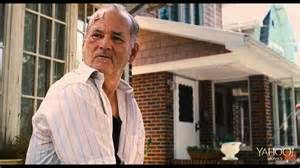
Bill Murray plays Vincent, a Vietnam veteran who spends his days at the track and on a bar-stool. His shabby life is interrupted one day by a single mother named Maggie (Melissa McCarthy) and her son Oliver (Jaeden Lieberher), who move in next door. The movers Maggie has hired accidentally knock a branch from Vincent's tree down onto the hood of his car. Vincent angrily demands compensation from Maggie, who is miffed at her neighbor's un-neighborliness.

As Maggie's hospital job leaves her son in a latch-key state, Vincent reluctantly allows Oliver to stay at his house after school but only for an agreed-upon wage he negotiates with Maggie. The moment Vincent and Oliver meet, we already know where the relationship will lead. We know Vincent will help Oliver with the bullying he faces at school and that irresponsible visits to the track and the bar will follow soon after. We also know that the symbolic father/son relationship will be beneficial for both as Vincent's parental instincts are roused and Oliver learns to stand up for himself.

The other story developments are as predictable. We know what will become of the Russian prostitute Daka; played by Naomi Watts, whose accent is as broad as the Mississippi River. It's almost a narrative imperative that Vincent will eventually help her and become a kind of surrogate husband.

The one character I had hoped to see more of was Chris O'Dowd's Brother Geraghty. He is fairly amusing the few times we see him and something funny always seems to spill out of his mouth. Terrence Howard plays Zucko, the man who threatens Vincent for welching on gambling debts. I can't imagine his role was imagined any further than his name. His character lacks humor, personality and even the requisite menace his line of work demands. He is barely there and I wondered if the best parts of the character ended up under a table in the editing room. Watts' accent grates after awhile and generates little humor.

Some scenes were genuinely funny and the film never strays far from its comedic tone. But it lacked the anarchic energy the preview promised. When we learn Vincent has a dementia-afflicted wife in a nursing home, what little edginess the film still has drips into a pool of sentimentality. It isn't enough that he helps Oliver's self-esteem or becomes his surrogate father or that he takes on Daka's problems too; he must be the saint the title demands he be. It doesn't exactly pain me to admit it, but saints are often a drag.

In the end, Vincent, Maggie, Daka, and Oliver come together to become a family of sorts. No surprise there.

If the film had been funny throughout, its sagging characterizations and story might have been made irrelevant. Comedic talents like Murray, McCarthy and O'Dowd can't quite distract us from the film's flaws. Maybe if Vincent had been more sinner than saint, the film might have established and maintained a comic edge.

I noticed the film was only playing in one theater in the area. Maybe industry barons Bob and Harvey Weinstein, the producers of St. Vincent, knew something about their own film that we unsuspecting ticket-buyers don't. Bob and Harvey, you should have trusted your instincts; you should have sent the flick straight to DVD. I know I would have conferred sainthood on you if you had.

Tuesday, July 8, 2014

Calvary


**Spoiler Alert**

Director: John Michael McDonagh/Starring: Brendan Gleeson, Chris O'Dowd, Kelly Reilly and M. Emmet Walsh

John Michael McDonagh follows up his irresistable The Guard with a darker, more dramatic film that is provocative and ultimately tragic. The exploration of morality and the Catholic church's struggle to stay relevant are the film's more salient concerns. It is a film that leaves you breathless and silently reflective with its power and its willingness to portray the church critically. It is also brave enough to examine the contradictions and incomprehensibilities of God and the Church and how both often fail to address both mundane and deeper issues that trouble those seeking psychic or spiritual succor.

The film wastes little time thrusting us into the story. Father James Lavelle (a superb Brendan Gleeson) is a priest in a small, Irish seaside town who receives a death threat during a confession. The confessor first reveals how he had been orally and anally raped repeatedly by a priest in his youth; a shocking confession which Father Lavelle is ill-prepared to hear. The confessor asks that the Father meet him on a beach in a week, at which time he will kill him. Father Lavelle doesn't panic or become hysterical but receives the threat calmly.

Lavelle eventually seeks advice from his superior; Bishop Montgomery, whose casual reaction is almost funny. The Bishop essentially leaves the matter to Lavelle's discretion. Though Lavelle tells the chief of police he is aware of the confessor's identity, it remains a mystery to us.

We meet the townsfolk who see Lavelle on a regular basis; some seeking advice or counsel while others seek absolution for crimes or thoughts of suicide.

Among those Lavelle hears out or dispenses advice to in his daily encounters are an aging American writer (M. Emmet Walsh), a young man with a feeble romantic life, a promiscuous woman named Veronica (Orla O'Rourke) who was recently abused by either her husband Jack (Chris O' Dowd) or by her lover Simon (Isaach De Bankole). Another is a wealthy, cynical, amoral man whose wife and kids have left him, a doctor who has little patience or tolerance for Lavelle's faith or the church, a foreign woman whose husband is killed in a local traffic accident, and an incarcerated serial killer whose insincere pleas for absolution anger Lavelle. Lavelle also contends with a young hustler who offers his services indiscriminately, a fellow priest whose lack of passion and integrity elicits an angry rebuke from Lavelle and his daughter Fiona, who has just recently attempted suicide.

It is important to itemize the characters, because each has a unique relationship with Father Lavelle, with varying degrees of suspicion, contempt, cynicism, or trust. It is fascinating to see how low the Catholic church has sunk in most people's estimation and how little respect is accorded priests. Lavelle's committment to his faith is undeniable. His love and concern for those who seek his help is also without question but he is constantly the target of derision by most of the town.

As the days are counted off--with subtitles--to the fateful meeting, we see that almost any of the townspeople, save the women, could conceivably be the Confessor.

It would be reductive to interpret the film as anti-catholic. The film doesn't condemn the church but it doesn't spare it scorn and biting criticism (all justified) either. It also doesn't withhold bewilderment of how God can forsake his creations in horrific ways. In one scene where Lavelle sits in the local pub, the local doctor (Aidan Gillen) approaches his table to tell the Father about a three-year old boy who was once improperly anesthetized, which rendered the child deaf, dumb and paralyzed. The doctor asks Father Lavelle to imagine how frightening it must have been for the child to wake in a prison where he felt abandoned. Why the doctor would share such a horrific story perplexes the Father but it underscores how religion and the church ineffectively explain why a loving and merciful God could permit such a tragedy.

As the day approaches, Father Lavelle becomes the target of harrassment and violence. Someone burns the church to the ground though the townsfolk seem to be blithely unconcerned. Another grisly act is committed during the week; with culpability pointing to the Confessor but the film effectively blurs the distinction between those with a solid motive and those without.

We see that Father Lavelle's spiritual ministrations have a profound effect on some while others remain disdainful or suspicious. Every character's story is moving in its own way and how Father Lavelle contends with each not only demonstrates his versatility for dealing with an array of problems, but his capacity to suffer scorn and ridicule. He is a Christ-figure, to be sure; and his imminent meeting with the Confessor is his Calvary. The murder threat and the town's hostility are spiritual tests of sorts; trials that challenge his capacity to be compassionate and loving. That he has had his own troubled past with drink and neglecting his daughter makes his spiritual resolve all the more compelling.

McDonagh's camera work is striking. Stunning landscapes, captured in long shot and in slow moving aerial shots, coupled with subtle interior compositions, make for startling visual contrasts.

The numerous shots of the surrounding landscape, all visually arresting, present a kind of Biblical Eden where the storm and stresses of the character's lives play out. I liked the way McDonagh composed the actors; sometimes slightly off-center, near the frames periphery, which lent backgrounds and colors accentuation. We also see the same with outdoor cinematography, where faces and people share screen-space with the sea or a landscape.

Though the supporting cast is outstanding, it is Gleeson's exceptional presence around which everything and everyone seems to orbit. He wears his flaws and virtues and his unshakeable morality and integrity as he does his black, priestly vestments. The performance is astounding, one that will no doubt remain prominent when the year-end critical encomiums are lavishly showered on award nominees.

Calvary is something to see. It is a powerful, sometimes disturbing but achingly beautiful film that renders one thoughtfully silent but also exhilarated. It isn't often one gets to feel that way after a film.