


**Spoiler Alert**
Director: Dan Fogelman/Starring: Al Pacino, Christopher Plummer, Annette Bening, Bobby Canavale, Jennifer Garner, Melissa Benoist and Josh Peck
How convincing one finds first-time director Dan Fogelman's Danny Collins depends mostly on how convincing one finds Al Pacino as an aging rock star. Before I saw the film I found the idea hard to swallow but after watching Pacino trying to execute rock star moves onstage and grumble his way through songs, the notion rocketed past ludicrous. It might not be an issue if the rest of the film weren't an indigestible, viscous soup of cliches and hooey. Though Pacino certainly has nothing to prove as an actor, one could understand the excitement he must have felt in taking on a role unlike anything in his resume. But he should have known better; he isn't remotely right for the part; though he made an earnest attempt.
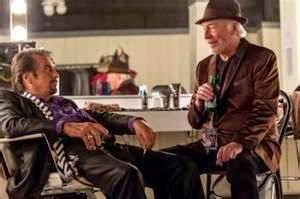
There isn't much we haven't seen in any film about an aging rock star who contends with age, creative impotence and an incorrigible substance abuse habit. It also isn't surprising to see the movie rock star keeping company with his long time manager, whose other unofficial roles include friend and therapist. Pacino plays the title role while Christopher Plummer (also in an unusual role) plays his manager, Frank Grubman.
We see Danny, on the verge of mega-stardom, being interviewed by a Rolling Stone-like reporter in the early 70s'. Unbeknownst to Danny, a quoted comment draws the attention of no less than John Lennon. A letter from Lennon that addresses Danny's comment never reaches him. In an early scene in the film, in present day, Grubman presents Danny with the letter he should have received decades earlier and explains how he acquired it. The message in the letter is friendly and motivational. The long, lost missive is supposed to serve as a source of regret for Danny, as he believes Lennon's kind words may have changed his perspective on his career and life. And though the letter is supposed to loom large, it makes little sense. That the letter could have had, given Danny's success and iconic, rock star status, life and career-changing implications seems a little strange to me.
Fogelman's script doesn't really mine anything profound from the life-changing letter idea. Sure, it means a lot to Danny, as it would most musicians but what exactly does it mean?
But the film has other problems...
One is Danny's search for his long, lost son, Tom Donnelly (Bobby Canavale), who (surprise) wants nothing to do with his father or his rock star life. Danny's absence from Tom's life and the anger and resentment it engendered is such a tired plot development. When Danny finds Tom and shows up at his door unannounced and uninvited, we know precisely what will be said in the first exchange between the two. Can you guess? You might take a stab by predicting Tom will ask Danny: What the hell are you doing here? followed by an angry directive demanding his father leave the house. Then you might also guess Danny will respond by uttering something like I just want to be part of my grandchild's life or a hackneyed equivalent we can easily anticipate.
Tom grudgingly allows Danny to pay tuition for a special school for his daughter, who shows signs of ADHD. Danny uses his rock star aura to charm a school official into waving the rigorous admission application process and overlooking the epic waiting list. Tom begins to warm to his father, especially after Danny learns his son has leukemia. Naturally Danny assumes the cost of treatment and promises to be by Tom's side as he undergoes a life-threatening ordeal. Father finds long-lost son, learns he has lethal disease; Hallmark Classics, here we come.
But Danny contends with other issues in his life and career. He hasn't recorded a song in thirty years but has taken steps to write new material, which he tries on a manager in a hotel where he has taken up long-term residence. The woman, Mary Sinclair (Annette Bening), who looks like a sexy librarian, is hardly impressed with Danny's celebrity credentials or music. She also rejects his numerous attempts to take her to dinner. But like Tom, she too begins to succumb to Danny's charms. Gee, didn't see that coming.
An uninteresting and unnecessary sub-plot involving Danny playing matchmaker to two young hotel employees takes up more of the film's running time.
I was troubled by Danny's supposed rock-star attire. Rather than looking hip in classic rock couture; a get-up of leather jacket, t-shirt and jeans, or some such sartorial trappings, we see Pacino in Barry Manilow-esque duds that are more than just a little embarrassing. His appearance is more Mel Torme than legendary rocker. Needless to say it was quite distracting and unintentionally comical. It is necessary to note that Mary Sinclair's plain, managerial outfit posed a direct threat to Danny's suits in the cool category. That's not good.
Before long, we learn from Grubman that Danny's finances aren't what the star believed them to be. This disclosure comes on the heels of Danny's decision to cancel his tour.
Danny's attempt to woo the attractive hotel manager, the resurrection of his songwriting and his pleas to be allowed into his son's life are narrative threads that never come together in any meaningful way or in any way that is remotely dramatic. Even a scene where Danny sets up a concert date at a small venue to try new material before losing his nerve and falling back on his standards just seems like the story going through the motions.
If you were one of those individuals who thought life would be unbearable if you never heard Al Pacino sing, the chance of a lifetime awaits you in Fogelman's film. One can give Pacino credit for trying but if his character actually made a career singing what one hears onscreen, one might vow to never ridicule Hall and Oates again.
The cast must have signed on to this mess, script unseen, after learning of Pacino's commitment, because every character is so stock we know them before they utter a word.
I did like the soundtrack, which consisted solely of John Lennon standards, but Danny's music suffers in comparison and does little to serve the illusion of Pacino as rock star. Hearing Lennon made me want to hear Lennon, not Danny Collins.
I might normally dissuade someone from seeing the film but the name cast might be worth one's time. It almost was for me. Knowing where the story was headed, I began to daydream before the sandman almost claimed my attention.
See Danny Collins, if you dare. Or if you crave Pacino's song-stylings.


