Showing posts with label Liev Schreiber. Show all posts

Monday, January 25, 2016

The Fifth Wave


**Spoiler Alert**

Director: J. Blakeson/Chloe Grace Moretz, Liev Schreiber, Maria Bello, Ron Livingston, Alex Roe, Maika Monroe and Nick Robinson

The Fifth Wave, based on the story of the same name by novelist Rick Yancey, is a hodgepodge of sci-fi movie plots welded together that work story-wise but is incapable of making the audience forget any of the films it shamelessly borrows or steals from. Films that immediately come to mind when watching Blakeson's film are: Independence Day, District 9 and the various movies about young people uniting to resist oppressive overlords, such as The Maze Runner and Divergent series. There isn't anything inherently wrong with a pastiche but The Fifth Wave (the title kept reminding me of The Fifth Element. Maybe someone will make a sci-fi movie called The Fifth of Jack Daniels) doesn't fuse what it plunders into anything original or thrilling. And what's worse, the movie seems like another greedy producer's calculated attempt to create a franchise cash-cow. And to give this franchise-manque credibility, some considerable talent was recruited; Chloe Grace Moretz, Liev Schreiber and Maria Bello; who have all acquitted themselves better elsewhere.

Has anyone noticed that in ALL alien invasion movies these days, we seem to see the same kind of massive spaceships floating menacingly in the skies above Earth? We see the same here though I noticed Blakeson was very sparing in how he deployed shots of the alien ships. Maybe the producers are saving more detailed images for the sequels they hope to mid-wive from this flick.

The whole plot can be summarized succinctly: aliens, referred to as Others, invade Earth, wreaking havoc in successive waves. One wave knocks out electricity and power, another visits Biblical-scale destruction across the planet in the form of literal waves; tidal waves, which is followed by the lethally mutated spread of the Avian virus, which is in turn followed by the alien infiltration of the human species while the last involves the use of children to carry out the mass extermination of humanity. A young woman named Cassie Sullivan (Chloe Grace Moretz) struggles to survive after her parents die in the initial waves. Her attempts to reach an air force base where her brother and other children have been taken for battle-training meet with danger, as she befriends a young man who displays superhuman fighting skills. Cassie manages to unite with her brother and the other children after they discover their military leaders are in fact Others who have recruited them for their plans of global conquest.

That is the story in its semi-concise form. The story does come with romance. Cassie is the focus of a triangle that includes her classmate Ben Parish (Nick Robinson) and Evan Walker (Alex Roe); said young man with extraordinary fighting abilities. The other burgeoning romance involves Ben and a tough, goth-ish girl named Ringer (Maika Monroe); who handles a gun as well as her army instructors.

About half-way through the film, it becomes clear the filmmakers want to ride the Hunger Games/Divergent/The Maze Runner wave of films about young people fighting totalitarian forces. I guess this attempt to draw young viewers makes sense but it really seems like a cheap and easy way to market future installments. I have to say I can't stomach many more of these films but then again, only young tastes count here, I guess.

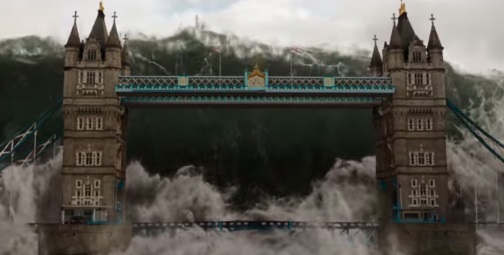
It seems pointless to expect a movie like The Fifth Wave to be logical or uniformly plausible since the movies it sometimes mimics, like Independence Day, can't be troubled to play by the same rules. What bothers me about the aforementioned movie and Blakeson's film is what I call the Bumbling Advanced Civilization Syndrome. An alien race masters interstellar travel; overcomes all the paradoxes and problems of Einsteinian physics, arrives on Earth with superior weapons and the means to destroy the planet; only to suddenly become thwarted by the relatively primitive human race. If one has the power to create tidal waves that tower above coastline hotels and London Bridge and the means to knock out power world-wide, why does it suddenly have problems wiping out a survivalist village, particularly when it knows its location? Instead, it sends Others-controlled army soldiers to gun down the inhabitants of said village. Very sloppy and inefficient for an advanced alien race, que no?

One character says destroying the Earth isn't part of the Others' agenda, as they need our planet mostly intact. Okay, but if you've already wiped out most of the human race without destroying ALL life on the planet's surface, how hard would it be to wipe out the survivors? It does make sense that an invading alien race would employ an electromagnetic pulse to knock out our power, inundate the planet with quasi-natural disasters and create a pandemic to wipe out humans but I don't think it would suddenly be troubled by those same creatures when the resistance cells are comprised of children and teens.

Suspending disbelief and every mental faculty, one should still find the story thrilling but it didn't take an alien intellect to see where everything was headed and how it would get there. The movie became dull and I did little to resist the sleepy fairy that coaxed me into a brief state of drowsiness.

Mr. Blakeson, you'll forgive me if I don't bother seeing the sequels. The Hunger Games series satisfied any and all desires I had to see films like yours. But I'm sometimes stubborn and if a movie weekend happens to be painfully wanting, I just might pay to see A Fifth Wave sequel. But then again, I resisted The Maze Runner and Divergent follow-ups so I know my will power hasn't weakened.

The key word here is resist. If a determined unit of tykes can resist an alien invasion, I can resist a franchise. And I won't even need an M-16.

Monday, November 16, 2015

Spotlight


**Spoiler Alert**

Director: Tom McCarthy/Starring: Michael Keaton, Liev Schreiber, Mark Ruffalo, Rachel McAdams, John Slattery, Brian d'Arcy James, Stanley Tucci, Jamey Sheridan and Billy Crudup

Two films on journalism are currently making the rounds of theaters; The Truth and Spotlight. Both tell stories based on actual events but of the two, it is safe to say the latter is the superior. While the former flounders in liberal sanctimony, the latter is tougher and ultimately more disquieting. The former makes the filthier aspects of journalism look glamorous with Cate Blanchett and Robert Redford in the leads while the latter is grittier and glamor-free.

Based on the Boston Globe's investigation into pedophilia in the Catholic Church, Spotlight tells the story of how the newspaper's crack reporting team; known as Spotlight, uncovered the Catholic church's efforts to bury evidence condemning more than 90 clergymen in the Boston area. We are reminded how daunting the investigation must have been in a city that is 53% Catholic and in thrall to men of the cloth. Pursuing the story means, as several Boston Globe personnel are quick to point out to the newly-arrived editor Marty Baron (Liev Schreiber), suing the Church. Baron learns how daunting the idea of taking on a monolithic institution with impressive and near-infinite resources can be when he assigns the Spotlight team; lead by Walter "Robby" Robertson (Michael Keaton) to research the story. Robertson's staff of veteran reporters; Mike Rezendes (Mark Ruffalo), Sacha Pfeiffer (Rachel McAdams) and Matt Carroll (Brian d'Arcy James) express surprise when given their new assignment; knowing former attempts to break the story of pedophiliac clergy were previously suppressed.

As Robertson and his staff chase down leads and interview victims, the effort to gain access to public files on cases against the Catholic Church is thwarted not only by the church itself, but the legal system, which becomes a collusive agent. But Spotlight learns of other lawyers who have filed cases or have pending cases against the church. One such lawyer: Mitchell Garabedian (Stanley Tucci), is at first reluctant to allow Spotlight to interview his clients but eventually cooperates. Another lawyer for a high-profile firm; Eric Macleish (Billy Crudup), has also tried cases against the church with mixed results but unlike Garabedian, he refuses to share any information on his cases. The way Macleish responds to Robertson's request for information tell us everything about the Catholic Church's extensive power and influence.

Those that share personal accounts of abuse with Spotlight reporters tell disturbing stories of being coerced by priests, who they held in reverence and awe, to perform sex acts on them, including fellatio and intercourse.

Spotlight also makes contact with a former victim; Phil Saviano (Neal Huff), who has since formed an organization to help victims and who becomes a key source in the investigation. Spotlight members encounter much resistance from parishioners, who find the idea of exposing priests and bishops unsavory.

We get a sense of the sickness that pervades the priestly ranks, which leaves one with a feeling of revulsion. In one disturbing scene, Sacha interviews a pedophile priest at his front door. We expect the priest to slam the door in her face but instead he is shockingly candid about what he did but more horrific is his lack of remorse or any acknowledgement of guilt. His mantra-like response to Sacha's questions about molesting kids is "Yes, but I didn't feel any gratification." The questions are brought to a halt by the priest's sister, who does slam the door. And though the Spotlight team makes progress in their interviews and fact-finding, Baron realizes the story will only make an impact if the they can prove the abuse was systemic, which means running afoul of Cardinal Law, the presiding church power. Doing so also means securing the files on cases against the church.

In a exciting sequence, Rezendes manages to gain access to the secret files but not without stiff resistance from a clerk who isn't sympathetic to the reporter's investigation.

What Spotlight accomplished is public record now, but seeing the story depicted in a movie gives one a sense of how determined the Catholic Church is/was to suppress its darkest, evil secrets. This is accomplished in part by excellent performances all around and intelligent, crisp dialogue that keeps one's ears engaged and mind alert. Michael Keaton proves his performance in Birdman is no fluke. His intense presence plays well against Schreiber's Marty Baron, whose reserve masks a penetrating intelligence. Mark Ruffalo is always terrific and Rachel McAdams, who has recently extricated herself from years of crappy romantic comedies, is also quite good.

The pace is fast but not frenetic though one is sure to confuse names and personalities in a film where facts and people quickly come and go.

Though director McCarthy's story is affectively told, somehow it failed to completely go for the throat. It is a terrific film and a stirring one, but it wasn't as dark as I had hoped it would be. This should in no way be read as a major criticism but maybe just personal taste. The Catholic Church has much to answer for in its history; the sexual abuse of children is only one example of its moral failings. The film's unflinching pursuit of one truth the Church would rather not acknowledge or pretend doesn't exist is commendable and brave, especially when one considers it may offend a certain movie-going demographic.

It is particularly sobering to see the staggering list of international cities where church members have reported abuse, which precedes the end credits. It is even more sobering to see one's home town on the list.

Spotlight is one of the significant films of the season. Whether it will be worth seeing again years hence or become a relic is for the future to determine. For now, it is a compelling drama with a big target.

Tuesday, September 29, 2015

Pawn Sacrifice


**Spoiler Alert**

Director: Edward Zwick/Starring: Tobey Maguire, Liev Schreiber, Peter Sarsgaard, Lily Rabe and Michael Stuhlbarg

Director Edward Zwick knows how to film a battle; having distinguished himself with his Civil War drama Glory. His latest film depicts another battle; one less bloody but fraught with political implications; the historic chess match between Russian master Boris Spassky and American chess prodigy Bobby Fischer. The film not only captures the heightened tension of the matches themselves but the broader competitiveness of the Soviet and the U.S. governments, who viewed the duel as not merely a game but a test of cerebral superiority. But the film is more than the game; it also explores Fischer's infamous idiosyncrasies and paranoid psychosis; wonderfully dramatized by Tobey Maguire. Maguire's strong and nuanced performance is reason enough to see Zwick's film.

The Cold War zeitgeist and the mania surrounding the match; in the media and popular culture, are also grippingly recreated, lending Pawn Sacrifice a potent authenticity and poignant context.

We see Fischer's early life; his exceptional skills draw the attention of Brooklyn chess club president Carmine Nigro (Conrad Pla), who defeats the young boy in an informal match but recognizes his sophisticated play. Fischer walks away from the table in a rage, tears streaming down his cheeks but returns to the table with a jungle-cat's resolve. In a montage, we see him taking on adult players and accepting an award for being the youngest grand-master in the country. Later, we see Fischer as a young adult; telling a reporter he hopes to play and defeat the Russians, who are considered to be the best in the world.

As Fischer becomes a formidable player on the international scene, he is finally able to take on the Russians in a tournament held in Los Angeles. We see how critical the matches become for the Russian and American governments. Fischer's victories over ranked Russian players is given a spin by the Soviets when one player attributes his defeat to the flu. Meanwhile, a shadowy American government official approaches Fischer, and is keen to remind him the powers-that-be are no less interested than their Russian counterparts in the outcome.

Though Fischer is able to defeat the best Russian players, he falls to Spassky (Liev Schreiber), which triggers erratic behavior. Wandering aimlessly after his defeat, Fischer finds himself waking on a beach. While looking around him, he sees Spassky on the beach with several Russian aids. Fischer, roused by the sight of his competitor; approaches Spassky, shouting angrily "I'm coming for you!"

Fearing for her brother's mental health, his sister Joan (Lily Rabe), consults a psychiatrist about his behavior; hoping for a cursory diagnosis. She tells Father Bill Lombardy (Peter Sarsgaard), Fischer's unofficial aid and Paul Marshall (Michael Stuhlberg), the U.S. government official assigned to her brother that his letters reveal a paranoid psychosis, which she believes is brought on by the stress of intense competition.

In a scene reminiscent of a moment in the film The Conversation, we see Fischer dismantle his hotel room, searching for eavesdropping devices he believes have been concealed. Lombardy walks in to find the chess prodigy surrounded by debris and junk that were once furniture and electronic devices. Fischer becomes suspicious of everyone around him, even going so far as to direct accusatory statements at Lombardy and Marshall.

Fischer's aberrant behavior reaches a peak in Iceland, during the series of historic matches between himself and Spassky. In their first match, ambient sounds trouble him to distraction, including the near imperceptible whir of a camera motor, as well as the coughing and clearing of throats in the audience. After Fischer loses the first match, he makes what Lombardy sees as impossible demands for the second. Though some, including Spassky, see Fischer's demands as evidence of his fear of losing, Lombardy believes the fear of winning is the actual motivation. Among Fischer's demands are that the second match be played in a quiet ping-pong room without audience presence and that the camera be re-positioned to limit further noise. After Spassky and the sponsors agree to Fischer's demands, the matches resume while the audience--and the world at large--watch the intense competition via camera. As Fischer scores a victory, the momentum shifts. A particularly interesting development is Spassky's behavior, which begins to mirror Fischer's. Spassky rises from the table to inspect his chair, trying in vain to locate vibrations only he detects. He briefly causes a commotion when he turns over his chair to search for the vexation, only to find nothing.
As the film suggests, a touch of madness might be a byproduct of genius-level chess competition.

Though the outcome of the matches is widely known, Zwick nevertheless wrings every atom of suspense from the competition, which is regarded in chess circles as the greatest ever.

Maguire is an actor who has never been given his due. Here he gives a taut, powerful performance; showing us Fischer's genius and overpowering madness. Maguire's cherubic face is almost at odds with his blue eyes, which radiate his character's mental acuity and dangerous volatility. Schreiber is no less moving as Spassky. Observing Fischer, his expressions of amusement and bemusement are entertaining in themselves. Schreiber is an actor who can say so much without uttering a word, which serves him well in portraying the taciturn Spassky.

Zwick understands the significance of the Spassky/Fischer matches, which he articulates superbly to the audience. It is nice to be reminded, in this post-Cold War world, that something as seemingly frivolous as a chess match once carried geopolitical implications. Oddly enough, Fischer seemed to have not a care in the world for the politics surrounding the match; his obsession with the game wasn't mired in the mundane.

In the film's epilogue, we learn what became of the various participants, the rematch with Spassky and Fischer's subsequent flight from American authorities. But its Zwick's film that gives the events and the times attention-grabbing relevance. What began as a sensational sideshow of Cold War competitiveness became an iconic historical event. We so often see films dramatizing larger than life sporting events or celebrating famous athletes. It's refreshing to see a film about two ferocious competitors whose brilliance resides in the mind rather than the body. That madness sometimes attends genius seems readily apparent; a point the film makes convincingly.