Showing posts with label Meryl Streep. Show all posts

Sunday, August 14, 2016

Florence Foster Jenkins


**Spoiler Alert**

Director: Stephen Frears/Starring: Meryl Streep, Hugh Grant, Simon Helberg, Rebecca Ferguson, Allan Corduner, Christian McKay, and David Haig

Florence Foster Jenkins (1868-1944), socialite and patron to the New York music scene, occupies a very peculiar place in American music history. A one-time pianist, Jenkins' inherited wealth allowed her to extend a philanthropic hand to musicians; including world-renowned conductor Arturo Toscanini. But she is known mostly for her concerts, which she performed without any ability to sing or carry a tune. Jenkins was so comically inept as a singer as to produce guffaws in listeners. Jenkins' dream of performing in her own concerts in her later years is the focus of director Stephen Frears' comedy/drama Florence Foster Jenkins; a funny film replete with a subtle, tragic edge. Frears' film follows on the heels of Xavier Giannoli's Marguerite; another 2016 release based on Jenkins' life. While Giannoli's film opts for a darker narrative, Frears' film allows the inherent humor of Jenkins' musical endeavors to find expression without succumbing to farce.

Set in New York in early 1944, the film opens in a small, theatrical setting where a gathering of socialites who call themselves The Verdi Club enjoy a musical play hosted by Florence Foster Jenkins (Meryl Streep) and her husband St. Clair Bayfield (Hugh Grant). It's clear from the scene how key a role music plays in Jenkins' life and how her wealth makes musical opportunities for others and herself possible.

At home among her posh surroundings, St. Clair's devotion to Florence is very conspicuous as he tends to her frail health. A startling moment when she removes her wig to expose her smooth, bald head reveals the seriousness of her illness whose cause is later made known to the audience.

Inspired by her ardor for music, Florence becomes infatuated with the idea of furthering her singing lessons; a pursuit her loving and accommodating husband supports. Needing a pianist to accompany her lessons, Florence and St. Clair arrange auditions with local musicians. In one of the more amusing moments in the film, we see the audition itself, which begins with a loud, over-zealous pianist whose cacophonous playing leaves Florence and St. Clair visibly pained. Following after is Cosme McMoon (Simon Helberg; whose comedic performance almost hijacks the movie); whose ingratiating version of Saint Saens' The Swan delights Florence while leaving the other pianists outside the door angry and bewildered. Their reaction will most likely elicit a solid chuckle from the audience.

Having selected Cosme, Florence's voice lessons begin in earnest. Her teacher, Carlo Edwards (David Haig) coaxes the first sounds from Florence, which are laughably off-key and almost ear-splitting. The reaction on Cosme's face when he first hears her voice is worth the price of admission alone. The scene becomes surreally funny as Carlo resorts to vigorous, physical contact in an attempt to draw musical sounds from her voice. While Carlo's praise for Florence's awful singing is puzzling, Cosme can barely contain his dismay. When Florence asks Carlo if she is ready for a recital, he offers his enthusiastic assent. Later, following the lesson, Carlo's real estimation of Florence's voice is expressed during his conversation with St. Clair in the lobby of the apartment building. When St. Clair asks Carlo whether he will attend the recital, Carlo mentions an engagement in Florida. But when St. Clair asks when his Florida trip might be, Carlo asks him when the recital might take place. That exchange is one of the funniest I've seen in movie this year.

St. Clair's efforts to protect Florence's feelings also leaves him defensive when he hears her voice being slighted. St. Clair takes mild offense to Carlo's reaction and is skeptical of Cosme's awkwardly-expressed comment about Florence's voice being "flat."

As Florence prepares for her first recital, St. Clair's feverish attempts to fill seats with sympathetic patrons proves exhausting and trying, while Cosme expresses his fears and doubts about his ability to accompany his patron onstage.

What gives Frear's film depth are the character's fascinating backstories, which sometimes provide clues to their motivations. We learn that St. Clair was once an aspiring actor on the stage who never achieved greatness. Florence mentions at one point how she protected him from scathing reviews--an ironic comment, considering St. Clair goes out of his way to shield his wife from equally scathing reviews of her singing.

Though we marvel at St. Clair's devotion to his wife, the sobering reality of their relationship becomes evident when we see him depart from the apartment late nights after he lulls Florence to sleep with his Shakespearean recitations. We see St. Clair visiting his girlfriend; Kathleen (Rebecca Ferguson) at an apartment he keeps. At this point in the film, we don't know if St. Clair's nightly visits are mere philandering or if they serve another purpose. In time we learn that St. Clair is Florence's second husband; her first marriage having proved pernicious in more ways than one. It becomes known to the audience that her debilitating illness is a result of her first marriage, which leaves Florence and St. Clair unable to enjoy or consummate conjugal relations.

St. Clair's desperate attempt to shield Florence from negative criticism is dramatized in a scene following her recital, where he buys all the copies of the New York Post. The paper features a damning review of her concert, written by St. Clair's nemesis; Earl Wilson (Christian McKay). We see the lengths St. Clair goes to protect Florence in a scene shortly thereafter, when he and Cosme negotiate the purchase of a copy of the Post from an angry cafe patron while she sits among her friends nearby, unaware of what is taking place.

The film builds to Florence's climactic performance at Carnegie Hall; an idea she first proposes to St. Clair after sitting in the illustrious venue. St. Clair tries to discourage her, citing her failing health but his reservations are overcome by his love for Florence and his indefatigable quest to secure her happiness. Fearing the ridicule that might come from a Carnegie Hall performance, Cosme nearly abandons Florence until St. Clair convinces him otherwise. The concert itself, a tense sequence, is full of surprises and terrific moments.

In less talented hands, Florence Foster Jenkins might have been a sentimental farce but Frears, never one for maudlin narratives, ensures the comedy has a dark flip-side. Underneath the comic travesty of Jenkins' singing is a tragedy Frears courts but doesn't asphyxiate the audience with.

Though Frears is a reliable talent behind the camera, the film's power is generated by some stellar performances. Anyone who has read my blog in the past is familiar with my distaste for Meryl Streep but I have to say she acquitted herself well as Jenkins; making a potentially pathetic person sympathetic and quite human. But the film's real treasures are Hugh Grant and Simon Helberg; who are very funny; showing their comedic flare in many scenes but they manage to tease out their respective character's sadder natures.

The film offers no clues as to how and why Jenkins believed her singing to be stage-worthy but what is axiomatic was her love for music, which St. Clair explains to Florence's doctor as the key to her longevity. Frears' film never mocks Jenkins but shows her admirable qualities; her resilience and blithe indifference to the more tragic aspects of her life.

Florence Foster Jenkins is an enjoyable film and one that seems even better in retrospect. Its main character isn't a buffoon but someone with darker corners than one might expect. The film also proves there is more to the facts we read in the end titles or that can be heard on her record, which has become quite popular with music lovers. Jenkins certainly was an oddity but one worth discovering in a two-hour film.

Saturday, August 8, 2015

Ricki and the Flash


**Spoiler Alert**

Director: Jonathan Demme/Starring: Meryl Streep, Kevin Kline, Mammie Gummer, Rick Springfield and Audra McDonald

Ricki and the Flash comes with a compliment of Oscar-celebrated talent: Director Jonathan Demme, Oscar-winner and oft-nominated Meryl Streep and Oscar-winning screenwriter Diablo Cody, so my question is: how can an assemblage of so much talent collaborate on what is essentially monumental, ghastly junk? I can understand Streep and Cody's significant contributions to this manure (see my diatribe on Streep in my blogpost; The Pantheon of the Overrated, Overexposed etc., and my forthcoming follow-up, in which Cody will figure prominently); both being honorary citizens of that unfortunate nation known as Mediocrystan, but Jonathan Demme? Demme, whose given us cinematic gold with Stop Making Sense, Something Wild and Silence of the Lambs, now smudges his impressive oeuvre with what is essentially a tepid, timid drama heated to scorching temperatures. Blame can almost be distributed evenly: Demme's sub-standard direction and Streep's tiresome hamming shoulder much of the blame but the biggest culprit may be Cody's script, which, like much of her other work, is uneven, sloppy and lazily conceived. What did Demme and Streep see in this story? A vanity project for Streep, who gets to sing and mimic a rock musician? An opportunity for Demme to make a musical narrative to bookend his numerous music docs? Let's leave the rhetorical questions and move on.

Streep plays Ricki Rendazzo, an aging, failed rock musician who, with her band The Flash, are the house-band at a shabby bar in a small town in California. Ricki's look is all rock star: long, partially-braided hair, heavy black eye-liner and funky, skinny jeans or tight black leather with black boots and towering heels. Her band is comprised of ragged-looking musicians (played by real-life rockers Joe Vitale, Rick Rosas and Rick Springfield) who look like they've played on one-too many roadhouse stages.

Her band is forced to pander to the bar crowd by belting out rock standards like Tom Petty's American Girl and more contemporary pop like Lady Gaga's Bad Romance. When not performing onstage, Ricki works in the check-out lane at the local health-food super market.

Ricki's quasi-romance with the lead guitarist of the Flash, Greg (Rick Springfield) is impeded by her reluctance to be in a relationship and a little of her self-loathing, which tries his patience.

Ricki receives grim news from her ex-husband Pete (Kevin Kline, in a dull, hyper-under-imagined role) in Indiana, who informs her that their daughter Julie's (Streep's real-life daughter, Mamie Gummer, in a role that is mostly extreme emoting) husband has left her. Though Ricki has been an absentee mother; having left the family when Julie was a child, Pete insists her presence might rescue their daughter from her steep, emotional decline.

Ricki gathers her guitar case and flies to Indianapolis. She shows up at Pete's home; a palatial spread that eloquently reflects his success. Ricki's rock musician appearance, which never changes, is a dramatic contrast to Pete's stiff, professional attire, which is matched by his demeanor. The script's shortcomings are immediately apparent. In no way can we imagine that Pete and Ricki were once a couple nor can we imagine--given her lifestyle and appearance--how she might have been attracted to such a straight-laced corpse, or he her. It seems like one of those Diablo Cody-esque touches that rings false from the get-go.

Pete is hardly surprised to find that Ricki doesn't have money for the taxi nor money for lodging, which makes it necessary for him to put her up. The fact that Pete's wife is away tending to her father is convenient for Ricki.

As Ricki marvels at the posh, comfortable surroundings, she learns more about her daughter's situation, which isn't good. Just as Ricki begins to settle in, Julie makes a noisy, dramatic entrance; essentially attacking her mother for her bad motherness. Seeing Julie in her wildly disheveled hair and bathrobe makes her an irritating rather than a sympathetic presence.

Over the course of a few days, Julie's combative behavior begins to subside when Ricki becomes a calming influence. Before that is accomplished, Ricki attends a dinner with Pete and Julie (who doesn't change out of her bathrobe and pajamas), where they meet up with Ricki's sons. One is engaged, with his fiance in attendance and the other is a young, gay man who is uncomfortable with sharing his personal life with his mother. Ricki's views on her son's preferences are decidedly reactionary but the given fact that she is an unabashed Bush supporter with a Don't Tread on Me tattoo on her back (ostensibly a symbol of her rebellion but really just dumb); we can acknowledge her consistence.

Julie blurts out inappropriately that her brother doesn't want Ricki to attend the wedding. The whole scene is meant to be awkward and a jarring reminder to Ricki how estranged she is from her children's lives but it mostly comes across as a mechanical contrivance that accomplishes little but to move an already flagging story forward. The family's noisy airing out of grievances attracts the unwanted attention of the upscale restaurant's patrons, who can't help but stare. Whether their stares are prompted by the family's momentary lack of social grace or their tediousness isn't immediately obvious.

Before Ricki returns to California, she makes a breakthrough with her daughter but Pete's wife Maureen (Audra McDonald) returns home; setting up what is supposed to be another awkward confrontation. Maureen has been the de facto parent of Ricki's kids, which of course is an incendiary bone of contention between the two.

Ricki returns home and though it feels as if the second act has just played before our eyes, nothing one could call rich, real conflict has taken place. Ricki accomplishes her mission without much resistance from her daughter. One would think a lifetime of resentment and anger might take years to resolve or reconcile but in this story, it's accomplished in less than twenty minutes of screen-time.

When Ricki returns to her gigging and Greg, more screen-time is filled with an overly generous portion of performance footage. Of course part of the film's draw is the promise of hearing and seeing Streep and band perform but it also serves as time-filler.

Ricki and Greg seem to work out their relationship without much storm and stress. When Ricki receives an invitation to the wedding she didn't expect to attend (from Maureen; a gesture of reconciliation), she tells Greg she can't afford to go, which inspires in him a self-less sacrifice.

The film's third act is the wedding, where predictability becomes the watchword. Aside from a couple of character developments, it isn't difficult to determine if and how Ricki might make peace with her family.

I got what I expected from Ricki and the Flash, which wasn't much. The sad fact that it didn't make much of an effort to challenge my expectations is one of its glaring flaws. But I guess something can be said for the film not being a story about a rock musician's one-last-chance-at-stardom who is rescued from obscurity by a record company scout.

That Ricki sacrificed her life with a family for her music and lifestyle isn't as much a problem as her lack of remorse or regret for having done so.

I will give Diablo Cody credit for writing lead roles for woman. She tends to enjoy conceiving female train-wrecks who are their own worst enemy, which is fine, but other than her script for Young Adult, her characters and screenplays always seem half-written.

Demme, whose resume is filled with music-themed documentaries, can't seem to make the music in the film anything more than listenable.

Demme can't seem to tease out one decent performance from anyone in the cast. Even the Empress of Fine Acting (as she is regarded in the civilized world) can't do much more than affect an attitude. The Tea Party tattoo on her back is more fully nuanced than her character. We get to see Streep play a rock and roller and belt out a few rock classics but so what?

Ricki sacrifices so much in her life for her music but how does she feel about it? What is there about it that would make her essentially give up three children?

This is a movie where nothing much happens and the characters--one and all (save for the real-life musicians in the band)--are people I didn't care to know or want to know more. I can't think of one character I wouldn't want to push out of a plane, including Ricki.

In the final reckoning, the movie seems like an excuse for an aging actress to play an aging rock musician though here Streep plays one without much conviction or fiery spirit. Both Dakota Fanning and Kristen Stewart were better at playing rock and rollers in The Runaways. Stewart seemed more like Joan Jett than Joan Jett.

I'm glad the film is behind me. I hope to fully forget it before the onrush of better fall films. It shouldn't be too difficult. In fact, it may only take the weekend.

Monday, November 24, 2014

The Homesman


**Spoiler Alert**

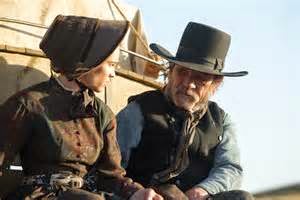
Director: Tommy Lee Jones/Starring: Hilary Swank, Tommy Lee Jones, John Lithgow, James Spader, Meryl Streep, Miranda Otto, Tim Blake Nelson, Grace Gummer, William Fichtner and Sonja Richter

One film that arrives without much fanfare is Tommy Lee Jones' The Homesman, which is too bad because a film so determined to depict the harsh and sometimes dangerous conditions awaiting those eking out a meager existence as farmers in post-Civil War America deserves closer examination. I came to Jones' film expecting costume-drama Oscar-bait but was impressed with the story's bleak, desolate, violent and powerful nature. This isn't Little House on the Prairie with girls in pigtails and farmers in suspenders and beards enjoying the fruits of their labor. Jones' film lets us know life for plains farmers was often dirty and muddy and death could be dispensed to them in many ugly and swift ways. If disease didn't claim one's life, being hanged or gunned down by one's fellow man were often effective, lethal surrogates.

Cast in this 19th century, Nebraskan milieu is Mary Bee Cuddy; a young woman tending her own farm and succeeding reasonably well. Cuddy is poignantly played by Hilary Swank, whose gaunt face and skeletal frame make her an ideal casting choice for a woman struggling to survive in an environment where deprivation is the norm. The film's opening shot is Mary guiding her mule-drawn plow through Nebraska soil. We see that she is an independent, determined, church-going woman who realizes survival and prosperity might be viable objectives if she had a man; preferably another farmer with whom to wed her fortune--as Mary might put it.

Mary invites a fellow farmer Bob Giffen (Evan Jones, in a brief but memorable role), to supper with the intention of asking for his hand in marriage. When Mary tries to entertain Bob with her singing, which she accompanies with a mock keyboard made of cloth, Bob nods off. After he awakens, Mary proposes marriage, which Bob responds to with alarm; citing her "plain as a tin pan" appearance as a reasonable pretext for refusal. Mary's marriage proposal is inspired more as a pragmatic solution than an act of passion.

While in the local church-house one day, the minuscule congregation discusses a problem confronting the community. Three farmer's wives, who have gone mad, are to be taken east to Iowa, where the Reverend's friend will receive the women before they are sent further eastward. While the men in the congregation balk at the idea, Mary's Christian compassion and duty, as well as her prowess with a gun, make her the best, if not the most desirable, candidate. She agrees to take on the mission; a formidable and time-consuming journey, not to mention dangerous.

In the film's early scenes, we meet the three women: Arabella Sours (Grace Gummer; Meryl Streep's daughter), whose madness comes on the heels of the deaths of her three children--all lost to diphtheria; Theoline Belknap (Miranda Otto), first seen in a trance-like state as an infant she holds to her breast is tossed horrifically into an outhouse hole; and Gro Svendsen (Sonja Richter), whose loss of her Swedish mother and her husband's callous disregard for her emotional well-being have robbed her of her sanity.
Tommy Lee Jones, who co-scripted the film, doesn't spare the audience the horrors and hardness people faced on the frontier. We get a very real (and often disturbing) sense of the prevalence of infant mortality and disease and how the grueling efforts to make a life as a farmer could take a punishing toll on one's sanity.

After Mary finds a carriage to transport the women, she happens upon a man named George Briggs (Tommy Lee Jones) who sits on a horse with a noose around his neck. We saw him earlier occupying the farm of Bob Giffen, who he claims abandoned the place to travel east to find a wife. The other farmers drive George from the property and execute their own brand of frontier justice by leaving him to hang. Mary frees him and after hearing George's story, offers him a job accompanying her on her trip. George refuses then accepts after Mary promises him $300. George is a ragged-looking drifter who has seen his share of death and brutality. His love for whiskey doesn't endear him to Mary nor does his rough-hewn manner.

George is forced to hide inside the carriage when he explains to Mary that some of the husbands of the women they are to transport are the same men who left him to hang. Gro's husband recognizes George and when he accosts him, he is given a violent rap on the nose while Mary levels her rifle at him as they pull away.

It seems there has been a movement in cinema the last twenty years or so to make dialogue in westerns and in frontier period pieces sound more authentic. Films like Unforgiven, The Assassination of Jesse James by the Coward Robert Ford and the Cohen brother's True Grit all feature a blend of literate and colloquial speech that seems to be true to the period. The verbal exchanges between George and Mary reflect this nicely as her eloquence plays against his profanity-laced comments.

As Mary and George set out, with the women inside the carriage, he draws from his rough and tumble experiences to guide their course. Mary's suggestion on where to cross a river is met by George's ominous warning about who they might encounter if they follow her lead. George tells Mary that anyone they meet might want to rape the women and any Indians they may run into will most certainly rape the women before killing them.

George is soon proven correct. When George and Mary wake one morning to find Arabella has wandered off, he finds her seated behind a dirty, ragged man (a scary Tim Blake Nelson) on a horse who has no intention of returning her. He is also quite frank about what he intends to do with her. After George's friendly negotiations lead nowhere, the two men engage in a knife fight that ends badly for the abductor when Arabella shoots him.

En route to their destination, Mary learns George is a deserter from an army unit who visited its own kind of brutality on the enemy during the Civil War. Though George's interest in Mary's mission is strictly mercenary, he carries a kind of subtle decency and sense of duty that belies his behavior.

Not long after, another harrowing experience greets George and Mary when a group of Shawnee Indians silently shadow the carriage. Before George sets out to offer the menacing natives one of Mary's prized horses, he offers her some grim advice about what to do in the event he's killed.

Jones long shots of the seemingly endless, desolate, flat, barren prairie, with its bitterly cold winds, adds visual emphasis to the lawlessness of the plains and the unforgiving loneliness that envelops all who partake of its empty vastness.

More grisly and violent episodes accompany the group en route to their Iowan destination. One particularly shocking development occurs after a night where Mary proposes marriage to George and even goes as far as forcing her naked body upon him while the three women watch bewilderingly. What happened the morning after, I didn't expect, which is a testament to the story's wrenching, anything-can-happen unpredictability.

What happens after is no less bleak. Jones's story is never sentimental nor does it attempt to spin its history for the audience's peace-of-mind. The ending is a victory and a defeat. George finds his monetary reward has been rendered worthless currency by the failure of the bank it represents which also means a bad end for the people Mary and George left behind in the small, farming community. And to exacerbate his situation, he realizes his time as a drifter may not be at an end, for he finds himself unwelcome everywhere, which gives the title its ironic twist.

Hilary Swank and Tommy Lee Jones are exceptional. Jones also coaxes some fine performances from the supporting cast, including James Spader and John Lithgow, as well as Gummer, Otto and Richter, who have little dialogue yet convey sorrow, hurt and mental anguish with their eyes and disheveled appearances.

So many memorable scenes in a film add up to a solid, honest and moving experience. While watching Jones' film, I couldn't help but think about author Karen Russell's brilliant story Proving Up (formerly titled The Hox River Window), which tells a horrifying tale of sod-busters (as plains farmers were called then) trying to legitimize their land-claims only to encounter death and despair.

I found The Homesman to be quite absorbing. Jones' attention to detail, his honest depiction of the plight of women on the plains and the insanity that lay in wait for them made for something alive and dark and gritty as all hell. It could be called revisionist but it doesn't need an academic designation; it's too visceral and earthy for that.

I hope it finds life on DVD or streaming; the film is too engaging to miss--or dismiss.

Tuesday, August 26, 2014

Al's Omniflick at 100: The Pantheon of the Overrated, the Overpraised and the Oppressively Empty-headed


I find myself at a blog milestone with my 100th posting. To celebrate, I thought I would carve up some sacred cows and question the sanity of those who unjustly heap mountains of praise on film history's undeserving.

You might ask about my criteria in making my selection and all I can say is that I chose those who came readily to mind and who have tormented me the most. You may notice I only chose five targets because one must be careful not to overindulge oneself in temple desecration. Five seemed liked a reasonable number. I realize readers might be rankled by my selections and although that isn't necessarily my aim, it's an inevitable hazard I risk. Everyone has their own list they keep inside their heads; mine merely escaped the fortress of unexpressed thoughts to go on a gleeful rampage.

As always, feel free to comment and provide a list of your own if you too feel the itch.

The following are listed in no particular order or ranking:

1. Meryl Streep
This feels like a no-brainer. 18 Oscar nominations for either Best Actress or Best Supporting Actress with several wins under under her belt, which doesn't include the numerous Golden Globe or BAFTA nominations showered upon her. If it seems like I've made an egregious error in judgement after that opening comment, trust me, I haven't.

If anyone has bothered to really watch Streep at her so-called best, they will notice an actress who, as Pauline Kael once put it, "hides behind accents." Aside from that criticism, her performances tend to be the movie rather than an integral part of it. Her roles also tend to crowd out the story and other performances one might otherwise notice and appreciate. Case in point: The Iron Lady, one of Streep's Oscar-nominated performances. The movie isn't really about Margaret Thatcher, England's first female Prime-Minister, it's about Streep's accent and her ability to mimic Britishness. I can't honestly recall the rest of the cast or specific scenes, only Streep's circus-stunt acting. It's almost as if she puts on the affectation along with the make-up.

Streep isn't a bad actress and in fact, she can manage a solid performance now and then but come now, does her acting merit all the praise, attention and award nominations? She can be interesting when she isn't doing impersonations, but even at her most intriguing, she doesn't awe me. In 2011 and 2012, Jessica Chastain had a streak of terrific roles, including Take Shelter, Tree of Life, The Help, Zero Dark Thirty and only a month into 2013, she was in the horror film Mama. When one considers the richness of her acting choices and her terrific performances in each, it's easy to appreciate a talent that has yet to find full flower. I couldn't imagine Streep taking on any of these roles in her youth without a gimmicky affectation to buttress her acting.
And I haven't even mentioned how Streep's acting ability suffers in comparison to her peers across the pond. Helen Mirren, Kate Winslet and Emma Thompson are but a few examples.

One can even visit the recent past to sample her hamminess. In the recent August: Osage County her over-the-top performance as the cynical family matriarch is an acting seminar in scene-chewing, as Streep sprays the walls with her broad character-interpretation.

Coincidentally, I was looking over the NY Times T.V. section this morning when I came across a listing for the film Proof, which mentioned Streep's role as the Catholic School nun/Principal. The blurb contained an exerpt of critic Manohla Dargis' review, in which she says of director John Patrick Shanley and Streep:
"His work with the actors is generally fine, though it's a mystery what he thought Ms. Streep, with her wild eyes and an accent as wide as the Grand Concourse, was doing. Her outsize performance has a whiff of the burlesque, but she's really just operating in a different register from the other actors, who are working in the more naturalistic vein of modern movie realism. She's a hoot, but she's also a relief, because, for some of us, worshiping Our Lady of Accents is easier on the soul than doing time in church."

No, it isn't; and I despise church.

2.The Nouvelle Vague
Or as it is commonly known in America; The French New Wave.
I include this with strong reservations because I admire the French New Wave for its revolutionary techniques and its tremendous impact on American movie-making in the 70s'. I even find some of the movement's films to be classics, like Breathless, A Band Apart, The 400 Blows and The Umbrellas of Cherbourg. But Jean-Luc Godard, François Truffaut, Éric Rohmer, Claude Chabrol, Jacques Rivette, Agnès Varda, Jacques Demy have also been worshipped all out of proportion, especially when one considers their respective bodies of work. The German Expressionists and the Italian Neo-realists have a considerable portfolio of great, watchable films but aside from The New Wave's ground-breaking techniques, what would compel one to to watch their films? Even in the 60s', Godard's heyday, he made some films that were nigh unwatchable. After the 60's he has a catalogue of films that aren't watchable at all. The other directors have fared better. The group has managed to make some terrific films the past twenty years, like Rivette's La Belle Noiseuse, Chabrol's La Ceremonie, and a few Rohmer films but as a group, I find them outrageously overrated. Of course my opinion of the Nouvelle Vague is susceptible to revision. I feel really guilty including the movement in this group but maybe tomorrow I won't. It wouldn't take much to convince me I messed up here.

3.Casablanca
Like the Nouvelle Vague, I feel some regret targeting Casablanca, the American public's selection for Best-Film-of-All-Time. Though I really like the film, to me it is preposterous to regard it as the best American film. I don't even consider it my favorite Humphrey Bogart movie. I enjoy The Maltese Falcon and The African Queen more and I still hold dozens of American films in higher esteem, like Citizen Kane, 2001: A Space Odyssey, Chinatown and Nashville. Don't get me wrong, Casablanca belongs in such an august assemblage; just not at as lofty a perch as many might place it. It is beautifully shot, acted and it has an urgency that is WWII-compatible but it doesn't stand head and shoulders above America's best cinematic efforts and it certainly doesn't fare any better when we factor the best foreign films into the mix.

4.Forrest Gump
Zemeckis' film falls into the category of the Oppressively Empty-Headed. Not only is the film about a simpleton, it appears that it was written by one too. I find the line "Life is like a box of chocolates..." so vexatious to my ears it gives me vertigo. The film's message seems to be that good-natured innocence and feeble-mindedness make a virtuous amalgam or if you're dumb but nice enough, success is all but assured.

I can't adequately express the intensity of my contempt for this film. Its brain-dead optimism and sickly-sweet cuteness are only a few of the film's unforgivable shortcomings. That the AFI included the film on its list of greatest films should alert one to the institute's suspect suitability as arbiters of greatness. How it beat out Pulp Fiction for a Best Picture Oscar might be the most mind-boggling conundrum in movie history.

Salvador Dali once said that whenever someone asked him his Zodiacal sign, he never phoned that person again. I feel the same about people who say they like Forrest Gump. I think Dante set aside the nether-most circle of hell for those who like Zemeckis' movie. May they simmer in a scalding cauldron there for all eternity. 'Nuff said.

5.The Sound of Music
I thought about dozens of actors and films that could have made this list but one film that caused a throbbing in my temple was The Sound of Music. Though it isn't as loathsome as Forrest Gump it isn't far behind. Everything about the von Trapp family makes me ill. I realize the story is based on historical fact and that the von Trapps narrowly escaped the Nazis but somehow even that doesn't make me abominate the film any less. The family is annoyingly chirpy and though the family's escape from the Third Reich's clutches is harrowing, I find myself rooting for the Nazis. I truly hope I never have to sit through the movie again.

As I mentioned earlier, I could have included more on the list but maybe we'll leave some for a future posting. Thank you for taking the time to read my Pantheon and for helping me celebrate my 100th post. Looking forward to more.

Saturday, August 16, 2014

The Giver


**Spoiler Alert**

Director: Phillip Noyce/Starring: Jeff Bridges, Meryl Streep, Brenton Thwaites, Alexander Skarsgard, Katie Holmes, Taylor Swift and Odeya Rush

All one need know when seeing The Giver are the plots of The Hunger Games and Divergent and if one is familiar enough with both films, then the story from director Phillip Noyce's latest can be traced like a subway map, though it might not be as interesting.

In a future time, society overcomes many of the problems that nearly caused its demise, like war, racism and inequality and in an attempt to prevent further catastrophe, it effectively erases all differences between people. A homogenous society arises, where everyone wears identical clothes and lives in identical homes. Memory of the past and all its horrors has been essentially erased. I guess minorities suffered the same fate, for I don't remember seeing one the entire film. Did society missplace them? Turn them into Soylent Green?

As in Divergent, one is assigned to a career path following one's teen years; each according to his or her attributes. And like the aforementioned flick, one stands before a great hall of bland, almost faceless citizens, who applaud each graduate after their role is designated by the Chief Elder (played by Meryl Streep, who is burdened with a ridiculous hairstyle).

At this point my eyes were nearly rolling out of their sockets at the cornball attempt to depict one more dystopian society onscreen, which unfortunately resembles every other of its kind this year.

And wouldn't you know it, our hero Jonas (Brendon Thwaites) is the last to receive his assignment, which causes much anxiety among his two best friends and his family. And would it surprise you to learn he has all the prized attributes rather than just one? Because Jonas is so unique, his given role is that of a kind of archivist, whose duty it is retain the history of mankind, which the people are expressly forbidden to know.

Jonas reports to a mysterious, bearded man whose library lies inside a building at the periphery of what is essentially an island in the sky; where all the inhabitants of this society reside. Below the island and beneath the cloud cover, one can see the surface of the earth, which is off limits to everyone.

In said building is The Giver (Jeff Bridges); an elderly keeper of civilization's memory. In his hall of books, The Giver takes on Jonas as his eventual successor and in doing so, subjects him to memories from Earth's violent past. As the old man grasps Jonas' arms, the young man sees two soldiers in Vietnam under intense sniper fire. He also has a vision of a sled and a log cabin in the snow, which he doesn't understand--its meaning is revealed later.

Returning to his community and friends, Jonas shares what he has seen and learned (an act prohibited by the authorities) with his friends and in doing so, subjects himself to the long reach of the oppressive big brother. Can you see where this is all going? Jonas becomes a fugitive, placing family and friends at risk and imperils himself in the process. Do you think he might discover the whereabouts of his predecessor; a young woman who vanished into the surface world and was never seen again? Where will Jonas eventually end up, I wonder? (Please note my rhetorical sarcasm).

In addition to being unoriginal and lethally dull, The Giver offers not one surprise or moment of suspense, though it tries. I had to fight like a demon to overcome the drowsies all through the film. It wasn't that I was tired; it was more that I was overcome with the somnolence I tend to feel when I know precisely where the story will go and how it will arrive there. And what were Streep and Bridges doing in this tedium? Bridges has an excuse as a producer but what about Streep? Must have been a favor. It seems fitting a fluff-pixie like Taylor Swift would be in this stale silliness.

The sled, one of the film's visual motifs, is so Rosebud its another eye-roller. And what Jonas discovers at the film's end is so unbearably asinine it may as well be a Budweiser commercial. You'll know what I mean if you bother to see this tripe.

I think what is unforgivable about a film like The Giver isn't its over-familiar setting and story but its creative exhaustion. Ripping off other movies isn't necessarily a crime--especially in Hollywood--but if your story lacks its own identity, then at least offer an exciting clone. I tried to care about the characters but they mostly came across as styrofoam apparitions. If my regard for this film were any more feeble, I might be arrested for a hate crime.

While online today, my eye caught an ad for the film that read "It's like no other movie you've seen before."--People Magazine. If that's really the reviewer's conviction, he or she might think about taking up another line of work, like writing menu descriptions for Chili's. Let my Good Samaritan deed for the month be my saving you money better spent on a better movie. Like no other movie you've seen before, eh? Please.