Monday, February 15, 2016

Hitchcock/Truffaut


Director: Kent Jones

It's hard to imagine Alfred Hitchcock's work was once dismissed as frivolous, light entertainment by the keepers of high culture. Though he had amassed an impressive body of work and contributed many of cinema's masterworks, Hitchcock's films weren't considered worthy of closer examination by the major critics of the time. But along came Cahiers du Cinema; the now famous French film periodical, whose contributors formed part of what became known as the Nouvelle Vague; Jacques Rivette, Francois Truffaut, Jean-Luc Godard, Eric Rohmer and Claude Chabrol. The aforementioned French cinephiles--soon to become groundbreaking filmmakers--didn't share the fashionable low American regard for Hitchcock's films. Their subsequent reappraisal of Hitchcock's films helped critics, film-lovers and the industry itself reconsider the British filmmaker's cinematic contributions.
A major champion of Hitchcock's films, French New Wave director Francois Truffaut's groundbreaking book Hitchcock/Truffaut may be one of the most significant books on cinema ever. If that claim seems hyperbolic, consider Hitchcock's reputation now, and his inclusion into the great director pantheon. Truffaut himself can claim a lion's share of credit for the rehabilitation.

Truffaut's book is based on hours of interviews with the great director, which not only illuminate Hitchcock's creative process but serve as an effective companion to Truffaut's detailed film analysis, which includes frame by frame coverage that spans the director's epic career. Director Kent Jones' film details the meeting of both legendary directors that came about via a fawning letter Truffaut sent to Hitchcock outlining his plans for the interviews, which took place in Los Angeles in 1966. The book that followed and its powerful impact are discussed by numerous interviewees, which include filmmakers Wes Anderson, Olivier Assayas, David Fincher, Martin Scorcese, Richard Linklater and Paul Schrader; to name a few.
Scorsese discusses the how the book allowed his directorial peers to embrace Hitchcock's work while Wes Anderson comments on how his copy of Truffaut's book is a now a well-thumbed pile of pages. On discussing the unpretentious nature of the conversations, Paul Schrader mentions how the two directors talked about craft. The various director's incisive commentary about Hitchcock's style and camera work are a movie-lover's treat.

Jones also tells us about the two directors became life-long friends; sharing thoughts and ideas on one another's work until Hitchcock's death in 1980. It is interesting to learn that Truffaut was decades younger than his hero but died a mere 4 years after Hitchcock at the age of 52.

It seems strange that it's only now we see a film on this subject. Jones' film, like the book that inspired it, is necessary and utterly fascinating. To think that one book helped rescue a great director's creative reputation seems highly improbable. Cinephiles everywhere owe a tremendous debt to Truffaut and his French, directorial peers for their keen perception and their passion, which made a critical reassessment of Hitchcock's work possible. We also owe something to Kent Jones; a film curator for the New York Film Festival and programmer at Lincoln Center; for his wonderful documentary, that in essence celebrates two great filmmakers. In the end, it's safe to say Jones film is an appreciation of an artist who appreciated another artist.

Saturday, February 13, 2016

Deadpool


**Spoiler Alert**

Director: Tim Miller/Starring: Ryan Reynolds, Ed Skrein, T.J. Miller, Morena Baccarin, Brianna Hildebrand, Leslie Uggams, Stefan Kapicic (voice) and Gina Carano

If you're like me and suffering from super-hero movie asphyxiation, you'll be pleased to know that first-time director Tim Miller's Deadpool is a lively and welcome addition to the genre. One of the movie's greatest strengths is its humor and satirical edge; qualities sadly lacking in most super-hero flicks.

In Miller's film, his anti-hero, played with comic verve by Ryan Reynolds, delivers a thermonuclear barrage of smart-ass-isms that keep the film from sinking into a morass of earnestness. One might notice that the rating for the film is R. This is a significant fact worth mentioning, being that this is hardly family viewing. Unless I'm mistaken, Deadpool is the first superhero movie strictly for adults. Unbound by family-viewing imperatives, the film freely employs adult humor and even some nudity to free itself from manacles that often bind the genre.

The opening credits are an inspired bit of drollery. Rather than merely post directorial or producer credits, the titles tell us personnel are "tools" or "asshats" or some other insulting term. One immediately feels the film is poised to break rules and do the unexpected.

Starting with a taxi ride, we immediately meet Deadpool; a costumed superhero who climbs from the back seat to the front to chat up the driver; an American-Indian named Dopinder (Karan Soni), who isn't shy about sharing his romantic woes. As the taxi crosses over a city overpass, we see the beginning of what will be a fun action sequence. But as the action commences, the hero uses the moment to catch the audience up to speed on why the movie has begun in the middle of the story.

Formerly a member of the special forces, Wade Wilson (Ryan Reynolds) has become an urban mercenary dedicated to "helping the little guy;" which means undertaking assignments like ensuring a stalker leaves a young woman alone by issuing a forcefully persuasive threat. He and his fellow mercenaries hang out in a seedy establishment, where Wilson's best friend Weasel (a funny T.J. Miller) tends bar and runs a daily deadpool, where patrons can bet on who will most likely die during a given assignment.

Seemingly content with his shabby existence, Wilson meets Vanessa (Morena Baccarin), a beautiful woman whose sense of humor is entirely compatible with his own. As their relationship becomes serious, Wilson suffers a collapse, which necessitates a hospital visit. The doctor's prognosis is grim: terminal cancer. And while Vanessa and Wilson try to find a way to cope with the horrific news, a mysterious man arrives at the mercenary hangout, requesting a meeting. The man wastes little time in offering Wilson a cure for his cancer and better still; a way to give him abilities beyond his imagination. Wilson's response is typically smart-alecky but he is also skeptical of the offer, which causes him to walk away. Later, realizing his survival means happiness for both he and Vanessa, Wilson calls the number on the card. In doing so, he receives treatment in a mysterious facility presided over by a man named Ajax (Ed Skrein). Strapped and trapped on a gurney, Wilson learns that the treatment entails becoming a super being to be auctioned off to unscrupulous bidders who will employ his heightened abilities to whatever ends they devise. Ajax is quick to point out that the treatment will leave him virtually invulnerable with an enhanced regenerative constitution. Unable to free himself, a serum is injected into his body but in order for it to take effect, his body must undergo a series of tortures--all administered by Ajax and his powerful assistant; Angel Dust (Gina Carano).

In trying to free himself, Wilson manages to destroy the lab in a fiery blaze but in doing so, he literally emerges from the ashes (Phoenix symbolism, anyone?); alive but with his face burned and disfigured. Knowing Ajax has the means to mend his face, Wilson sets out to find him. But his condition also renders him freakish and unable to face Vanessa. He goes into hiding; taking up residence in an economically depressed neighborhood with a blind, black woman named Blind Al (Leslie Uggams), who is also a recovering coke-addict. Her relationship with Wilson becomes one of humorous contention.
In his quest to find his nemesis, he dons a costume and begins a vigilante spree that draws the attention of the X-Men; particularly the Russian-accented Colossus and the young Negasonic Teenage Warhead (Brianna Hildebrand), who arrive at the bridge just as Deadpool is unleashing his lethal array of weapons and fighting abilities on Ajax and his henchman. This brings the narrative full circle to the beginning of the film.

As Colossus and Negasonic try to stop Deadpool and coax him into their fold, the superheroes engage in some funny repartee, though Ajax manages to escape in the process. Some of the movie's best moments are Deadpool's encounters with the X-Men, who he calls "a boy band." His quest to find Ajax runs afoul the X-Men's non-vigilante code but it also serves as the movie's plot.

For the film entire, we're treated to Deadpool's non-stop, jokey motor-mouthing, which almost proves to be too much. Rarely is he serious and only really becomes angry when Ajax kidnaps Vanessa in an attempt to capture Deadpool himself. Nevertheless, it is quite fun.

Some of the film's funniest scenes involve Wilson's interaction with Weasel, particularly the moment his friend first glimpses his facial deformity. Rather than offer Wilson sympathy, Weasel riffs picturesquely on all the different things his friend's face reminds him of, which induced some hearty guffaws.

Miller's film refuses to be PC, which helps unshackle the humor's edginess. During a scene where Wilson bids farewell to Blind Al, his cocaine-addicted roommate, he offers her faux, heartfelt, parting words: "somewhere in this apartment is 110 pounds of coke...next to the cure for blindness."

I was astonished to learn Deadpool is Miller's first feature film. His camera work and flair for staging action scenes betray a startling precociousness. Due credit goes to screenwriters Rhett Reese and Paul Wernick for finding a joyous medium between action and comedy.

Part of the film's charm is its kooky self-awareness. We're always in on the joke and laughing with Deadpool. He even makes funny asides to the audience, making us his sidekick.

Though CGI is always necessary for superhero movies, here it doesn't overpower the story, nor does the sound effects, which are usually punishing to the ear drums in other superhero flicks, like The Avenger's.
After a string of duds, Reynolds finds himself with a solid franchise opportunity. This series could be good for five installments. Deadpool, like Ant-Man, mines the comedic possibilities of the characters, which seems to work better than the humorless Thor and Captain America franchises.
The audience with whom I saw the movie seemed to be having a good time. Ample applause followed, which is always a good sign. I too was enthusiastic, walking through the lobby afterward with a big smile draped on my face. Miller's film will no doubt be a hit. May the Spring and Summer blockbuster sludge be as inspired as this film...or at least half as good.

Note: I didn't wait for the end credits so I missed the clips that followed.

Thursday, February 11, 2016

Pride and Prejudice and Zombies


**Spoiler Alert**

Director: Burr Steers/Starring: Sam Riley, Lily James, Charles Dance, Sally Phillips, Lena Headey, Douglas Booth and Jack Huston

There are certain novels and plays that have been adapted--over-adapted--for the big screen. Two of them; Hamlet and Pride and Prejudice, have been interpreted so many times as to be nauseating. With Jane Austen film adaptation fatigue now in full effect, along comes Pride and Prejudice and Zombies; a re-imagining of the Austen classic which pits the now-famous characters against--what else; zombies. The idea seemed inspired and fun and I thought it would be a sure winner. Director Burr Steers' film, based on the novel by Seth Grahame-Smith, may remind one of another film adapted from another of the author's works: Abraham Lincoln: Vampire Hunter. Unfortunately, like AL: VH, Steers' film lacks what it needs most: a mirthful, tongue-in-cheek spirit that has little time for earnestness. The title in Steers' film suggests that nothing in the story will be serious, yet that is the direction to which the narrative stubbornly leads; to my personal regret and the filmmaker's peril.

Having read Austen's novel in college and having sat through several big screen iterations, the last thing I need in my lifetime is another straight interpretation. Though I really like film adaptations of Austen's other novels, I feel I've had my fill of corsets, rigid social customs and women fixated on finding their ideal mates. What I wanted to see was something satirical and funny. To sum up the major flaws in this film: it's too serious and too unaware of its need to be outrageously silly. What I wanted was Monty Python but what I got was, well, more Jane Austen.

I won't synopsize the story because I feel most people have some knowledge of the characters and plot from the book or other filmic adaptations. I'll try to just explain how zombies figure into the narrative.
We learn at the beginning of the film that the robust, 18th century sea trade brought a plague to England's shores. Quickly reaching pandemic proportions, the plague spread, causing those infected to become living, breathing corpses hell-bent on devouring the non-infected populace. During this time, a massive wall was erected around the city of London to protect its citizens from the roving, zombie hordes.

Because the upper classes found themselves essentially imprisoned, distractions became an imperative. As a result, a self-improvement movement began in earnest in the form of martial arts. While the gentry became adept in the Japanese martial arts, the less genteel; such as the Bennet sisters, chose the Chinese varieties.

One of the more inspired scenes in the film is our first glimpse of the Bennet sisters; a few of the protagonists of Austen's story. Rather than sitting around, crocheting or knitting or reading poetry, as Austen's female characters are wont to do, Steers' Bennets are bad-asses who sit in a circle; maintaining weapons; sharpening long blades and tending to pistols. Underneath their proper, period-appropriate dresses, the young women wear sheaths for their blades on their very sexy stockings.

It is quite amusing to hear the narrator mention a zombie attack during a game of whist; the default card game of 19th century European novels. While the Bennet sisters and guests enjoy a hand; Austen's dour, male hero; Mr. Darcy (Sam Riley), barges into the room and unleashes a vial of flies. He explains to the bewildered gathering that the flies will immediately alight on rotting flesh, thus enabling the party to identify any zombie in their midst. When the flys' buzzing stops, the ominous silence alerts everyone to the presence of an infected party, which Mr. Darcy dispatches without much remorse or regret.

As the novel's narrative particulars proceed, the un-dead threaten to overrun the countryside and the country itself. Before long, Mr. Darcy and Elizabeth Bennet (Lily James) begin to see four mysterious, black-clad horsemen. It is explained in the story that the riders may be the biblical Four Horsemen, whose appearances may herald the coming of a zombie apocalypse.

When not concerning themselves with their romantic pursuits, the Bennet sisters apply their considerable martial skills to slashing and smashing zombie skulls.

As the zombies overrun London and the countryside, the only safe haven for the living lies across a river where only a single bridge serves as means of protection from the un-dead legions. A climactic moment takes place on said bridge as Mr. Darcy and Elizabeth try desperately to cross before the army detonates explosives, which serve as a fail-safe method for keeping the zombie army at bay.

Other than the zombie angle, which quickly loses its novelty, there isn't much to recommend the film. And though the Bennet sisters and Mr. Darcy adroitly remove heads from bodies, the action scenes are nothing much. Zombies roaming through Austen's world is a juicy gag that never becomes a gag; merely material with unrealized potential.

Watching Riley play Mr. Darcy with an irony-free earnestness was one more bummer that sponged all the fun out of the movie. How can anyone be in a flick called Pride and Prejudice and Zombies with a straight face? Couldn't Burr Steers and Seth Grahame Smith have pulled out all the stops and given us something anarchically loony?

Well, vampires have become passe and zombies are on their way out. What can we expect next? Crime and Punishment with evil aliens? War and Peace and Werewolves? Stay tuned.

Tuesday, February 9, 2016

Hail, Caesar!


**Spoiler Alert**

Directors: Joel and Ethan Coen/Starring: George Clooney, Josh Brolin, Scarlett Johansson, Tilda Swinton, Alden Ehrenreich, Frances McDormand, Channing Tatum and Jonah Hill

Joel and Ethan Coen have made exceptional films in their careers and some irredeemable time-wasters. One can count a fair number of comedies in their oeuvre but for me, I've always preferred their dramas, which sometimes contain their brand of dark humor. I realize my low opinion of their comedies is in the minority. People insist Raising Arizona, O Brother, Where Art Thou and Burn After Reading are hilarious but they only leave me cold. (I've heard some movie lovers even suggest that The Hudsucker Proxy and The Ladykillers are funny... not to me.) I'm still not wild about The Big Lebowski but I think Jeff Lebowski is a comic master creation. The Coen Brothers' comedies are too self-aware to be truly funny.
That being said, I found their new film; Hail, Caesar to be unfunny, unfocused and unfailingly tedious. I heard one woman laugh through the entire film but there is always that one person in the audience who can be counted on to find every gag and comic situation funny even when they aren't. In spite of the woman's compulsive laughter, the patrons in my immediate vicinity--and in most of the theater--were mostly silent. So it goes; everyone is entitled to laugh; it certainly isn't a crime, but maybe it's a case of sour grapes on my part, who knows?.

The Coen Brothers celebrate/skewer old Hollywood; the characters and genres that ruled the screen and the dramas that raged off of it.

Capitol Pictures' production manager Eddie Mannix (Josh Brolin) broad job description makes it necessary for him to also manage scandals that threaten to ruin actor's lives and derail movie projects. When the film begins, we see him visit a home where an intoxicated, high-profile actress is being photographed pornographically. Mannix, who seems accustomed to damage control of this ilk, manages to keep the situation from becoming headline fodder by pulling the starlet from the scene and paying off a couple of cops who arrive on the scene. When not defusing near-disasters, Mannix tends to studio production business. One film over which he presides is a big-budget, Ben-Hur-like epic called Hail, Caesar, which stars Hollywood mega-star Baird Whitlock (George Clooney).

During production, Whitlock is kidnapped; leaving Mannix to contend not only with a crime, but a situation that could conceivably become a media typhoon. Compounding his woes are the cost overruns Whitlock's absence creates for the the film. And yet another of Mannix's vexations are the Hedda Hopper-like, twin gossip columnists; Thora and Thessaly Thacker (Tilda Swinton, sporting great alliterative names); who skulk about the studio lot, sniffing for scandal and gossip.

But we also meet the film's other dramatis personae, like Hobie Doyle (Alden Ehrenreich), the singing cowboy of the big screen, who Mannix eventually recruits in his effort to find Whitlock and DeeAnna Moran (Scarlett Johansson); an Esther Williams-like star whose personal troubles become studio troubles. We also meet Burt Gurney (Channing Tatum); a song and dance star who later plays a part in the kidnapping drama.

Whitlock awakes in a posh, seaside home and after wandering around, he finds his kidnappers, who turn out to be a disgruntled group of screenwriters who are fed up with the industry's obeisance to the bottom line. The audience learns what it may have suspected all along; the group's agenda is strictly communist.
Meanwhile, Mannix assembles a cash payment after receiving the group's $100,000 ransom note while trying desperately to keep the kidnapping from leaking to the studio, the public and the press.

The film reaches for laughs when Hobie becomes a substitute cast member for director Laurence Laurentz's (Ralph Fiennes) tux and gown drama; a movie for which his Texan accent and cowboy persona are hopelessly ill-suited. The film's most inspired comedic scene is Mannix's meeting with local religious figures to ensure the movie's subject matter offends neither Christians nor Jews. The exchanges between the rabbi and catholic priest are peppered with a few barbed, comments about scripture.

As the mystery behind the kidnapper's intent comes to light, Whitlock becomes an ardent believer in their cause before eventually returning to the set of his movie.

The various secondary character's stories never add up to much, particularly DeeAna Moran's and Hobie Doyle's, who are more representations of old Hollywood types than people.

The Coen Brothers' film seems like an opportunity to poke fun at the anti-communist hysteria of the time. We see a boat containing Whitlock's captors and Burt Gurney approach a Russian submarine, which surfaces near the California shore, awaiting the bag containing the $100,000, which is being offered up as a gift. The absurdity of the scene seems to reflect the outrageous, right-wing, Cold War paranoia that held America in its grip during that period.

I suppose the film will seem funny to those who are attuned to the Coen Brothers' sense of screwball. I went into the movie expecting to laugh but unfortunately, their film fell flat. It isn't the first time I've had that reaction to one of their comedies and it may not be the last.
I'll move on now and hope their next movie will be more fun than this slog.

Sunday, February 7, 2016

Mustang


**Spoiler Alert**

Director: Deniz Gamze Erguven/Starring: Gunes Sensoy, Doga Zeynep Doguslu, Tugba Sunguroglu, Elit Iscan, Ilayda Akdogan, Nihal G. Koldas, Burak Yigit and Ayberk Pekcan

The Turkish Oscar nominee for Best Foreign Film; Mustang only just arrived at the local art cinema and it is readily apparent why the committee selected director Deniz Gamze Erguven's stirring film. As more and more films about women or directed by women made their way to movie screens in 2015, movie audiences were treated to powerful stories that offered viable viewing alternatives to male-heavy Hollywood. Many of the films addressed various social conditions facing women in the past and present; Joy, Carol, Brooklyn, Suffragette, I Am Najoom, Aged 10 and Divorced and Chi-raq; to name a few. Erguven's own contribution, like Najoom, shows us the suffocating, cultural norms of less progressive countries where women's freedom of choice and expression have been nullified by draconian laws and customs conceived and enforced by men. The key similarity between the films are female protagonists who recognize the oppressive nature of their culture and take action to escape it.

Set in present day northern, rural Turkey, Mustang tells the story of five young, teenage sisters who incur the wrath of their grandmother when a busybody neighbor notices them frolicking with some local boys in the water. While young girls sitting on the shoulders of boys trying to topple one another into the water seems harmless in our western eyes, to the elder members of the Turkish community, the game is a shocking breach of female propriety. Their grandmother scolds them angrily and forces them into a kind of house arrest; fearing further contact with boys and unkind, gossipy talk. Of course their domestic incarceration means no school and zero contact with the outside world. Because the girl's parents are deceased, their upbringing is overseen by their grandmother (Nihal G. Koldas) and their strict uncle Erol (Ayberk Pekcan), who grant them few freedoms.

The most defiant of the five sisters and the youngest is Lale (a terrific Gunes Sensoy), who resists and questions all stringent customs and rules she and her siblings must obey. Lale's interest in football (soccer) prompts her to petition her uncle to watch a game on television with the men, which he forbids without a second thought. As the girls find ways to surreptitiously escape their home, some manage to meet boys on the sly while Lale, eager to see a football match live, enlists her sister's participation. In an amusing but hair-raising scene, the girl's narrowly escape being seen in a televised game by their uncle. The grandmother resorts to cutting off the electricity to ensure the uncle doesn't catch a glimpse of the girls in the broadcast.

When the uncle discovers he can no longer keep his nieces from venturing out, he welds bars over all the windows to insure their captivity.

Before long, the two older sisters; Selma (Tugba Sunguroglu) and Sonay (Ilayda Akdogan) find themselves married off, against their wishes and will, to young men. And not only must they accept their respective wedding arrangements, they must also provide proof of their virginity on their wedding nights. In one scene, Selma's husband frantically searches for blood stains on the bed sheets while his family pounds on the bedroom door, demanding to see the evidence. Unable to satisfy her in-laws, Selma is subjected to a degrading medical examination, though the male physician proves to be sympathetic. Horrified at the prospect of a similar fate, the younger sisters are powerless to protest or to refuse Erol and their grandmother's unspoken demands.

As their uncle exerts his authoritarian rule, we discover that his feelings for the sisters are hardly avuncular; a fact that doesn't escape Lale's notice. Caught between compulsory marriage, which presents a life of spousal servitude and their uncle's amorous violations; we see the women are snared in a hopeless and inescapable web spun by the culture's male elders. Enabling the men are the older women, who train and prepare the younger women for their future roles as housewives.

For Lale, an escape to Istanbul, which serves as a symbol of freedom, is a goal she tirelessly pursues. So eager is Lale to break free from her home, she befriends a delivery man named Yasin (Burak Yigit), who helps the young teen learn the rudiments of driving to aid in her escape.

The film comes to a thrilling climax when the second youngest sister, Nur (Doga Zeynep Doguslu) is suddenly offered up as a wife to a prospective suitor, which galvanizes both she and Lale to effect an escape from Erol and their grandmother's clutches.

A film like Erguven's works when we care enough about the characters to be drawn into the story. The young women who play the sisters were cast exceptionally well and seem very much like sisters in manner and appearance.

Erguven's film makes a compelling statement about the powerlessness of women in the Islamic world. Whether stories like Mustang can offer hope to women in the Islamic nations (assuming this film has a worldwide release) remains to be seen. But given the rise of ISIS and Islamic extremism across the Arab world, progress may come to an unfortunate halt.

An earlier comparison to Najoom is apt, for both films feature young, female heroines whose actions reflect a youthful call for female liberation.

The film is powerful, sometimes disturbing but very real and heartfelt. The characters are sensitively drawn, as is the vivid world Erguven depicts. Lale refuses to be a victim and a subject; her actions and decisions make her an unlikely heroine in a culture that is loathe to celebrate female self-determination. I hope we see more women like her as the cinematic year unfolds.

Thursday, February 4, 2016

The Finest Hours


**Spoiler Alert**

Director: Craig Gillespie/Starring: Chris Pine, Casey Affleck, Eric Bana, Ben Foster and Holliday Grainger

Based on the book: The Finest Hours: The True Story of a Heroic Sea Rescue, director Craig Gillespie's film tells the story of a T-2 oil tanker that literally split in half during a particularly savage sea storm in the Atlantic, which prompted a harrowing sea rescue. Braving terrifying, towering waves, the Coast Guard's rescue operation stands as one of the more amazing feats in American maritime history.

Having stated that, one might expect a movie depicting something so mind-boggling to be sufficiently nail-biting. Unfortunately, Gillespie's film falls well short of translating the story's more harrowing aspects. We're left instead with a technically accomplished action flick that would have been better off being projected from a plasma display than a movie projector. What was most likely a life-altering experience for all involved plays like a pedestrian sea disaster on-screen. One might find the story interesting and the visual effects impressive but if you're like me, you might also become drowsy; even during some of the film's climactic sequences.

The events depicted in the film took place off the coast of Massachusetts, early 1950s'. During said snow storm, the aforementioned tanker encountered violent, colossal waves. The tanker crew, led by Ray Sybert (Casey Affleck), watch nervously as the welded seam of the hull threatens to crack with the ship's every crashing descent from the mighty waves. When the seams does give, a powerful blast of water penetrates the interior, knocking crew-members against the bulkhead. Unthinkably worse, the ship actually splits in two which one crew-member discovers to his horror. While one half the ship sinks beneath the angry waves, Sybert and the remaining crew struggle to keep their half afloat. While the ship threatens to drift, sink or capsize, Sybert realizes their only hope is to steer what remains of the vessel onto a shoal, thus stabilizing it until help arrives.
Meanwhile, a Coast Guard crewman named Bernie Webber (Chris Pine) undertakes a dangerous and ill-advised mission to rescue the survivors of the tanker crew; well aware of the mission's slim chances for success. He and his small crew are nevertheless brave, knowing their small, Coast Guard boat must negotiate the roiling sea. Adding a wrinkle to Bernie's efforts is his fiancee Miriam (Holliday Grainger), who waits anxiously for him to return.

The story draws a parallel between the two crew chiefs as both Sybert and Bernie are burdened by the need to prove themselves as able leaders and earn their respective crews respect.
In an attempt to make the film more female friendly, the action is frequently interrupted to show us Miriam's anguish, as she clings desperately to the hope of her fiance's return.

The action is divided evenly between Sybert's attempt to ground the ship and Bernie's crazy brave effort to find the survivors, which seems hopeless in the unforgiving tempest.

Both narrative threads provide some minor thrills--accent on minor. The visual effects are effective enough to give a landlubber like myself an idea of what violent sea really means but the action didn't make me squirm. One might say; hey, cool CGI, but shouldn't this be more exciting? Knowing the story is based on fact was a sure tell that all would work out for everyone, which robbed the film of tension crucial to the narrative.

As mentioned earlier, I couldn't help but think the movie might be an okay late night, channel surfing stop but on a movie screen, it just seems several sizes too big.
The characters also fail to register as real people; they're more realized personality types. Eric Bana, Affleck and Pine aren't given much to interpret, character-wise. The same can be said for British actress Holliday Grainger; whose performance consists almost solely of teary-eyed stares into the oceanic horizon. Her character is really the producer's carrot to lure women into theater seats.

Craig Gillespie has done better work; the odd Lars and the Real Girl and the light and whimsical The Million Dollar Arm demonstrate his quirkier, more humorous trademark style. This film seems all wrong for him. This stuff is the domain of a seasoned hack like Michael Bay.

The men who lived through the horrific ordeal were undeniably at their finest. If only the filmmakers could claim the same. A better title for the film might have been; A Passable Two Hours.

Monday, February 1, 2016

My Favorite Films of 2015


I've come to that time in the early part of the year when I reflect on the films I found to be the previous year's most exceptional. What an incredible gathering it turned out to be! I whittled my list to 16 this year in the interest of concision; the twenty-six films I compiled from the year before proved to be too much. I'm sure you'll understand. There were those films I hated to omit but I offer them due compensation by bundling them together in an Honorable Mentions list that will follow my top 16. Believe me when I tell you the selection process was no easy task.

I don't know that a common thread links the films on the list but I noticed something that might be called a trend: the number of movies featuring strong female leads. I hope this becomes a habit in 2016.

If you feel I've left off one of your favorite films, please let me know in the comment section below. I hope my list evokes thoughts, some good memories and maybe spark some argumentation.
The list is arranged chronologically and not according to degrees of excellence.

FAVORITE FILMS OF 2015

Gett: The Trial of Viviane Amsalem
Easily one of the best of the year and one of the most powerful. Israeli actress Ronit Elkabetz, who also co-wrote and co-directed the film, gave one of the more amazing performances on-screen last year. The story of an Israeli woman seeking divorce from her husband seems simple and straightforward but as we see, the process becomes an emotionally grueling, bureaucratic nightmare. The woman's struggle to be free from her husband is a powerful metaphor for the plight of women everywhere. Viviane is a character I won't ever forget.

It Follows
This film proves conclusively that a creatively creepy story never needs a bloated budget to achieve maximum terror. Director David Robert Mitchell may have only had a $2 million dollar budget but he wielded it as if it were $100 million.
A woman becomes the target of a malevolent, supernatural force, which she finds impossible to shake. Her efforts to elude said force and free herself from its deadly agenda are the stuff of nightmares. The film deserved more attention than it got.

Ex Machina
Author Alex Garland's directorial debut showed a cerebral film could also be thrilling and tension-filled. The story's ideas about artificial intelligence touches upon ethical and moral concerns. Word to anyone creating humanoids with the capacity for abstract thought; beware of your creation's ideas about self-determination and self-preservation.

Salt of the Earth
Wim Wender's documentary on photographer Sebastiao Salgado isn't merely a bio but a beautiful film about a man whose artistic ambitions are inextricably linked to his humanitarian causes. Wender's images are as striking as those of his subject. The scene that details Salgado's efforts to reforest the land surrounding his boyhood home should serve as motivation for those who care about the planet's welfare.

3 and 1/2 Minutes, 10 Bullets
Director Marc Silver's film arrived during a year when news articles about blacks being gunned down across America (mostly by police) became more commonplace. In Silver's film, we see how it easy it is for a white man with a twitchy trigger finger to loosely interpret what constitutes a threat to his person. That his victim was only guilty of playing his music loudly underscores the travesty of some state's gun laws, which grant gun-owners great latitude in how they apply lethal force. Silver's film is paradoxically rousing and sobering.

A Poem is a Naked Person
A previously unreleased film from the late, great documentary filmmaker Les Blank finally reached movie screens forty-one years after its 1974 birth. Blank's film isn't merely about rock legend Leon Russell but the odd, sometimes surreal world of his home state, Oklahoma. Blank's camera captures some wonderful images; one being an artist painting the surface of an indoor swimming pool inside Russell's soon-to-be recording studio. The beautiful mural is but one memorable shot in a film spilling over with them. We also get Russell's great music and live performances to complete a complete film.

Straight Outta Compton
Overlooked at the Oscars, F. Gary Gray's film about the legendary hip-hop group N.W.A. not only captures the triumphs and travails of five ambitious men en route to stardom but also the violent, bullet-riddled world that inspired their music. Excellent performances all around, particularly by Paul Giamatti and O'Shea Jackson Jr.; Ice Cube's own son. Scenes of the group being harassed by the LAPD seem very current and very relevant.

The Witch
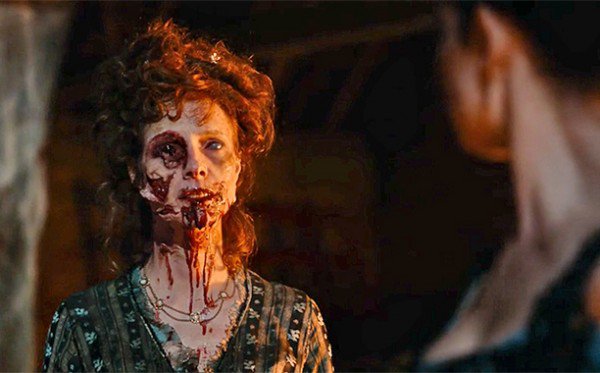
This is really a 2016 film but I was fortunate to catch an advanced screening. If I had to limit my best film choices to three, director Robert Eggers' brilliant, frightening story about an early American colonial family's encounters with a witch would hover at the top of my list, if it doesn't already rest on the summit. The commitment to authenticity is admirable, including period-authentic language and the film's look of deprivation and dirt. Truly an exceptional film.

Goodnight Mommy
Don't let the film's innocent title fool you; nothing about directors Severin Fiala and Veronika Franz's story is so benign. Young, twin brothers become suspicious of their mother after she undergoes cosmetic facial surgery. Unconvinced that the woman living with them is their mother, the boys' distrust leads to some horrific acts of violence. An unforeseen twist arrives in the third act, which helps make sense of the boys' motivations. Darkly psychological, much about the film is designed to make one squirm.

Room
I saw Room the same weekend as The Witch and Goodnight Mommy, which made for a fairly intense, cinematic triumvirate. Brie Larson and young actor Jacob Tremblay offer searing performances as a mother and son who escape an enclosure where they've been kept 7 years. The wrenching aftermath, where the mother must deal with psychological fallout and the boy with a bewildering world he has never seen left me feeling simultaneously teary and in awe of the film's visceral strength. The film was rightly nominated for several Oscars.

Meru
Three world class mountain climbers attempt to scale a seemingly unscalable mountain in the Himalayas named Meru. The story of their second attempt on the mountain and the backstory of their lives lead one through an array of powerful emotions, including fear, excitement, heartbreak and finally joy. What distinguishes this mountaineering film from others is the footage; captured by the climbers themselves. It is an unforgettable story about unforgettable men.

The Martian
Sci-fi films have made a comeback in recent years. Last year's offering in this genre was an absorbing, harrowing and exhilarating story of an astronaut who becomes stranded on Mars. The steps he takes to survive the hostile environment are fascinating and a testament to human ingenuity. The visual and sound effects are stellar (excuse the expression) while the ensemble cast is outstanding. It had been literally decades since I had last seen a Ridley Scott film I actually liked. This film shows what magic he is capable of.

Youth
Paulo Sorrentino's dreamlike meditation on aging is visually mesmerizing and beautiful. One might think an entire story set in a spa in the Swiss alps would impose impossible limitations on a director's vision but nothing seemed to impede Sorrentino. The film's final shot asks us to question veracity of what we've seen. In fact, we often learn that no one and nothing are what they seem.

Joy
David O. Russell strikes cinematic gold again with his story of a woman whose tenacity, grit and smarts become indispensable attributes in her trying ascent to success. Jennifer Lawrence's amazing performance almost blinds us to the film's other standout qualities, like Russell's superlative direction. The film celebrates female empowerment and does so convincingly.

The Revenant
Alejandro Inarritu's gritty and tough film about revenge is also otherworldly and visually breathtaking. Leonardo DiCaprio's performance is sure to garner an Oscar. He is as dazzling as the images of the unforgiving landscapes Inarrritu holds in his lens. The often talked about scene of the grizzly attack and a shot of a horse and rider plunging over a cliff are but two of many searing moments in the film. If The Revenant wins best picture, I myself will hardly object.

Anomalisa
Charlie Kaufman and Duke Johnson's poignant film is the only one of the aforementioned that is animated. The film manages to be quite moving in spite of the inherent challenges in creating a drama with stop-motion puppetry. A man's struggle to be connected to people meets with some success as he begins a romance with a woman he finds refreshingly unique. But also he finds his anxieties are difficult to overcome and hard to define; leaving him a in an unrelieved state of existential despond.

And so that brings my list to a merciful close. I hope you find some of my choices to be stimulating if not compatible with your own. I also hope you take the time to sample those you may have missed or just find intriguing. Thank you for taking the time to read over my list.

Honorable Mentions: Love and Mercy, Inside Out, Stanford Prison Experiment, The Walk, Steve Jobs, Chi-raq, The Hateful Eight, The Wave, The Big Short and Spotlight.