Friday, October 31, 2014

John Wick


**Spoiler Alert**

Director(s): David Leitch and Chad Stahelski/Starring: Keanu Reeves, Willem Dafoe, John Leguizamo, Ian McShane, Michael Nyqvist, Alfie Allen and Adrianne Pelicki

I think I've lost count but I've seen six middle-age (or post-middle age) Hollywood actors this year--including Keanu Reeves--take on the aging bad-ass action hero role, which has become all the rage in movies now. In 2014, Pierce Brosnan, Kevin Costner and Denzel Washington were welcomed into Liam Neeson's archetypal, more-mature action-hero society and now Keanu Reeves enters the fold with his latest film John Wick. I guess we should expect more of these films in the near future. Neeson's Taken 3 is due out shortly and who knows; we may see Susan Sarandon join the ranks before the year is spent.

I can't think of one film the aforementioned actors have made in this new genre that has been any good. Some of had their moments. 3 Days to Kill, with Kevin Costner, at least brought a little tongue-in-cheek lightness to the genre while The Equalizer featured one inspired scene where Denzel Washington offs some Russian bad dudes in an office. But for the most part, the movies are highly forgettable and utterly disposable, though all or most of the actors will no doubt reprise their characters in sequels.

So what does Keanu Reeves bring to the party? His youth, for one, and like the other actors, a physical appeal to attract the female demographic. He has his earned his own action hero bona fides with Speed so it isn't preposterous that his membership be validated for the Academy of Over-50 Action Stars.

What does the movie itself bring? After 100 minutes of acrobatic fighting and shoot-outs by the score, I can honestly say--not much. In fact, I found my daydreaming and disinterest almost offensive, given the violence, blood and carnage onscreen.

Keanu Reeves plays the title character; a former hit-man for a Russian mobster though his former occupation isn't revealed until the 20 minute mark or so.
Wick has just lost his beloved wife to an undisclosed illness. In the days following the tragedy, a small cage is delivered to his home and inside is a small dog with a note from his wife. The dog is supposed to be something to salve his bereaved condition and provide companionship but the fact that the canine is from his wife adds a sentimental dimension to the gift.

Wick's other love is his '69 Mustang; a beautiful muscle car that attracts the attention of a young dirt-bag at a gas station. While Wick gasses up his car, the punk admires the Mustang and then forcefully inquires about it's sale price. After Wick rejects the offer to sell, the man becomes aggressive, uttering an insult in Russian. Wick counters with some Russian of his own, which surprises the young creep.

Later that evening, while the dog rests on Wick's chest as the two slumber, his home is broken into and sometime later, Wick is assaulted and beaten. The young man from the gas station is among the three assailants who demand the key to the car. Wick refuses, which not only earns him a severe beating, but his dog is killed with a savage kick.

The young man takes the Mustang to a chop shop run by a man named Aureilo (John Leguizamo), who recognizes the car and will have nothing to do with it. We then learn that the car thief (and dog murderer) is Iosef Tarasov; the son of a Russian mobster.

Shortly thereafter, Iosef visits his father Viggo (the Swedish actor Michael Nyqvist, playing a convincing Russian), who informs his son that the car he has just stolen and the dog he's killed belonged to John Wick, his former hit-man. When Viggo explains to his son just how dangerous Wick is, the son asks him if he is the boogeyman to which his father replies, "Wick is the man you hire to kill the boogeyman." While Viggo discourses on his former associate, scenes of Wick taking a sledgehammer to a slab of concrete in his garage underscore the mobster's words. We can mostly guess what Wick is hiding beneath the concrete rubble: an impressive array of weapons and a stash of gold coins.

Rather than persuading his son to make amends, Viggo hires an army of thugs to attack Wick at his home, which results in a bloodbath. The hand to hand fighting and the shootings are so acrobatic and stylized as to be cartoonish, which is hardly a shortcoming in this kind of movie.

When Viggo learns Wick has dispatched his thugs, he hires a former friend and associate of Wick's named Marcus (Willem Dafoe), to kill his nemesis. Marcus accepts the contract.

The film does tries its hand at humor. A hotel with the stately appellation of The Continental is actually a haven for a community of assassins; many who are friendly to Wick. The desk clerk is comically accommodating to the killers; allowing all manner of violence and murder to transpire under the hotel's roof. This might have worked well in a film that took itself less seriously

Wick is captured later, after some head-scratching, reckless behavior that is highly uncharacteristic of someone so methodical and circumspect. While tied to a chair awaiting his grisly fate, he explains to Viggo why the dog means so much to him, which of course is unpersuasive. Just as Wick is to be killed, Marcus comes to his rescue, thereby breaking his contract with Viggo and earning his enmity in the process.

The rest of the film is Wick pursuing his prey and leaving bodies in his wake. Where this ends doesn't require an advanced degree in mathematics from MIT to extrapolate.

What hobbles John Wick and makes it a drag are action scenes that are technically accomplished but don't have any heat or dazzle. They are only mechanically impressive.

One of my favorite action sequences this year took place in X-Men: Days of Future Past when the character Quicksilver raced around a room at hyper-speed, deflecting bullets and projectiles while everyone else moved glacially as the song "Time in a Bottle" played on the soundtrack. It was a beautifully choreographed scene with humor and verve. That's what a movie like John Wick needs; action sequences with a fresh, haven't-seen-that-before approach.

I didn't care about Wick's quest other than wanting his dog's death avenged. I also wanted him to really want that glorious Mustang back, but that curiously never crossed his mind.

I wish Keanu Reeves had interpreted the role with less earnestness and more mischief. Many of these action movies, like John Wick, suffer from slogging self-seriousness. This film just wasn't any fun.

If aging film stars are to indulge in action film trifles, then they should remember that they aren't performing an Ibsen play but something most likely over-the-top and absurd, which calls for a little of the same from the story and cast. The makers of The Fast and Furious franchise understand this only all too well. That series is a joy to watch, with all its giddy offerings of hyperbolic nonsense.

Trying to make silly into serious begets more silliness. The creators behind John Wick might keep this in mind if they choose to foist this guy on audiences again.

Wednesday, October 29, 2014

Ouija


**Spoiler Alert**

Director: Stiles White/Starring: Olivia Cooke, Ana Coto, Daren Kagasoff, Bianca A. Santos, Douglas Smith and Shelley Hennig

Ouija boards will never stop being a source of fascination for horror filmmakers. Though they're used mostly by bored teenagers and cranks to summon demons (at least in movies) or commune with the dead, one can buy a version for a little more than 15 bucks on Amazon or any toy retailer. I remember our family owned one when I was a kid but it usually provided only ten minutes worth of amusement after the incommunicado spiritual world refused to play along. After a Ouija board was featured in The Exorcist, one of my brothers burned our copy; fearing it's malevolent potential. Why Satan's minions or the spirit world would find a game board manufactured by Hasbro or Parker Brothers an effective means of transit into our world is quite peculiar. If a board game like Ouija works so well, might not Stratego or Yahtzee be just as effective? (Note to self: try summoning dead relatives or a netherworld entity using Candyland)

In director Stiles White's first feature film, Ouija makes another appearance.

We see two young girls playing with the game while going over unwritten rules about how and when to use the Ouija board (e.g. never play alone, etc.).
We then see one of the girls, Debbie (Shelley Hennig), now a teenager in the present day, trying to burn the game after some unpleasant experiences. As the game board smolders in the fire, her best friend Laine (Olivia Cooke; a poor man's Leighton Meester), visits and tries to convince Debbie to join her for an evening at a school event. Debbie decides to remain home; choosing instead to stay alone in what must be one of the the most poorly-lit homes in horror film history. How anyone with a modicum of sound mental health would spend an evening alone in such a house says something about the writers' idea of plausibility.

Before long, strange, spooky things begin to happen inside the house. Shortly thereafter, Debbie uses a cord of lights to hang herself from a light fixture. Laine and friends are naturally distraught but also puzzled as to why a seemingly happy teen would commit suicide. While at the funeral reception, Laine finds the Ouija board Debbie tried to destroy, which she remembers using with her best friend as children.

Feeling dissatisfied after canvassing her friends to determine Debbie's state of mind before the suicide, Laine decides to use the Ouija board to try to summon her best friend's spirit (talk about bad ideas!). Having agreed to house-sit in Debbie's home while the parents are away (bad idea #2), Laine, her sister Sarah (Ana Coto), and her friends hold a seance to make contact with their deceased chum. Some of the friends are naturally skeptical but go along with it. Of course the game planchette responds to their questions, and before long, eery, scary sounds are heard throughout the house and for once in a horror movie, the teenagers head for the door and escape.

Afraid to return to Debbie's house, Laine brings the Ouija board home with her (unbelievably bad idea #3) and unwittingly invites whatever tormented her friend into her own house.

Unable to leave well-enough alone, Laine continues to delve into the mystery of the friend's death while also feeling guilt about whether her intervention might have prevented the tragedy. And because Laine is persistent in pursuing answers, the spirits involved begin to menace her friends and kill them off, one by one, until only she and her sister Ana and Debbie's boyfriend Pete (Douglas Smith) are left to fend off the spectral naughties.

In time Laine learns that the former occupant of Debbie's home was a medium whose daughters became evil practitioners. Debbie inadvertently became one of their victims after playing with the Ouija game.

The rest of the film involves Laine, Sarah and Peter returning to Debbie's home and there they find a secret basement where the daughters observed their dark rituals. To dispel the evil, Laine must burn the skeletal remains of the daughter who succumbed to the dark side with the Ouija board, which of course the daughter/spirit tries to thwart.

If I've missed some key elements of the story, I'm sure you'll forgive me; I was menaced by my own abstract foes in the theater; namely boredom and distraction. Unlike the recent Annabelle, White's film doesn't go for the gut. Horror movie cliches are trotted out, one by one, like models on a fashion runway but without any style or tension to give them a unique or fun spin.

And like most teenagers in horror films, who are on furlough from the Asylum for the Stupid, Laine and her friends abandon common sense at every turn. And in the aftermath, after Laine loses several of her friends to the spirit's murderous designs--we see her sitting on her bed at home. Her sister asks if she is okay, to which Laine offers a very reserved "Yeah, I'm okay." I wanted to scream at the screen, "Hey, Laine, you're directly responsible for the deaths of several of your best friends and you act as if you just got over a bad cold; where the hell is your tortured guilt or regret?!" I think the spirits killed the wrong person. Laine's insistence on contacting Debbie, which she mindlessly and recklessly pursued over the strong objections of her friends, left a trail of dead bodies her actions can hardly justify. But what about Laine's friends' complicity in their own deaths? I would think most people, after having a frightening first encounter with the spirit world, might say "Screw you, Laine; go chat with a ghost on your own; I'm not idiotic enough to to mess with something that wants me very dead."

But that would be a movie where everyone behaved sensibly.

Before I left the theater, I caught the producer credits onscreen. Among the names was--I should have guessed--Michael Bay. It's bad enough the 2014 Summer movie season was littered with mindless shlock he either produced or directed (Teenage Mutant Ninja Turtles and Transformers: Age of Extinction; to name two) but now we have to suffer his other seasonal, inane swill as well.

Annabelle used the horror movie panoply of scares to great effect. We recognized all the tricks but the film delivered. Ouija couldn't even be troubled to give us one scare or chill. Instead, we meet a bunch of teen lunkheads who look high school but think kindergarten and some clowns from the spirit world who couldn't frighten a room full of jumpy 4-year-olds.

No folks; don't burn that Ouija board just yet; you may want to use it to have your movie money refunded, or better yet, to contact the dark lord of the underworld to come claim one of his minions: a knuckle-headed wraith named Michael Bay.

Saturday, October 25, 2014

Birdman or (The Unexpected Virtue of Ignorance)


**Spoiler Alert**

Director: Alejandro Gonzalez Inarritu/Starring: Michael Keaton, Emma Stone, Naomi Watts, Edward Norton, Zach Galifianakis, Andrea Riseborough, Amy Ryan and Lindsay Duncan

I've always found director Alejandro Gonzalez Inarritu's films so serious as to be suffocating. Even so, his talent has always been very conspicuous. In Birdman, we finally see some of the dark humor that has been sadly absent from films like 21 Grams and Babel.

Inarritu's film is dark, funny, surreal and it features extraordinary performances--particularly Michael Keaton's. To put it bluntly; it's a helluva film. It's also one of the year's best.

Michael Keaton plays Riggan Thomson, a one-time successful Hollywood actor whose career is now on the skids. He is famous for a series of Hollywood blockbusters in which he played a superhero named Birdman; a role that haunts him in many ways and that weighs on his career.

He has adapted a Raymond Carver story called What We Talk About When We Talk About Love for the Broadway stage and has strained his finances in the process. Riggan's career rides on the play's success, which burdens the production with a do-or-die imperative.

The production is fraught with obstacles, mishaps, actor's frail egos and in some cases, selfish arrogance. Unhappy with a male cast member, Riggan arranges for a stage light to fall on the actor's head, which provides a pretext for replacing him. His lawyer Jake (a terrific Zach Galifianakis), finds a talented but very difficult actor named Mike Shiner (superbly played by Edward Norton), whose prima donna behavior isn't relegated to the stage. Complicating Riggen's production is Shiner's stormy relationship with another cast member named Lesley (Naomi Watts).

Attached to the production is Riggan's daughter Sam (an awesome Emma Stone), who acts as his assistant. Sam's relationship with her father comes with a deep-seated animosity relating to his absenteeism during her formative years.

It doesn't take but a minute for Shiner to hit on Sam after meeting her, which disgusts her at first but his rogue-like appeal overcomes her later; a development that irks her father acutely.

Riggan has relationship issues of his own. He is divorced from Sam's mother and is carrying on a relationship with the other woman in the cast named Laura (Andrea Riseborough), whose disclosure to Riggan about being pregnant doesn't elicit a response that might please her.

As egos clash and romance ebbs and flows, Riggan tears his hair out over the pre-opening performance, which allows little time for Shiner to warm to his role. Compounding his stress is Shiner's contempt for Riggan's success in Hollywood. Shiner isn't beyond belittling what he sees as Riggan's meager acting talent and his hubristic attempt to restore artistic credibility by acting onstage.

Lying in wait like an angry predator is the formidable New York theater critic Tabitha (an intimidating Lindsay Duncan), whose reviews can make or break any stage production.

The film's eccentricities are many. Riggan's Birdman alter-ego offers whispery advice and is hardly his better angel. Always urging him to discard his artistic ambitions, he becomes another nemesis he must overcome. Riggan also imagines he possesses Birdman's telekinetic abilities; which he uses capriciously and sometimes violently.

Inarritu uses many tracking shots when the characters navigate the tunnel-like corridors of the theater. This gives the film a constrictive, claustrophobic feeling, as if the characters are held captive by a theater world that allows no escape. Aside from a few scenes, most of the film takes place inside the theater or on its rooftop, where the towering, Manhattan office buildings seem to keep the theater penned in.

The barriers between performance and real life are effectively dissolved, which denies the audience its reality moorings. Actors often sound as if they are reciting a soliloquy rather than speaking conversationally.

The performances are uniformly stellar. I've heard many moviegoers ask about Keaton's whereabouts the past decade; his long absence from the screen has been strange. Here he gives the performance of his career and though I hate to call it a comeback, it very much feels like one. It also is eerily similar to his onscreen character's. It's easy to see why Keaton would accept the role; he too has a Birdman in his past with his Batman character. One wonders if Riggan is his real-life reach for credibility and career restoration. If so, it will most certainly revive his career.

Emma Stone's career is still ascending and her performance is one of the most striking in the film. Sam is a skein of resentment, anger, conflicted love/hate feelings for her father, sexual longing, and substance abuse. Emma Stone's big, beautiful eyes can convey both hurt and anger and innocence and vulnerability so powerfully. They are used to devastating effect in Inarritu's close-ups.

The opening night performance concludes with a horrific act, which leads to Tabitha's improbable critique and Riggan's darkly amusing hospitalization. The ending is delightfully ambiguous and maybe appropriate; how else could Inarritu possibly conclude a film both so bizarre and yet so grounded in real emotion?
Birdman is magical realism and comic lunacy spiked with a bitterness that underlies the entire film. It is an odd, wonderful, experience that elicits an assortment of emotional reactions; elation, sad reflection, and maybe the most potent response: wonder. I've seen very few films this year that invite repeat viewings; Birdman belongs in that rare and rarefied company.

Wednesday, October 22, 2014

Cataclysmic Cinema: Bill Morrison's The Great Flood


Director: Bill Morrison

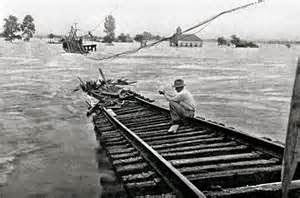
Seldom seen on movie screens in 2014 is avant garde director Bill Morrison's The Great Flood; a mesmerizing, moving and ultimately sobering found-footage film of the 1927 Mississippi River flood. The disaster displaced a million people and visited devastation on several states.

The words avant garde might be off-putting to many movie audiences but for want of a better term, it will have to do. Morrison is the talent behind Decasia and The Miners' Hymns; films that also re-purpose images to create something hypnotic and poetic. In Decasia, Morrison used decaying archival footage in a way that made the deterioration seem beautiful. His The Miners' Hymns is footage of a British miner's strike from the 1930s' made poignantly immediate by his careful arrangement of the images. His films lack narration and talking heads, which leaves the audience free to apprehend the imagery without a scholarly intermediary to provide a point of view.

In The Great Flood, Morrison again uses archival footage to show us not just the physical toll the flood exacted from people and communities but also the tough, practical response to the disaster from those who were affected directly. Set to a bluesy, jazz and rock score by the great, offbeat jazz guitarist Bill Frisell, Morrison's film is divided into segments, which are chronological but don't strictly adhere to a chronological structure.

That so much precious footage of the disaster exists at all is mind-boggling. The images of the flood are startling: inundated houses and businesses; drifting cars, people on horseback braving the rushing waters to get somewhere or anywhere and men working tirelessly to fill sandbags and shovel dirt on levees to stay the floodwater's relentless siege. We see one couple sitting on the roof of their car as the waters rush by them until the vehicle is also carried along.

But the word flood carries many meanings, some of which Morrison cleverly addresses. One inter-title informs us that the Sears Roebuck Catalog was circulated to 75 million people at the time of the flood. The film takes leave of the flood footage to show pages of the catalog flashing quickly by, like the waters that carry trees and cars forcefully along. Like the literal flood, this was a deluge that also made a devastating impact on Americans, which made cheap goods widely available and very affordable. This economic torrent preceded another great disaster: the stock market collapse of 1929.

The juxtaposition of images also yields subtle sociopolitical commentary. In one scene we see a crowd of wealthy, privileged white people waiting to board a train to escape the disaster while other footage shows black families stranded on a levee. Though no one was spared the devastation, we see mostly blacks handling the tough physical labor. We even see blacks in prison stripes join the ad hoc labor forces. This isn't to say whites were passive observers; only that we see mostly blacks in the footage.

Another segment includes footage of politicians, like Herbert Hoover, who were on hand to witness some of the flooding.

In the segment titled Migration, we see how many blacks were forced to relocate north, which was also a cultural migration of sorts. The blues culture of the south found new digs in places like Chicago, thereby creating a kind of counter-flood.

Morrison can mostly be described as a found footage director. In his major films, very little, if any, of his own camerawork makes its way to the screen. His mastery at editing images and arranging them in meaningful, moving ways, is his forte.

The Great Flood is an exceptional film; one whose images become more revealing and powerful by Morrison's editing. Though the footage is of a natural phenomenon wreaking havoc on human habitats, it also celebrates mankind's--and America's--capacity to overcome sweeping disasters. The segment entitled Aftermath are images of the recovery; people and communities busily restoring their homes and lives.

Morrison is a thoughtful curator of images; his passion for historical found footage enables him to breath life into film that might otherwise molder in a warehouse. From disparate pictures come a coherent vision; one stirring and absorbing.

Tuesday, October 21, 2014

St. Vincent


**Spoiler Alert**

Director: Theodore Melfi/Starring: Bill Murray, Melissa McCarthy, Naomi Watts, Jaeden Lieberher, Terrence Howard and Chris O'Dowd

First time director Theodore Melfi's St. Vincent, which he also scripted, introduces a motley assemblage of potentially amusing characters, then quickly consigns them to situations and behaviors as readily packaged and ready to serve as vending machine candy bars. One could chart the story knowing only the characters, who are more archetypes than people: the crusty old slob who drinks and gambles too much and is hostile to his neighbors but has a heart of gold; the single, working mother who has just moved in next door and has a son who is bullied at school; the street-wise, struggling prostitute who services the old slob but has a heart of gold; and an underworld figure who is after said slob for a gambling debt but doesn't have a heart of the shiny, precious metal. The only character who doesn't come in a box happens to be the one we seldom see; a Catholic school brother/elementary school teacher with a mildly sarcastic sense of humor whose class is made up of Jews and agnostics, who are welcomed warmly. Can you already see where this story will go?

Bill Murray plays Vincent, a Vietnam veteran who spends his days at the track and on a bar-stool. His shabby life is interrupted one day by a single mother named Maggie (Melissa McCarthy) and her son Oliver (Jaeden Lieberher), who move in next door. The movers Maggie has hired accidentally knock a branch from Vincent's tree down onto the hood of his car. Vincent angrily demands compensation from Maggie, who is miffed at her neighbor's un-neighborliness.

As Maggie's hospital job leaves her son in a latch-key state, Vincent reluctantly allows Oliver to stay at his house after school but only for an agreed-upon wage he negotiates with Maggie. The moment Vincent and Oliver meet, we already know where the relationship will lead. We know Vincent will help Oliver with the bullying he faces at school and that irresponsible visits to the track and the bar will follow soon after. We also know that the symbolic father/son relationship will be beneficial for both as Vincent's parental instincts are roused and Oliver learns to stand up for himself.

The other story developments are as predictable. We know what will become of the Russian prostitute Daka; played by Naomi Watts, whose accent is as broad as the Mississippi River. It's almost a narrative imperative that Vincent will eventually help her and become a kind of surrogate husband.

The one character I had hoped to see more of was Chris O'Dowd's Brother Geraghty. He is fairly amusing the few times we see him and something funny always seems to spill out of his mouth. Terrence Howard plays Zucko, the man who threatens Vincent for welching on gambling debts. I can't imagine his role was imagined any further than his name. His character lacks humor, personality and even the requisite menace his line of work demands. He is barely there and I wondered if the best parts of the character ended up under a table in the editing room. Watts' accent grates after awhile and generates little humor.

Some scenes were genuinely funny and the film never strays far from its comedic tone. But it lacked the anarchic energy the preview promised. When we learn Vincent has a dementia-afflicted wife in a nursing home, what little edginess the film still has drips into a pool of sentimentality. It isn't enough that he helps Oliver's self-esteem or becomes his surrogate father or that he takes on Daka's problems too; he must be the saint the title demands he be. It doesn't exactly pain me to admit it, but saints are often a drag.

In the end, Vincent, Maggie, Daka, and Oliver come together to become a family of sorts. No surprise there.

If the film had been funny throughout, its sagging characterizations and story might have been made irrelevant. Comedic talents like Murray, McCarthy and O'Dowd can't quite distract us from the film's flaws. Maybe if Vincent had been more sinner than saint, the film might have established and maintained a comic edge.

I noticed the film was only playing in one theater in the area. Maybe industry barons Bob and Harvey Weinstein, the producers of St. Vincent, knew something about their own film that we unsuspecting ticket-buyers don't. Bob and Harvey, you should have trusted your instincts; you should have sent the flick straight to DVD. I know I would have conferred sainthood on you if you had.

Monday, October 20, 2014

Fury


**Spoiler Alert**

Director: David Ayer/Starring: Brad Pitt, Shia LaBeouf, Logan Lerman, Michael Pena and John Bernthal

David Ayer, the helmsman behind the gritty 2012 cop drama End of Watch, brings a grittier film to theaters with the World War II story Fury. If you thought Saving Private Ryan was a bloody, violent affair, you might find Ayer's film more so. I don't know that I've seen a grimier, filthier, more brutal depiction of war. But the visuals aren't the only element that overpowers, the sound was also fairly extraordinary. Every explosion from ordnance and every discharge from a tank barrel rattled my seat. Fury leaves almost no sense unstimulated. Ayer makes certain the audience knows war is frightening, ugly business, and he succeeds exceptionally well in that regard. There is hardly a moment where one feels the characters are far removed from the savagery of battle. Ayer maintains a heightened sense of fear; allowing the audience to feel the soldier's anxieties and dread.

But the movie also borrows too heavily from many other war films. We're left with a technically and visually arresting film whose story succumbs often to cliche.

Titles before the film inform us that American tanks were outgunned and lacked the heavy armor of their German counterparts. The implicit message in this factoid is that American tank crews were very brave but the information also helps create an atmosphere of anxiety.

Brad Pitt plays Sargent Don "Wardaddy" Collier, a battle-hardened tank commander whose tank crew has seen action in every major American/British offensive; North Africa, D-Day and now the push into Germany.

His crew has just fought a ferocious battle where bodies and carnage litter the landscape. In the collection of wreckage, Collier emerges from his possum-playing tank to stab a German officer in the eye, who happens to be wandering among the smoldering, ruined tanks. We gather from Collier's gruesome act that the depictions of battle will be unsparingly grisly.

Collier's tank crew has just lost a gunner and has arrived at a camp to take on a new recruit; a former clerk/typist named Norman (Logan Lerman), whose appalling lack of experience disgusts the entire unit. Collier and his crew are dirty, tired and ragged and have the look of soldiers who have seen too much war. The crew is also gruff, edgy, war-weary and bear a ferocious hatred of anyone in a German uniform.

Collier's crew is made up of Boyd "Bible" Swan (Shia LaBeouf), who mans the main gun and is given to quoting Bible verse; Trini "Gordo" Garcia (Michael Pena), who mans one of the machine guns and Grady "Coon-Ass" Travis (John Bernthal), the gun-loader with a heavy southern accent. The crew has seen a lot together and like Collier, have little patience for Norman's inexperience.

Collier orders Norman to clean the machine gunner's seat inside the tank, which becomes a nauseating experience after the recruit finds the chair drenched in his predecessor's blood and half his face in a stew of bodily matter. Norman exits the tank to vomit-a justifiable response. We know Norman's innocence will eventually be shattered, along with his humane disdain for violence.

Collier's crew and the unit's tank, which bears the word "Fury" on its barrel, are commanded to take part in a search and destroy mission. Joining a convoy, Collier's tank proceeds slowly on a German road until the column passes a copse of trees. Norman sees a German soldier wielding an anti-tank weapon but doesn't shoot. The German fires at the tank ahead of Collier's, incapacitating it and causing the interior to ignite. American soldiers emerge from the burning interior, bodies ablaze and in the case of one soldier, a self-inflicted gunshot to the head precludes a lurid, fiery death. Collier is naturally livid with Norman for not firing his gun and when asked for an explanation, the recruit mentions the very young age of the enemy soldiers; some of them children. We know the encounter will be one lesson among many for the young gunner.

Shortly thereafter, we come to understand just how poorly armored and outgunned the American Sherman tanks were in battle as a much-feared German Tiger tank ambushes the four-tank unit. Repeated firing from the Sherman tanks merely glance off the substantially-armored Tigers and in the harrowing encounter, one turret is blown off its main body while in another American tank, a commander is decapitated by a German tank round. In the final hair-raising encounter, as Collier's Sherman faces the German monster alone, the American tank manages to make its way around to the Tiger's vulnerable rear area before crippling it. As the German tank crew emerges from the disabled tank, Collier and his men gun down the survivors.

In yet another battle, after the American army destroys another ambush, a German captive is paraded through the American soldiers. Collier sees the situation as an opportunity for Norman to execute the the soldier, thereby testing the new recruit's resolve and mettle.
It seems no war film of the past 30 years can resist the almost obligatory enemy soldier execution scene. We see it in Full Metal Jacket, Saving Private Ryan and now Fury. It's a tired go-to plot device and a cliche the film doesn't need.

The battle scenes are dazzling. Tracer fire zips back and forth between armies like a futuristic laser battle, tank shells ping off armor, tank treads roll mercilessly over dead bodies and mud seems to coat every soldier and mechanized surface, which ably serves the film's dirt and grim aesthetic.

After a significant incident involving two German women in a captured town, Collier and his men are ordered to guard strategic crossroads. When they arrive, a tank tread strikes a landmine, rendering the tank inert and leaving the tank without means to maneuver. To make matters worse, Norman spots an approaching German convoy--300 men strong. Rather than flee, Collier chooses to stand his ground. The puzzled crew joins him reluctantly, thus setting the stage for a climactic battle.

I liked so much about Fury but it is a film that often goes wrong. The execution scene aside, some dialogue rings unnatural and false and Ayers' script has Collier indulging in some war-movie philosophizing that strikes a discordant tone. Collier says to Norman: "Ideals are peaceful, history is violent." The statement seems too detached and very out of character for someone severely scarred by war.
I also found the final stand a Saving Private Ryan, against-heavy-odds-we-stand contrivance that seems very out place in a movie that works overtime to give the audience an authentic experience. I can't imagine battle-weary soldiers would fight against such heavy odds when they would be well within their rights to run. I'm not suggesting soldiers wouldn't be brave enough to take a stand, it just seems a character like Collier, who is doggedly-determined to see his crew survive, would be more sensible in such a situation.
And you're telling me 300 German soldiers, some armed with anti-tank weapons, couldn't surround or outflank one tank?

The character of Collier was plausibly established then betrayed by war movie cliches. In spite of said flaws, Brad Pitt's performance is fairly superlative. The rest of the cast are poorly served with stock characters and in the case of actor John Bernthal; he is saddled with a very broad, southern accent for a face that screams Bronx, Brooklyn or Queens. Every-time he opened his mouth, I expected a tough, New Yorky voice but was greeted with Huckleberry Finn instead. His performance, like that of the other cast-members, is hardly bad, but I think set design, sound design, visual effects and production design trumped characterization.

I came away from Fury quite impressed but hardly satisfied. It is a terrific technical film but makes a less-than-terrific artistic statement. It has many exceptional attributes but when it stumbles, it doesn't always recover.

Saturday, October 18, 2014

Al's Omniflick Spotlight: The Nefarious 10


I've made it a point to commemorate my blog milestones and would like to so again by celebrating my 125th posting. I thought it would be fun to list some of my favorite villains from the last 100 years of cinema. Though I abhor lists, my wife suggested the theme to me, which I embraced eagerly after considering the idea for a few moments.

The undertaking is hardly a simple task, given the staggering number of scoundrels and miscreants who populate movie history's rogue's gallery.
Any list could swell well into the hundreds but I've learned from past Spotlight posts that it's better to keep them concise and tidy.
So what criteria did I employ to make my selections? The most obvious was the visceral criterion. I chose villains I hate to love but love to fear. I also tried to stay clear of villains who might appear on an AFI list, such as Darth Vader, Norman Bates or the shark from Jaws though some of my selections might appear there as well.

I ask that female readers please overlook my inclusion of only one villain-ess, as men make up the evil bastard majority in the movie universe. Maybe I'll create a companion list in a future Spotlight devoted solely to the harpies of cinema. You can hold me to it.

My list is brief but I hope you all find it entertaining and stimulating. They appear chronologically. Please feel free to mention some of your favorites in the comments section below.

1. Hans Beckert (Peter Lorre)--From Fritz Lang's M

Fritz Lang's slithery serial killer from his 1931 classic is every bit as menacing and frightening as Hannibal Lecter and maybe more so considering his victims are young children. Peter Lorre was an outstanding casting choice. He never overplays his character and like some villains, he can be dangerously charming. His Beckert could easily make one obsessive about checking locked doors and windows and maybe never allowing one's children out in public.

2. Gregory Anton (Charles Boyer)--From George Cukor's Gaslight

Gregory Anton can mostly be credited for the term Gaslighting, which is defined as one's attempt to make another doubt one's sanity. And no one can employ the tactic quite like Gregory Anton, who nearly robs his wife Paula (beautifully played by Ingrid Bergman) of her mental health for material gain. Boyer is a cunning, malevolent dandy and very unforgettable.

3. Mrs. Eleanor Shaw Iselin (Angela Lansbury)--From John Frankenheimer's The Manchurian Candidate

It's entirely appropriate that I would include Angela Lansbury on this list. She also happens to play Charles Boyer's accomplice in Gaslight. Here she is even more manipulative and could easily challenge Lady MacBeth for Machiavellian, scheming superiority. As the wife of Senator John Yerkes Iselin, a presidential hopeful and pawn of powerful communist forces, Mrs. Iselin is the mastermind behind his campaign and provides the brains that counter her husband's bumbling ineptitude. Angela Lansbury is brilliant as a power-mad, treasonous menace who pursues her sinister agenda with a monomaniacal fervor.

4. Liberty Valance (Lee Marvin)--From John Ford's The Man Who Shot Liberty Valance

Liberty Valance isn't the crafty, malign individual Eleanor Shaw Iselin or Gregory Anton prove to be; his villainy is of a different flavor. He is vicious, violent and brutal and his presence in any room is enough to silence conversation and intimidate the most stalwart male specimens. His stentorian voice alone could make milk curdle. Though Jimmy Stewart's Ransom Stoddard has the guts and the resolve to face his frightening nemesis, we know he is hopelessly over-matched, outgunned, and over-powered; almost laughably so. Liberty Valance is Lee Marvin's finest performance, in my opinion, and one of John Ford's most memorable characters.

5. Sentenza/Angel Eyes (Lee Van Cleef)--From Sergio Leone's The Good, The Bad and The Ugly

As The Bad in the title of Sergio Leone's unforgettable western, Lee Van Cleef's character wastes little time establishing his villainy credentials. Like Liberty Valance, violence is his means to any end but unlike Valance, Sentenza/Angel Eyes' leavens his aggression with Mephistophelian guile in his fox-like pursuit of $200,000 in gold coins. He is the kind of killer who has few qualms about shooting his employer after receiving his pay or murdering without conscience all the male members of a family in their home after sitting down to share a meal with them. Even the way he slices a loaf of bread is delightfully evil. Sentenza/Angel Eyes is Van Cleef's most famous role and one he played with devilish relish.

6. Don Lope de Aguirre (Klaus Kinski)--From Werner Herzog's Aguirre, the Wrath of God

Unlike the aforementioned baddies, Don Lope de Aguirre is the only character based on a real-life historic, personage. From what I've read, the real Aguirre was hardly different from the man Klaus Kinski superbly depicts in Herzog's film. As part of a Spanish expedition seeking Eldorado, the mythical city of gold, Aguirre seizes control of the campaign and breaks ties with the Spanish crown. In doing so, his lust for power and gold twists his mind and leaves the expedition terrorized and often bloodied. Kinski's maniacal gaze has few peers in cinema for conveying dangerous insanity. His convincing performance makes us believe Aguirre is the Wrath of God.

7. Noah Cross (John Huston)--From Roman Polanski's Chinatown

If there are still politicians like Noah Cross in America, we're finished as a democracy. Not only does he murder, intimidate and cheat to control the water supply in a drought-ravaged Los Angeles, he has an unholy relationship with his daughter, which rounds out his SOB profile. When he says to Jake Gittes (Jack Nicholson), "You may think you know what you're dealing with, but, believe me, you don't," the ominous, cryptic statement tells us Gittes has yet to see the size and scope of Cross' corrupt manipulation of the police, Angeleno politics and the real estate market. What is particularly frightening about Cross is that he is accountable to no one and unlike many of the villains that comprise this list, we learn his comeuppance is unlikely. Some evil is just too powerful to overcome.

8. Frank Booth (Dennis Hopper)--From David Lynch's Blue Velvet

Frank Booth, a nitrous oxide-inhaling, demented, violent, murderous fiend from the darkest hell, might get along famously with Liberty Valance. There are very few people he doesn't terrorize and when he first sizes up the innocent and straight-arrow Jeffrey Beaumont (Kyle MacLachlan), he wastes little time threatening him too. His sexual encounters with Dorothy Vallens (Isabella Rossellini) consist of mostly nitrous oxide-fueled, sado-masochistic humiliation. He even has a few choice, hostile words for Jeffrey's taste in beer. It's hard to believe that the same man who portrayed the hippie, motorcycle-rider Billy in Easy Rider also inhabits the role of Lynch's creepiest underworld ghoul. Terrific performance of a terrifying monster.

9. Little Bill Daggett (Gene Hackman)--From Clint Eastwood's Unforgiven

Sometimes bad can wear a sheriff's badge. Little Bill Daggett, keeper of law and order (at least from his own definitions of those abstract concepts) in a frontier town called Big Whiskey, seems more a threat to the public peace than any of the criminals and lawbreakers who come into his muddy municipality. He is lenient to cowboys who slice up a prostitute's face but administers a vicious beating to a former gunslinger (Richard Harris) who violates his town's gun ordinance though said gunman is only guilty of having a shave. Later, his brutal whipping of Ned Logan (Morgan Freeman) makes the entire town recoil and flinch. Daggett's crookedness extends literally to his housebuilding, which betrays a comic incompetence. Hackman won an Oscar for his offbeat performance as a violent man with a complicated personality. It is a well-deserved award. Little Bill Daggett is surely one of cinema's great villains.

10. Colonel Hans Landa (Christoph Waltz)--From Quentin Tarantino's Inglorious Basterds

It is often said that the devil's most potent weapon is his charm. This applies to Colonel Hans Landa; one of the most charming screen-creeps I've even seen. Waltz's performance is exceptional and he too won an Oscar for his portrayal of a sadistic Nazi on the hunt for Jews. Landa is charming until he isn't, when his expression changes from benign amity to malign humorlessness. The scene where Landa discusses the delights of apple strudel with Shosanna (Melanie Laurent) portrays this beautifully. After he waxes rhapsodic for awhile about the perfect strudel, his Luciferian venom abruptly appears as he snuffs out a cigarette in middle of the sweet and delectable-looking dessert. The second time I watched Inglorious Basterds, I almost hated to see Landa get his comeuppance; he's that magnetic.

So there is my very short list of memorable villains. I hope you enjoyed it. Sometime, though not soon, I'll assemble a list of some more bad guys (and gals). I also hope you find the time to visit or revisit some of the characters on the list. They are forever fascinating and mesmerizing.

IMDB links: M, Gaslight, The Manchurian Candidate, The Man Who Shot Liberty Valance, The Good, The Bad and the Ugly, Aguirre, the Wrath of God, Chinatown, Blue Velvet, Unforgiven and Inglorious Basterds.