Showing posts with label Anne Hathaway. Show all posts

Thursday, October 1, 2015

The Intern


**Spoiler Alert**

Director: Nancy Meyers/Starring: Robert De Niro, Anne Hathaway, Rene Russo, Linda Lavin and Celia Weston

I'm wondering if The Intern can actually be called a movie because what it resembles more is a dull pilot for a sitcom that has little hope of being picked up by a network. It is so innocuous and free of actual conflict it could be mistaken for a soft-focus T.V. commercial peddling Alzheimer's medication. Of course one doesn't pay to see any Nancy Meyer movie expecting a psychologically dark, Bergmanesque drama; one expects the cloying taste of a caramel apple dipped in chocolate with a powdered sugar coating. How producers hornswoggled Warner Brothers into laying down $35 million for this swill might make for a diverting movie of its own. After seeing the film, one wonders where the money went. I suppose a third of the budget could have been apportioned to the salaries of its two stars; Robert De Niro and Anne Hathaway because the film doesn't look like it was made for half that price.

De Niro plays Ben, a retired widower who answers an ad for senior intern program at a fashion company run by Jules (Anne Hathaway); a young entrepreneur whose start-up has achieved considerable success. Accepted into the program, Ben arrives at the company headquarters dressed in a suit, which contrasts dramatically with the casual, twenty-something office attire. Every male on the staff seems to wear identical clothes, which is a uniform in itself: open, button-up shirt with a t-shirt underneath and jeans. I hardly saw one exception to this fashion trend the movie entire. I guess guys under 30 wear nothing else--at least in Meyers' eyes.

Sitting between two young men; one of whom is also an intern, Ben quickly makes friends and becomes acquainted with their problems.

Ben is soon assigned to assist Jules, which at first rankles her assistant Becky (Christina Scherer), whose frazzled state is the result of being under-confident and unorganized. After coolly greeting Ben, she offers him advice as to how to make a first impression with Jules. She tells him to blink; being that her boss finds people who don't creepy (how many people don't blink?). This leads to an unfunny sight gag where Ben blinks rapidly in Jules' presence. No further mention is made of the blinking in the movie, which is probably fortunate for the audience.

The initial awkwardness between the two stems from conspicuous differences of age and a dearth of tasks to assign Ben. Ben finds he has little to do as Jules assistant but he stays late to ensure she has help when she needs it. Though Jules is slightly perplexed by Ben at first, she slowly warms to his presence after a brief episode where she requests he be reassigned. As their time together grows, Jules learns a few things about Ben; like his substantial business acumen. His 40 years of experience as a company VP is supposed to make him an invaluable resource to Jules.

Showing initiative, Ben begins to assume more responsibilities, such as taking on the duty of her chauffeur when he discovers the regular driver drinking on the job. As he motors Jules to various appointments, he in turn learns much about her life and becomes acquainted with her daughter and her stay-at-home husband. In becoming more closely connected to Jules, Ben sees the clash between Jules' professional and home lives, which leave her little time in which to devote to her family.

In order for Jules to focus on and implement her ideas at work, the unpleasant prospect of having a CEO run her company becomes a concern. Knowing a CEO could assume more control than Jules wants to yield, the search becomes fruitless. Meanwhile, Ben proves to be both an indispensable assistant and wise counsel and as one might expect; a trusted friend.

As the demands of work and home become impossible for Jules to reconcile, a new crisis emerges when Ben sees her husband kissing a woman. Faced with the harrowing prospect of telling Jules, Ben finds she has known about it all along.

One doesn't need the Oracle of Delphi to know where the story will go. It is also readily apparent how Ben and Jules' relationship will develop.

In sitting through Meyers film, it is necessary to overlook implausibilities, such as Ben becoming the beloved of all on Jules' staff. In this age; where everyone over fifty in the job place faces permanent irrelevance, it's impossible to imagine a start-up company troubling itself with senior interns. I've never heard of it but if such company initiatives do exist, then I stand corrected. I also find it unlikely that the young people would have much patience for someone of Ben's years working in their midst. In real life, Ben would most likely suffer asphyxiating condescension.
It seems inevitable--and improbable--that the young men in the office would begin to mimic Ben's dress or go as far as to buy a vintage briefcase just like his. Is it also inevitable that Ben will offer sage advice to a young, male colleague about how to win a female co-worker's hand? Of course; a 70 year-old intern has the answers to everyone's problems.

If the film can be said to have a virtue, its Meyers' willingness to address the career/kids dilemma many women face and the marital problems that are its fallout.

De Niro's character is limited to one facial expression, which he seems to wear often; a tight-lipped, goofy grin, which imparts a dull, benign, avuncular manner that leaves him with few interpretive options. The character isn't much of a character; just a clutch of cliches borne of wishful thinking. Hathaway's Jules is more of challenge though hardly much more. It is her magnetic presence and arresting beauty that disguise the script's shortcomings. The fact that she is eminently watchable steers the film away from the abyss of slogdom (if Kate Hudson had been cast in this role, the film would have been torturous). Poor Rene Russo looked like she was photobombing the film; her role was a few crumbs attached by sewing thread.

Meyer's film arrives at an inauspicious time. With Danny Boyle's Steve Jobs and Ramin Bahrani's grim 99 Homes poised for wide release, one can see Nancy Meyers' film as a hopeless and frail misfit in the fall schedule. It might have kept better company with the summer blockbusters. As it is, The Intern just takes up space and sits there...kind of like an elderly intern.

Friday, January 23, 2015

Song One


**Spoiler Alert**

Director: Kate Barker-Froyland/Starring: Anne Hathaway, Johnny Flynn and Mary Steenburgen

It makes sense that Jonathan Demme, renowned for Stop Making Sense, his Neil Young trilogy and other music documentaries, would be a producer on Song One; a film that is as much about music as it is a drama about how three lives are impacted by one man's struggle to survive a traffic accident. Music flows throughout the film but rather than a score or song-track providing the soundtrack, the characters themselves create a sonic atmosphere that is more than a worthy surrogate. Music serves as an emotional thread; connecting characters to one another, their respective pasts and for some, it is a way of life.

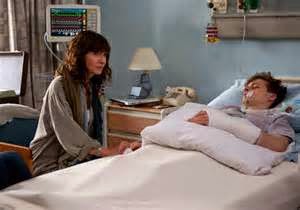
The accident that befalls a young man named Henry (Ben Rosenfield) comes after he caps off a busking gig in a New York City subway. While distracted by music playing on his headphones, he is struck by a vehicle, which leaves him hospitalized and in critical condition. While doing research on nomadic tribes in Morocco for her doctoral dissertation, his sister Franny (Anne Hathaway) learns of his accident and hurries home to be at his side. Greeting her at the hospital is her distraught mother; played with verve and poignancy by Mary Steenburgen.

While the Damoclean sword of death hangs over Henry in his comatose state, Franny sifts through her brother's personal belongings in his room at her mother's house. She comes across demo CDs' Henry has recorded and while looking through his guitar case, she finds a concert ticket for a folksy singer named James Forester, whose posters line her brother's walls.

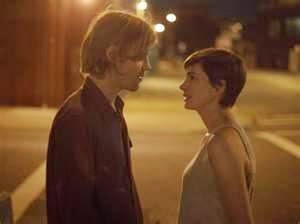
Franny uses the ticket and in doing so, she steps into her brother's musical world and becomes moved by the experience. Afterward, she visits James (the talented singer/songwriter/actor Johnny Flynn) backstage and after mentioning her brother's comatose state, she presents him Henry's CD demo. Sensitive to Franny's brother's serious condition, James visits the hospital and plays a song to Henry as he clings to life in his bed. Touched by James' compassionate act, the two begin to hang around together and soon after a romance blossoms.

Franny spends time reading her brother's diaries and notebooks, learning of his favorite clubs and his partiality to a certain diner which has great pancakes. Visiting all his favorite places, she becomes sympathetic to his musical pursuits, which was previously a cause of contention between the two when years earlier, Henry left school against his sister's wishes to pursue a career in music.

If the story seems gimmicky and in danger of mugging by schmaltz, the material is steered toward the melancholy and somber by Barker-Froyland's direction. The actors manage to keep their performances from sliding to a melodramatic precipice.

We learn James has slipped into a creative block, which has carried on five years. Try as he might, he has had little success extricating himself from his mental impasse, which Franny, with her charm and modest musical talent, slowly draws him out of.

Furthering her quest to free her brother from his coma, Franny buys a small, vintage organ to play at his bedside. Henry's coma and James' musical block are a sort of metaphorical parallel.

As Franny and James' romance begins to burn white hot, their divergent life paths pose an obstacle to their nascent relationship.

I couldn't help but think of the film Once as I was watching Song One, and it may be the case that other film-goers might be reminded of that film as well. Both films have a bittersweet and beautiful aura of ephemeral love and music is a landscape the characters' inhabit lovingly. Both feature charming lovers whose time on screen never degenerates into cuteness and silliness one might find in any movie where Rachel McAdams is the love interest.

Whether Henry awakes is a question dealt with late in the story, and what becomes of Franny and James is left refreshingly vague and unanswered.

Barker-Froyland's first feature is moving and sweet without being cloying and melancholy without being morose.

Anne Hathaway gives a heartfelt performance, while Johnny Flynn effortlessly embodies the musical spirit of James Forester; showcasing some strong vocal chops and musicianship. I would like to have seen more of Mary Steenburgen but she electrifies her scenes; nevertheless, with presence and charm.

Song One is a film that will stimulate your tear ducts but will do so without cheesy manipulation. As they say; it earns its tears. But this isn't maudlin cinema; it's a simple story and an emotionally satisfying one. It may not be monumental, but it more than serves its purpose.

Sunday, November 9, 2014

Interstellar


**Spoiler Alert**

Director: Christopher Nolan/Starring: Matthew McConaughey, Anne Hathaway, Jessica Chastain, Casey Affleck, Mackenzie Foy, Ellen Burstyn, John Lithgow, Wes Bentley, Michael Caine, Matt Damon, Topher Grace, David Gyasi and William Devane

I've wondered for some time if Christopher Nolan might someday join the ranks of cinema's directorial best. I've always thought he was ferociously talented and his style distinctive and singular. After seeing his new film Interstellar, which he penned with his brother Jonathan, I can finally say, with forceful emphasis--yes; he is on his way to entering the Pantheon. I found his new film to be monumental, highly intelligent, moving, visionary and riveting.

When one considers the film in retrospect, it seems incredible that a movie that begins on a country farm surrounded by cornfields could carry us to another galaxy, through a black hole and conclude in a space station in orbit around Saturn. But as the staggering stretches of time and space leave us breathless and our minds expanded, it's the mysteries of humanity that ultimately make Nolan's film an emotionally-rich experience.

The film's pervasive, melancholy tone begins in the opening scenes, where we see a less-habitable Earth of the near future. Though what specifically ails the planet is never overtly stated, we can see from the dust storms that smother and lash a small farming community that things aren't good. We learn that most crops have suffered some sort of mysterious blight, while only corn withstands the blankets of dust that besiege the small town residents.

In this community lives Cooper (Matthew McConaughey), his daughter Murphy (Mackenzie Foy), his son Tom (Timothee Chalamet) and his father-in-law Donald (John Lithgow). Cooper, a former pilot and engineer who now farms to survive, never had the opportunity to parlay his piloting skills into a space mission.

As he and his family endure the ominous environmental plagues, Cooper must also contend with his kid's school teachers, who believe Tom will never be qualified to be anything but a farmer, and look askance at Murph's fascination with NASA's Apollo programs. Her teacher bears a bewildering skepticism and contempt for space travel; going so far as to call the moon landing a fraud perpetrated by the U.S. government.

Strange, ghost-like occurrences begin to take place in Murph's bedroom; phenomena she attributes to the supernatural, which Cooper's rational mind interprets scientifically. Because Murph shares her father's analytical prowess, she believes the manifestation is a coded message in Morse, which offer longitude and latitudinal coordinates to a place not far from their home. When Cooper and his daughter investigate the location, they find a secret government NORAD site and when shown inside, they discover the place is actually a NASA base where a secret project involving space travel is being undertaken.

Leading this project is a brilliant scientist named Professor Brand (Michael Caine), who learns Cooper's piloting skills would be ideal for the mission he is overseeing. The professor explains to Cooper that the Earth's atmosphere is changing molecularly; becoming more nitrogen rich, which will soon make it difficult for humans to breathe and survive. The professor's project, already in advanced stages, involves finding planets suitable for human colonization. When Cooper mentions, quite reasonably, that the planets in our solar system can't support life, the doctor tells him of a worm-hole discovered near Saturn; one most likely placed by an alien race that anticipated mankind's need to abandon the Earth. The worm-hole allows travelers passage between our galaxy and another and on the other side are several planets which are candidates for colonization. These planets happen to be circling a massive black hole--at a safe distance--called Gargantua. It is also explained that several scientists have already traveled to said planets and are exploring them, though their fates remain unknown. Professor Brand offers Cooper the opportunity to travel to the planets, via the worm hole, to follow-up on the erstwhile expedition's progress.

Though eager to pilot a spaceship and satisfy his hunger to travel in space, the trip leaves Murph afraid and angry; knowing she may never see her father again. And when Cooper comes to say goodbye to his daughter, she refuses to see him. While she bars the door, books fall from her bookshelf, further confirming the existence of some sort of poltergeist, though what it actually is becomes clear later in the film.

As the mission to Saturn begins, Cooper is joined by Professor Brand's daughter Brand (Anne Hathaway), Doyle (Wes Bentley), and Romilly (David Gyasi). After their ship breaks Earth's gravitational pull, the crew enters cryogenic freeze for the long voyage. On awakening near Saturn, the crew prepares to enter the worm-hole and when they successfully navigate their way through, they find the black hole and the planets the professor described.

The shot of the Earth from space and the rings of Saturn are lovely and breathtaking. It is particularly humbling to see a massive spaceship reduced to the size of a penny next to Saturn's massive majesty. It is also fascinating that the worm-hole is presented more as a sphere rather than the traditional hole-like, sci-fi conceptions we're accustomed to seeing. Hovering like a ticking clock over these wondrous visuals is the mission's pressing objectives and the imperiled human race back on Earth. Nolan keeps the scientific intricacies of space travel and Einsteinian time-dilation reasonably accessible without drowning the audience in technical jargon.

As Cooper, Brand and the crew visit the prospective planets, they encounter some surprises, some life-threatening setbacks and one of time-dilation's mind-boggling peculiarities (time-dilation dictates that time will slow significantly for those who travel at or near the speed of light while it proceeds normally for observers. If one were to visit a distant star at light speed and return to Earth, the traveler will have hardly aged at all while hundreds or thousands of years may have passed for those on Earth). Because the planets circle a black hole, the more bizarre effects of time-dilation wreak havoc with the crew.

And because of time-dilation, Murph has aged into normally into adulthood (now represented by Jessica Chastain) while her father has more or less remained the age he was when he left Earth. Her transmissions to the Cooper's ship leave him floored when he sees the sobering sight of his aged daughter; who, in relativistic terms, is hardly younger than he.

Back on Earth, Murph has matured into an accomplished scientist who has joined Professor Brand's project and in doing so, she learns (as Cooper and crew discover separately) the mission through the wormhole was a one-way trip, which dashes her hope of ever seeing her father again. The realization has a devastating impact on her and on Cooper alike.

A tragic turn of events on one of the planets threatens the mission, which leads to some life-altering decisions for Cooper and Brand, one of which forces him into the black hole; a phenomenal sequence where travel inside a black hole is beautifully imagined; a trip that ends where one might least expect.

A film like Nolan's only works if the sterile, coldness of space can be countered by a powerful human drama, and it is. The relationship between Cooper and Murph is the dynamic that really drives the film. The desire to see Cooper keep his promise to return to his daughter is powerful, though the unimaginable distance and time between them makes that prospect seem unlikely.

Matthew McConaughey may have given the performance of his career in Interstellar. It's hard to imagine how improbable this role seems when just a decade ago his career was mired in witless, romantic comedies with Kate Hudson. That phase in his career seems as far removed from the present as the black hole is from Earth.

Hoyte Van Hoytema, the cinematographer behind Her and Let the Right One In, has a rich palette from which to work as he captures the dusty brown of a farming town, the cold grays of a icy planet and the lovely, ringed face of Saturn; real and imagined environments he records with an artist's eye.

If the film has a flaw, it might be the later scenes on Earth, which seem to pull us reluctantly away from the unbelievable drama taking place a galaxy away. The scenes of an adult Murph combating her brother to make contact with her father is necessary to the story but it can't match the scenes in space for power or wonder. And of course one could be nit-picky about the science in the film. I doubt anyone in a spacesuit would survive entry into a black hole but why should we be forced to think literally to appreciate the Nolan's imaginative story?

I think Interstellar is a masterpiece; a term I very rarely apply to any film, even great ones. It challenges our intellect and our conceptions of reality while showing us how precious a sight a human face might be when it lies beyond interstellar and intergalactic reaches, and what happens when time dilation allows a young father to visit his elderly daughter on her deathbed. And it asks us to consider the notion that our species may not me meant to occupy this celestial ball forever. Nolan asks us to consider a lot, which is what makes his film a stunning achievement.