Showing posts with label Jake Gyllenhaal. Show all posts

Monday, April 11, 2016

Demolition


**Spoiler Alert**

Director: Jean-Marc Vallee/Starring: Jake Gyllenhaal, Naomi Watts, Chris Cooper, Judah Lewis and Heather Lind

Jake Gyllenhaal has become adept at playing dark, oddball characters who contend with bizarre situations or are thrust into them involuntarily. His character in director Jean-Marc Vallee's new film; Demolition is no less fascinating or strange as he plays a man who slowly becomes unhinged after he loses his wife in a violent car collision. Vallee's film keeps us emotionally involved in the protagonist's quest to establish an emotional connection to a deceased wife to whom he denied love and attention and if his arc seems a little too pat, it is nevertheless unpredictable and often full of jarring surprises.

Gyllenhaal plays Davis, who we see riding with his wife Julia (Heather Lind) down a New York street. She chides him for not listening to her and his general inattentiveness; drawing on his inability to deal with their leaky refrigerator as an example. As if to confirm his wife's assessment, he barely listens to his wife's querulous patter. A second later, another car strikes their car violently on his wife's side. Moments later, we see a series of images in Davis' head of his wife flash before our eyes, which serve as a visual segue to a shot of Julia's father Phil (the superb Chris Cooper) walking toward him in a hospital; nearly collapsing from the knowledge that his daughter has just passed. What is particularly unusual is Davis' reaction, which is decidedly impassive. Even more bewildering is what he does shortly thereafter. After trying to buy peanut M&Ms' from a vending machine, the candy becomes stuck; prompting Davis to complain to a hospital staff member. The worker deflects Davis' complaint by informing him that a vending machine company is responsible for malfunctions. Davis approaches the machine to snap a iPhone shot of the vending machine's address. The scene is astonishing for several reasons. Almost incomprehensible is his glaring indifference to the news of his wife's death but even more so is his craving for candy and his displeasure at being cheated. Is Davis numb; too shocked to grasp his loss? Or was his wife right about his aloofness?

The story takes a stranger turn when Davis writes a letter of complaint to the vending machine company at the funeral reception; detailing not only the candy incident at the hospital but the loss of his wife. The letter we hear Davis read in voice-over gives us background information on his life and his wife, including his employment at his father-in-law's investment firm. While at the reception, we also see Davis practicing a grieved expression in the mirror.

Davis surprises his father-in-law and his colleagues when he shows up for work shortly after the funeral. Not giving an explanation for his presence, Davis proceeds with business.

Something Phil says to Davis inspires more peculiar behavior when he tells his son-in-law that sometimes it is necessary to dismantle and take something apart to understand its insides. In scenes that follow, we see Davis dismantle his refrigerator as he tries to ascertain the cause of the leak and a creaky bathroom stall door at his office; separating the discrete parts neatly on the floor. And most confounding of all; he strips his office computer; leaving the wreck in myriad parts on the office floor. Phil's dismay prompts Davis' compulsory leave of absence.

Davis' letters to the vending machine company become frequent, which elicit a response from a customer service representative named Karen, who begins following him surreptitiously. When Karen agrees to meet Davis at a diner, she watches him from the parking lot and calls him on his cellphone to tell him she can't join him. But in the days following, she continues to follow him and read his letters. Davis tries to find her at work then at her house. To his surprise, he encounters her boss at the door, who is more than just a little angry and puzzled to see a customer on his doorstep at 11pm. Karen (Naomi Watts) is naturally flabbergasted at the sight of Davis but accepts his latest letter before discouraging him to return.

But Karen's boyfriend leaves on a trip, allowing Davis to visit her at home. One might expect the friendship to quickly morph into something sexual but instead we the makings of a quirky friendship. Soon Davis becomes acquainted with Karen's son Chris (Judah Lewis, in a performance that is sure to make Hollywood notice), who offers him a gruff greeting sprinkled with four-letter words. Davis learns Karen's relationship with her teenage son is troubled by a lack of connection in a way that echoes Davis' problems with his wife.

As Davis' friendship with Karen burgeons, he becomes friendly with Chris; discovering a troubled teen in need of an ear and and fatherly companionship. Davis learns Chris has been suspended from school for giving a too-honest and too-graphic account of an incident in the Afghan War. With time on his hands, Chris joins Davis in his efforts to demolish his home.

It is fairly clear at this point in the film that Davis' obsession with dismantling objects and demolishing his own home is a metaphor for his attempt to break down his life and as his father-in-law said; "to understand what is in the inside." It also serves as a symbolic means to understanding his failed relationship with his wife, who haunts his waking life as a specter.

The more time Davis spends with Karen and Chris, the more he becomes estranged from his job and his in-laws, particularly Phil, who is angered by his son-in-law apparent apathy to a scholarship fund he has formed in honor of his daughter's memory.

Strangeness abounds in Davis' behavior as he and Chris test a bullet-proof vest in the woods with Karen's boyfriend's gun. Chris shoots Davis in the side and just as he recovers from the bullet's ferocious impact, Chris shoots him again. The scene, though harrowing in its own way, shows the growing trust between Davis and Chris. When Chris becomes more comfortable with Davis, he confides in him one day about his sexual confusion. The issue is made more poignant when Davis catches Chris dressing up in the bathroom.

In spite of Davis' behavior, which continues on its destructive course (he buys a bulldozer on e-bay to facilitate his home's collapse, only to be thwarted by the defective vehicle), he comes closer to dealing with his wife's death on emotional terms. But shocking developments are never in short supply in Vallee's film. While demolishing dresser drawers in his home, he discovers his wife's ultra-sound photo. Davis' judgement being unsound, he chooses to confront his in-laws about it during the scholarship-fund awards ceremony. As he heads to the door, his mother-in-law reveals another shocker about the baby.

As the story winds down, a few threads are tied-up though not neatly. Davis' issues with his wife are resolved in a semi-satisfying manner and the film's final scene reveals a rapprochement that is significant for its happy resolution.

So much is happening in Vallee's film, it is amazing how the various characters and scenes manage to cohere. The tone shifts at times, from dark drama to dark comedy to blithely surreal to upbeat conclusion. I'm still not sure if the film works as a whole but so much of it is too wonderfully eccentric to dismiss. One of my favorite shots in the film is of Davis walking toward the camera on a crowded city sidewalk. As he moves forward, one notices that the crowd is effectively moving backward--a nice, subtle, visual touch.

As much as I enjoyed the film, there is something about the end that seems incongruent to everything that came before. Or maybe I've become suspicious of films that insist on buoyant endings. One could pose a counterargument that the ending is well-earned. And does the demolition metaphor work? Is it too heavy-handed?

Vallee's soundtrack is quite delightful. I like music that is directly incorporated into the story. Heart's Crazy on You is not only part of the soundtrack but the song itself becomes part of a question Davis poses to a gathering of his office colleagues during a meeting.

I like Vallee's film. I found its flaws to be minor or negligible. I don't think it's the great film it had the potential to be but it worked well enough. Its limited release will work against it but it will find its way to those who will appreciate its oddities.

Tuesday, July 28, 2015

Southpaw


**Spoiler Alert**

Director: Antoine Fuqua/Starring: Jake Gyllenhaal, Rachel McAdams, Forest Whitaker, Oona Laurence, 50 Cent and Naomie Harris

Antoine Fuqua has never been a subtle director. Most of his movies run on high-octane emotions and can sometimes sacrifice nuance for the sake of sentiment. His new film Southpaw, which stars Jake Gyllenhaal as a Bronx boxing champion named Billy Hope (yeah, the name isn't exactly subtle either) is no less subtle but it atones for that shortcoming with conviction, terrific performances and inspired fight scenes.

It's difficult to avoid the classic cliches in boxing movies: the fighter who seeks redemption in the ring, or fights to save his family or to stay economic hardships; it seems most boxing films draw from one or several of these tired, familiar plots. The secondary characters are just as familiar; the ragged, boxing gym manager whose dreams of getting a shot at the title are curtailed for one reason or another and the wife or girlfriend who fears for her husband's mental health and would like nothing more than to see him hang up his gloves. It isn't surprising to find the cliches dusted off for another round (pun not intended) in Fuqua's film but what does come as a surprise is how he re-purposes them compellingly.

Billy Hope isn't a bottom of the boxing card chump but a successful light-heavyweight who, with his wife Maureen (Rachel McAdams) and his daughter Leila (Oona Laurence) live luxuriously in their New York home. When we first see Billy, he is deliberately taking brutal, repeated head-shots in the ring. His taut, obscenely chiseled frame is a menacing spectacle. But though Billy can mete out severe punishment, he almost relishes the pounding he takes, a la Jake LaMotta. Watching nervously from ringside is Maureen, who shouts encouraging words and the Don King-like Jordan Mains (50 Cent), who often sees Billy as a marketing tool. Just as defeat seems imminent, Billy unleashes a flurry of savage blows and in doing so, he manages to eke out a slim victory.

But in the post-fight media conference, as Billy and his opponent field questions, a prospective challenger, Miguel Escobar (Miguel Gomez), taunts Billy from the crowd; demanding a chance at the title. Billy ignores Miguel and his entourage's baiting. But a little later in the story, after a prestigious fundraiser, Billy, Maureen and their friends pass through the hotel lobby. Waiting for them is Escobar and his entourage, who taunt Billy again but also direct insults at Maureen. Billy retaliates by punching Escobar in the face, which ignites a brawl between the two parties. Gunfire breaks out and in the aftermath, Maureen lies bleeding on the floor. Billy tries desperately to keep Maureen conscious but to no avail.

Following his wife's death, Leila is placed in foster care after a judge decides the fracas casts a dubious light on Billy's fitness as a father. Before he can reclaim custody, he must prove he can be a responsible father. Meanwhile, Billy discovers his finances aren't what they seem. Soon all his home furnishings are sold off and his house goes into foreclosure.

As Billy agonizes over his daughter's situation, he finds his visits to her are supervised and very brief. Billy also finds Leila refuses to speak to him; her anger over her situation is quite palpable. The fact that Billy was a foster child himself growing up makes his emotional stress all the more acute.

Jordan presents Billy with a chance to recover from his economic woes by offering him a three-fight deal. Billy is reluctant to accept, given the danger it presents to his body, which has sustained excessive punishment over his career. The burden of having to prove he can provide financial stability and be a fit father leaves him with few alternatives. He signs the contract but his first fight proves to be a disaster. Still haunted by his wife's death, he finds he is unable to look over at her usual place at ringside for morale support. Billy fights but without his usual animalistic spirit. He loses the fight and the hope of prize money. Worse yet, Jordan informs him the lackluster fight is a breach of contract, which means adverse, legal fallout. The boxing commission decides to suspend Billy for a year; the financial implications of the decision are too much for him to bear.

Fuqua piles on a little too much adversity, which feels like a contrivance, but the narrative momentum remains intact and unaffected.

Still having to prove to the court he has a legitimate job, Billy visits a shabby-looking boxing gym where a trainer and manager named Tick Wills (Forest Whitaker, who almost steals the movie) acts as a guide for poor, disadvantaged kids whose home lives are decidedly bleak. Billy asks Tick for a job and a place to train. When Tick offers a job cleaning the gym, Billy recoils at thought of cleaning toilets. He leaves angrily but returns days later; having reconsidered the position.

Billy begins to annoy Tick by making a habit of showing up to join him at a local watering hole. In conversations, Billy learns about Tick's boxing past; his own pursuit of a top ranking and the unfortunate injury to his eye; administered by a bum fighter that left Tick with a glassy surrogate, whose color contrasts almost grotesquely with its twin.

As Billy proves he can hold down a job at the gym, he is granted more latitude in his visits with his daughter. His reformative behavior earns him the trust of the case worker and the judge.

After Billy fights in a boxing exhibition for a fund-raising event, Jordan approaches him to offer him the chance to fight Miguel Escobar, who reigns as the light-heavyweight champion. Jordan informs Billy he can use his influence to remove the suspension, which would allow him to fight again. Billy accepts but needing an ace trainer to help him defeat Escobar, he approaches Tick, though he is aware of the trainer's policy about not training professionals. In time, Tick relents. Billy's subsequent re-training mimics every regimen previously seen in nearly all the Rocky films, albeit without the signature theme music. And of course this is all prelude to the crux of the narrative and most boxing movies: the big fight.

The film establishes its engaging, dramatic momentum early on and builds on it. As the story charges to its inevitable boxing climax, Fuqua ensures we are deeply invested in the characters. To give cliches a new coat of paint, a storyteller must also give them a new color. Never for a moment do we doubt the story's direction and outcome but the care Fuqua shows for his characters makes it easy to overlook the chestnuts.

Gyllenhaal's impressive physique, which must have taken great effort to define and expand, would be a visual gimmick if his character were nothing but a savage brute. But Gyllenhaal is an actor who knows how to give intensity nuance and character, as he did in Nightcrawlers. His character squints for much of the movie, as if boxing injuries and a metaphorical inability to see his life clearly are debilitative.

Though Gyllenhaal is exceptional, the real delight in this film is Forest Whitaker, which hardly comes as a surprise. From the moment he utters his first lines of dialogue to his last, I wanted to see more of him and learn more about his past. His presence and performance are electrifying and he provides the film a higher gear in which to reach its exciting climax.

Fuqua demonstrates he can make a prize fight a pulse-quickening experience, which isn't easy. Though he is hardly an artist with the camera, he knows how to wield it visually for optimum effect. The blood is kept to a minimum; we hardly need any director to try to outdo Raging Bull.

I came to Southpaw expecting the usual boxing cliches and was hardly surprised to find them but Fuqua, who is very aware of boxing movie tropes, employs them with generous dollops of heart and soul. Is the film an eminent entry into the boxing movie pantheon? Hardly, but the film is as bracing as a real exchange of jabs and hay-makers. It remains that way until the final bell.

Monday, November 3, 2014

Nightcrawler


**Spoiler Alert**

Director: Dan Gilroy/Starring: Jake Gyllenhaal, Rene Russo, Bill Paxton and Riz Ahmed

We've grown accustomed to seeing Jake Gyllenhaal in films where he is confronted by creepy characters or situations. Donnie Darko, Zodiac and this year's Enemy are but a few that come to mind. In Nightcrawler, Gyllenhaal has the rare opportunity to actually play a creep. And as he takes on this new career challenge, he proves he is quite adept at playing a character who gets under one's skin.

His character, Louis Bloom, reminds me somewhat of Robert DeNiro's Travis Bickle in Taxi Driver; he is humorless and earnest and when he tries to sustain an ordinary conversation, he is awkward and more than just a little unnerving. And like Travis Bickle, you know something dark, angry and maybe violent is seething beneath a deceptively self-possessed demeanor.

When we first see Louis, he is using a bolt cutter to remove a chain link fence near some train tracks. When he is confronted by a security guard, Louis offers a feeble excuse about being lost. His gaze rests on a watch the security guard wears, which he covets. After the guard scoffs at Louis' reason for being on the premises, he is attacked brutally. We see the outcome of the melee in the next scene, as Louis sports the security guard's watch.

After selling his scrap metal to an unscrupulous buyer, Louis comes upon a crash scene on an L.A. freeway. He stops to find two police officers trying to extricate an injured driver from a car. He also sees a cameraman, Joe Loder (Bill Paxton) filming the scene. Louis learns Joe is capturing footage of the crash to sell to local T.V. news stations. While Joe is in his van gathering his camera equipment for his next opportunity, Louis approaches him and asks if he might need help. Joe gives him the brush-off but it is obvious from Louis' eyes as he watches the van pull away that the incident has made an impact on him.

After seeing Joe's footage on the local news, he sets out to buy his own camera and to fund his new found enterprise, he steals a bicycle to sell to a pawn broker. Unable to get his preferred price for the bike, he instead trades for a home video camera and a police scanner.

Louis then tries his hand at capturing his own footage when his police scanner leads him to a crime scene involving domestic violence. He boldly approaches the epicenter of the scene as police officers tend to a bleeding victim. Louis aggressively thrusts his camera over the victim to capture grisly footage. After the police force him back, Louis returns to his car but not before a rival cameraman vents his frustration at him for thwarting his own attempts to film.

Later that evening, Louis visits a local T.V. station, intending to sell his modest footage. He meets a producer named Nina Romina (an excellent Rene Russo) who buys his footage for a modest fee. Though Nina's colleague has reservations about the footage being appropriate for television, she is hardly troubled or disturbed by the video. Her focus on ratings leaves her blind to ethical considerations.

Nina encourages Louis to find more footage and to consider her first when marketing it, to which he agrees. An unholy partnership forms; both parties hungry for success and willfully oblivious to scruples.

At this point in the film, we've grown accustomed to Louis' bizarre chatter about success, which he drones about in a robotic fashion. He is happy to offer his views to anyone who will listen, including Nina.

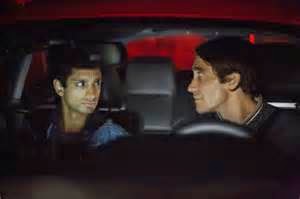
As Louis submits more footage, he hires a young apprentice named Rick (Riz Ahmed); a down and out homeless person with a shaky work history. Excited by Louis' offer of employment, he too listens to his employer's clinically expressed ideas about business.

As the footage sales climb, Louis upgrades his vehicle to a brand new muscle car and acquires new camera equipment and a computer to edit his videos. And as the two men become experienced in the ways of filming, Louis becomes more ambitious and even less concerned about how he gathers his footage.

Flush with success, he invites Nina out to dinner one night. While she considers the dinner something strictly professional, Louis interprets it as something romantic. When Nina rebuffs his amorous intentions, Louis reminds her how his footage has been instrumental in reviving her career while also making subtle, unkind comments about her age and the fact that her professional life has been sporadic. He also makes demands for higher footage fees and more brazenly, insists she introduce him to the news production staff. Nina is repelled by his aggressive, roughshod tactics but is subtly taken by his initiative. Louis is the reflection she sees looking back at her in the mirror.

Louis' ambition and his shockingly unethical approach to his work lead him to an incident he cunningly manipulates for his own gain, which involves filming a murder in progress. Rather than turn over evidence which might incriminate the assailants, he withholds it to prolong potential money-making opportunities. In a unconscionable attempt to collect the reward on the suspects and film the footage of their arrest, he follows them after learning their whereabouts from the license plate number in his footage. His plan leads to a deadly shoot-out and a car-chase that ends fatally for several parties. But it is what he films that heralds his descent into total ethical and moral bankruptcy.

The film ends cynically; not only will Louis will remain impervious to arrest and prosecution, he will also prosper.

Gilroy's story is taut and bleak and wonderfully plotted. It is easy to see how a sociopathic opportunist like Louis might easily find success via the news media, with its declining standards of taste and integrity.

Gyllenhaal keeps the audience on edge with his portrayal of Louis' unpredictable, menacing personality. Gyllenhaal's wide, alert eyes are a perfect vehicle for conveying an eagerness to learn (which he accomplishes with disturbing ease and speed) and a dangerous volatility. Rene Russo is the biggest surprise in the film. Her world-weariness and insecurities are worn on her face like lacerations. She is smart but we see that years of working in the news media has left her with a mercenary attitude toward her job, which is finely attuned to ratings imperatives. She and Louis are simpatico in their approach to their work. I don't think I've seen a better performance from Russo. Her career has mostly been relegated to Hollywood-movie-babe roles where all that was asked of her was to smirk and look sexy. Here she shows a range and a darkness I didn't think she had.
Riz Ahmed was also quite good as the conscience Louis so sorely needs but appallingly lacks.

The film makes a powerful and pessimistic point about American opportunism; its intolerance for competition and its debilitating effect on character. It also says something about how the capitalist system abets the unethical agendas of those who see illicit conquest as a means to success.

Nightcrawler might leave you feeling like you need a good scrubbing with hot water and soap. But it is also an intriguing film; one that left me hoping life doesn't always resemble the grim make believe on movie screens.

Friday, March 7, 2014

Enemy

**Spoiler Alert**Dir. Denis Villeneuve, Starring: Jake Gyllenhaal, Melanie Laurent and Isabella Rossellini. Based on a novel by Jose Saramago

Denis Villeneuve's Prisoners was sadly overlooked in 2013, in my opinion, for end-of-the-year honors but the subject matter and movie may have been too dark for the Academy's and the Golden Globes' tastes. It was certainly more interesting, in my opinion, than Gravity and August: Osage County but so it goes.
Enemy is another dark offering, heavy with dread and anxiety and a challenge to parse. Jake Gyllenhaal plays a history professor who discovers he bears more than a passing resemblance to an actor in a dvd rental. This causes much angst, which prompts a search for said actor. In doing so, the two eventually meet, causing mutual distrust and fear.
The premise sounds simple, right? With Villeneuve, nothing is ever so. Strange imagery, a spider metaphor and an unconventional, David Lynchian "story" make for a near-opaque mystery. Accompanying the viewer in this creepfest are Stygian interiors and a soundtrack fraught with ominousness and unrelenting dread.
Both men, played expertly by Gyllenhaal, have blonde, significant others who figure prominently in the drama. The actor is married to an expectant, young woman, to whom he seems indifferent most of the time while the history teacher is in a relationship with a woman to whom he also seems aloof.
A key to fathoming the story involves the riddle of the spider motif, a symbol inspiring many interpretations. The climax involves the actor's weekend with the history professor's girlfriend; an act accomplished with intimidation and the teacher's reluctant consent. The film's final scene is frighening and jarring. The audience with whom I saw the film jumped and gasped, as did I. It was apt, consistent and a perfect conclusion to a film that was sure to reach an ambiguous and nightmarish end.
I enjoy films that resist interpretation and challenge the viewer's capacity to fathom the seeming unfathomable. Enemy is just that kind of film and one I enjoyed.
Jake Gyllenhaal has taken to playing dark characters or characters in dark films: Donnie Darko, Zodiac, Prisoners and now Enemy. His roles reflect a determination to challenge himself as an actor and his performances have responded in kind. I would have liked to see more of Isabella Rossellini, whose appears more in a cameo role than as a fully-realized character. Villeneuve offers us another fascinating, psychological drama; one sure to stimulate the mind and make the audience simmer in anxiety and unease.