Showing posts with label Jonah Hill. Show all posts

Sunday, August 21, 2016

War Dogs


**Spoiler Alert**

Director: Todd Phillips/Starring: Jonah Hill, Miles Teller, Bradley Cooper and Ana de Armas

Watching War Dogs; director Todd Phillips' comedy/drama about young, novice gun-runners who almost make the score of their short-lived careers, I couldn't help but be reminded of two things: 1.) Andrew Niccols' Lord of War, which deals with arms dealing and 2.) Martin Scorsese's Good Fellas and Wolf of Wall Street. War Dogs and Lord of War are only related by subject matter but Phillips' film bears the unmistakable stamp of Scorsese's influence--maybe a little too much so. The editing, the use of freeze-frame, the main character's narration and the persistent presence of its classic rock soundtrack are very much Scorsese. The based-on-actual-events morality tale of young men finding and basking conspicuously in ill-gotten wealth before greed and ill-fortune become their undoing is also a premise one will often find in Scorsese's oeuvre. Be that as it may, Phillips' film is quite entertaining; a spirited telling of a true story, which is based on the New York Times article Arms and the Dudes, by Guy Lawson. The film is also helped along with terrific performances by Jonah Hill and Miles Teller. War Dogs may not be a stunner but it is engaging and it makes a reasonably cogent comment about the perils of opportunistic capitalism.

Miles Teller plays David Packouz; a young man earning an unremarkable but honest living as a massage therapist. When we first see him, he is sitting in his shabby car, which is parked in a posh Miami neighborhood. As he tokes a joint, a security guard approaches his car and urges him to move on. Packouz informs the guard he's waiting to serve a client, then is mildly scolded for smoking pot before driving away. The scene cuts to him massaging a man, who lets his towel fall provocatively to the floor before Packouz rebuffs his pass by awkwardly returning the towel to its proper place.

Trying to improve his financial situation, Packouz tries his hand selling quality bed-sheets to retirement homes. His idea's non-viability is apparent when he actually meets with a retirement home manager, who talks frankly about the preposterousness of old bodies wrapped in Egyptian cotton. Dejected from a lack of interest and the fact that all his savings is tied up in the sheets, Packouz maintains his job as a massage therapist.

His life changes dramatically when he sees his one-time best friend; his old school chum Efraim Diveroli (Jonah Hill), at a funeral for a mutual friend. The two make friendly eye-contact and afterward embrace. After catching-up with old friend conversation, Packouz learns Diveroli has gone into business selling arms. Before long, he invites Packouz to go into business with him, selling arms to the U.S. Government. Packouz resists, particularly after Diveroli mentions being cheated of $70,000 by a former associate.

Packouz is nevertheless intrigued, as he visits his friend's office to hear Diveroli's detailed explanation of how the government broadened the competition for arms sales during the Iraqi War. Packouz listens intently as Diveroli relates the history of how George W. Bush's administration, seeking a level playing field in the arms market, made it possible for virtually anyone to buy and sell large quantities of weapons. Diveroli then shows Packouz the government's long list of weapons contracts on a federal website. As Diveroli is keen to point out, the major arms dealers pursue the more lucrative contracts, while the lesser contracts--still worth millions--are made available to smaller companies. Packouz is initially reluctant after listening to Diveroli's pitch, citing his and his wife's opposition to the war in Iraq. Diveroli justifies his position by declaring his business to be pro-money rather than pro-war. Packouz agrees to a 70-30 partnership, but rather than face virulent opposition from his wife Iz (Ana de Armas), he tells her the business involves selling bed-sheets to the American military. In on the deal is Diveroli's silent partner and financial-backer Ralph Slutzky (Kevin Pollak); a successful businessman who owns a chain of dry cleaners in the Miami area. Packouz's decision to join his friend is helped along after Iz announces her pregnancy.

Diveroli and Packouz (and the audience as well), become quickly acquainted with the political complexities of the business when the two men take on a contract to supply an army captain named Philip Santos (Patrick St. Esprit) with several thousand 9mm Berettas. Hoping to ship directly from the factory in Italy, Packouz and Diveroli discover Italian arms companies are forbidden to deliver arms directly to the war zone. While Santos becomes impatient with the delays, Packouz and Diveroli scramble to find a solution to their problem. They manage to hatch a clever plan by which the guns are to be be routed to Iraq via Jordan;, an Italian ally. But they encounter another snag when the guns are seized in Jordanian customs, making it necessary for them to fly to the country to free the shipment themselves. Meanwhile, Santos presses Packouz and Diveroli for his guns while Iz grows suspicious of her husband's business.

One of the more entertaining sequences in the film follows when Packouz and Diveroli find themselves negotiating the release of the guns with a Jordanian who has connections in customs, only to find their only means of delivering the shipment is by truck--a very dangerous proposition. Their driver gives them "fifty-fifty," odds of reaching their destination, which does little to gain their confidence. The subsequent drive through the desert is met with some harrowing moments as they face a checkpoint and later, at a deserted gas station, Packouz sees two trucks of armed men heading in their direction. Their escape is fraught with peril and high comedy as the driver is forced to pore gasoline directly into the tank as they make their getaway. Only the intervention of a U.S. helicopter and some Humvees keep their truck from being overrun.

When Packouz and Diveroli reach Captain Santos, they learn their journey by truck was actually a daring drive through what the captain calls the "triangle of death." Diveroli, enchanted by their unwitting act of bravery, struts arrogantly around the compound.

Flush with a success, Packouz and Diveroli's lifestyles change dramatically shortly thereafter, as we see them driving matching Porsches and moving into separate apartments in the same Miami, luxury high-rise. They also expand their office to accommodate a larger staff, who they train in the finer points of buying and selling arms. But we begin to see signs of discord between Packouz and Diveroli when the former discovers the $70,000 his partner claims he was cheated out of is actually money he swindled from a partner. Distrust deepens after Packouz draws up a formal partnership agreement, which he has Diveroli sign. As the business prospers, Packouz notices its negative impact on his marriage, as he is frequently called away.

Packouz' business relationship and friendship with Diveroli are tested when they bid on a contract worth a mind-boggling $300 million dollars, which involves the U.S. government's plan to train and arm the Afghan army with a vast supply of weaponry, including AK-47s. The significant part of the deal becomes the million rounds of ammunition needed for the guns. Finding themselves over their heads with the logistics of shipping a mass quantity of ammunition, the deal nearly falls through until they make the acquaintance of a notorious arms dealer named Henry Girard (Bradley Cooper). After a Vegas arms show, Girard offers them a can't-lose solution to their problem. Packouz and Diveroli accept his help, in spite of his name being on a terrorist watch list. Over Packouz's objections, Diveroli secures the deal.

The film's final third act is fraught with betrayal, marital woes, Packouz's near death in Albania and a major deal gone awry. With it comes moralistic finger-wagging but oddly enough, no end titles inform us of the various character's fates.

As stated earlier, the movie felt very Scorsese-like. That in itself isn't a problem but the method of storytelling has been done so often it feels formulaic. Phillips is hardly the first to mimic Scorsese and it's certain he won't be the last but we can guess where the story will go merely from the way it's told. We know Good Fellas and The Wolf of Wall Street will end badly for the characters because Scorsese enjoys telling stories with character arcs that follow a steep rise and precipitous fall, with the requisite, intoxicating brush with Mephistophelian success in between.

But the film moves along at a heady pace; the character's misadventures make the story a fun and sometimes thrilling romp. It's also enjoyable to watch Miles Teller and Jonah Hill, who are quite excellent as the respective naif and the more worldly and ethically compromised partner. It's probably no accident that Hill was cast in Phillips' film; as he was also in Scorsese's Wolf.

No development in the film is particularly surprising, as we know from watching the trailer that no film about arms dealing will end well; Hollywood's liberal slant wouldn't permit anything else.

I've seen better films of late but Phillips' is a piquant coda to the late summer movie season. If it isn't groundbreaking, it also isn't dreary or dull.

Tuesday, February 9, 2016

Hail, Caesar!


**Spoiler Alert**

Directors: Joel and Ethan Coen/Starring: George Clooney, Josh Brolin, Scarlett Johansson, Tilda Swinton, Alden Ehrenreich, Frances McDormand, Channing Tatum and Jonah Hill

Joel and Ethan Coen have made exceptional films in their careers and some irredeemable time-wasters. One can count a fair number of comedies in their oeuvre but for me, I've always preferred their dramas, which sometimes contain their brand of dark humor. I realize my low opinion of their comedies is in the minority. People insist Raising Arizona, O Brother, Where Art Thou and Burn After Reading are hilarious but they only leave me cold. (I've heard some movie lovers even suggest that The Hudsucker Proxy and The Ladykillers are funny... not to me.) I'm still not wild about The Big Lebowski but I think Jeff Lebowski is a comic master creation. The Coen Brothers' comedies are too self-aware to be truly funny.
That being said, I found their new film; Hail, Caesar to be unfunny, unfocused and unfailingly tedious. I heard one woman laugh through the entire film but there is always that one person in the audience who can be counted on to find every gag and comic situation funny even when they aren't. In spite of the woman's compulsive laughter, the patrons in my immediate vicinity--and in most of the theater--were mostly silent. So it goes; everyone is entitled to laugh; it certainly isn't a crime, but maybe it's a case of sour grapes on my part, who knows?.

The Coen Brothers celebrate/skewer old Hollywood; the characters and genres that ruled the screen and the dramas that raged off of it.

Capitol Pictures' production manager Eddie Mannix (Josh Brolin) broad job description makes it necessary for him to also manage scandals that threaten to ruin actor's lives and derail movie projects. When the film begins, we see him visit a home where an intoxicated, high-profile actress is being photographed pornographically. Mannix, who seems accustomed to damage control of this ilk, manages to keep the situation from becoming headline fodder by pulling the starlet from the scene and paying off a couple of cops who arrive on the scene. When not defusing near-disasters, Mannix tends to studio production business. One film over which he presides is a big-budget, Ben-Hur-like epic called Hail, Caesar, which stars Hollywood mega-star Baird Whitlock (George Clooney).

During production, Whitlock is kidnapped; leaving Mannix to contend not only with a crime, but a situation that could conceivably become a media typhoon. Compounding his woes are the cost overruns Whitlock's absence creates for the the film. And yet another of Mannix's vexations are the Hedda Hopper-like, twin gossip columnists; Thora and Thessaly Thacker (Tilda Swinton, sporting great alliterative names); who skulk about the studio lot, sniffing for scandal and gossip.

But we also meet the film's other dramatis personae, like Hobie Doyle (Alden Ehrenreich), the singing cowboy of the big screen, who Mannix eventually recruits in his effort to find Whitlock and DeeAnna Moran (Scarlett Johansson); an Esther Williams-like star whose personal troubles become studio troubles. We also meet Burt Gurney (Channing Tatum); a song and dance star who later plays a part in the kidnapping drama.

Whitlock awakes in a posh, seaside home and after wandering around, he finds his kidnappers, who turn out to be a disgruntled group of screenwriters who are fed up with the industry's obeisance to the bottom line. The audience learns what it may have suspected all along; the group's agenda is strictly communist.
Meanwhile, Mannix assembles a cash payment after receiving the group's $100,000 ransom note while trying desperately to keep the kidnapping from leaking to the studio, the public and the press.

The film reaches for laughs when Hobie becomes a substitute cast member for director Laurence Laurentz's (Ralph Fiennes) tux and gown drama; a movie for which his Texan accent and cowboy persona are hopelessly ill-suited. The film's most inspired comedic scene is Mannix's meeting with local religious figures to ensure the movie's subject matter offends neither Christians nor Jews. The exchanges between the rabbi and catholic priest are peppered with a few barbed, comments about scripture.

As the mystery behind the kidnapper's intent comes to light, Whitlock becomes an ardent believer in their cause before eventually returning to the set of his movie.

The various secondary character's stories never add up to much, particularly DeeAna Moran's and Hobie Doyle's, who are more representations of old Hollywood types than people.

The Coen Brothers' film seems like an opportunity to poke fun at the anti-communist hysteria of the time. We see a boat containing Whitlock's captors and Burt Gurney approach a Russian submarine, which surfaces near the California shore, awaiting the bag containing the $100,000, which is being offered up as a gift. The absurdity of the scene seems to reflect the outrageous, right-wing, Cold War paranoia that held America in its grip during that period.

I suppose the film will seem funny to those who are attuned to the Coen Brothers' sense of screwball. I went into the movie expecting to laugh but unfortunately, their film fell flat. It isn't the first time I've had that reaction to one of their comedies and it may not be the last.
I'll move on now and hope their next movie will be more fun than this slog.

Monday, April 20, 2015

True Story


**Spoiler Alert**

Director: Rupert Goold/Starring: James Franco, Jonah Hill, Felicity Jones and Gretchen Mol

The inevitable comparisons to the film Capote and Truman Capote's book In Cold Blood will no doubt plague director Rupert Goold's True Story, which, like Capote's masterpiece, is based on fact. But unlike the aforementioned book, Goold's film is less compelling and can't forge an identity that would have us forget Capote's book or the film starring Phillip Seymour Hoffman.

The cast certainly shows up and is quite good. Jonah Hill, James Franco and Felicity Jones aren't merely along for the ride; they carry the film on their shoulders.

Based on former New York Times columnist Michael Finkel's memoir of the same name, True Story is the story of how the journalist became involved with the convicted murderer Christian Longo and how their literary relationship derailed in the process.

As we see in the film, Finkel (Jonah Hill) finds himself without a job and essentially a blacklisted journalist after an article he wrote for the New York Times was deemed fraudulent. Finkel was accused of attributing several interviews from multiple sources to a single interviewee. In spite of Finkel's reasonable defense of his act, he finds his editors and the journalistic community cannot overlook his ethical breach; his good intentions notwithstanding.

Finkel returns to his wife and home in Montana after being fired from his position. As he desperately tries to submit ideas for articles to the print media in an attempt to recover and maybe rehabilitate his soiled reputation, he finds no takers.

While Finkel contends with his diminished career status, he learns that a man named Christian Longo (James Franco), who is accused of murdering his own wife and kids, has been impersonating him. Intrigued by what a killer might be doing claiming to be a famous/infamous journalist, Finkel travels to the prison facility in Oregon to meet his impersonator.

As Finkel sits before the accused, he listens as Longo's explanation carries a whiff of adulation and flattery for the journalist, which isn't lost on Finkel. Finkel sees Longo's position as not much different than his own and becomes sympathetic. Longo insists he is innocent of his alleged crimes while Finkel believes he too has been judged harshly; by his journalist peers and the news media.

Finkel hits on the idea of writing a book about Longo's case, which he believes could help free the accused and restore his own reputation as a journalist. As Finkel secures a hefty advance for the book, Longo grants him exclusive access to his tragic story.

And as Finkel becomes wrapped up in the book, he sees his wife Jill (Felicity Jones) less and less. Though she knows her husband's book is meant to help exonerate Longo, she begins to see the accused for what he is: a master manipulator who won't accept his own guilt. Finkel, dazzled by the promise of literary success and career rehabilitation, driven by his belief in his subject's innocence and an empathetic regard for Longo's beleaguered state, refuses to believe what may most likely be the truth.

Much of the drama is propelled by the scenes of Finkel and Longo's conversations. Longo's insistence that he is innocent assumes plausibility in Franco's persuasive performance. Audiences may forget how terrific Franco can be in dramatic roles as he certainly is here. Hill has established himself as something more than a comedic actor. His deft performance demonstrates how a seasoned journalist like Finkel might be prey to a master manipulator. The two actors are quite good, as is Jones, though her character is unfortunately more peripheral.

As Longo begins to infiltrate Finkel's life in subtle, sinister ways, Jill finds her husband is becoming more more distant. She also finds herself being manipulated when she happens to speak to Longo on the phone one day when her husband is out. Later, in a face-to-face conversation in the prison facility, she lets Longo know in subtle terms that he is guilty as accused and she is not his psychological pawn.

Finkel's book deal begins to waver when Longo makes both a plea of innocence and guilt in an open court. Finkel is naturally infuriated as he wonders why Longo would jeopardize his own case and the book in pleading guilty to half of the murders.

The closer the film comes to the actual trial, the more suspect becomes Longo's claim of innocence. The film climaxes with Longo's trial, where his true nature becomes conspicuous and his spell on Finkel is dispelled.

As previously stated, the film, though based on true events, doesn't succeed in making the case riveting. Strong performances are a plus but I couldn't help but think that story/film suffered in comparison to Capote and as mentioned, Capote's book. We've seen it all before; the cunning con making a fool of the journalist. A true story shouldn't play as a cliche onscreen.

Even the idea of truth's relativism is hardly new.

The film should have been a fascinatingly dark, psychological melee but its ambitions remain stubbornly tethered to what is on the page.

This is Goold's first feature film. He shows some promise as a storyteller and may surprise us in the future with something more powerful. True Story isn't a bad film, just one that fails to launch.

Friday, June 13, 2014

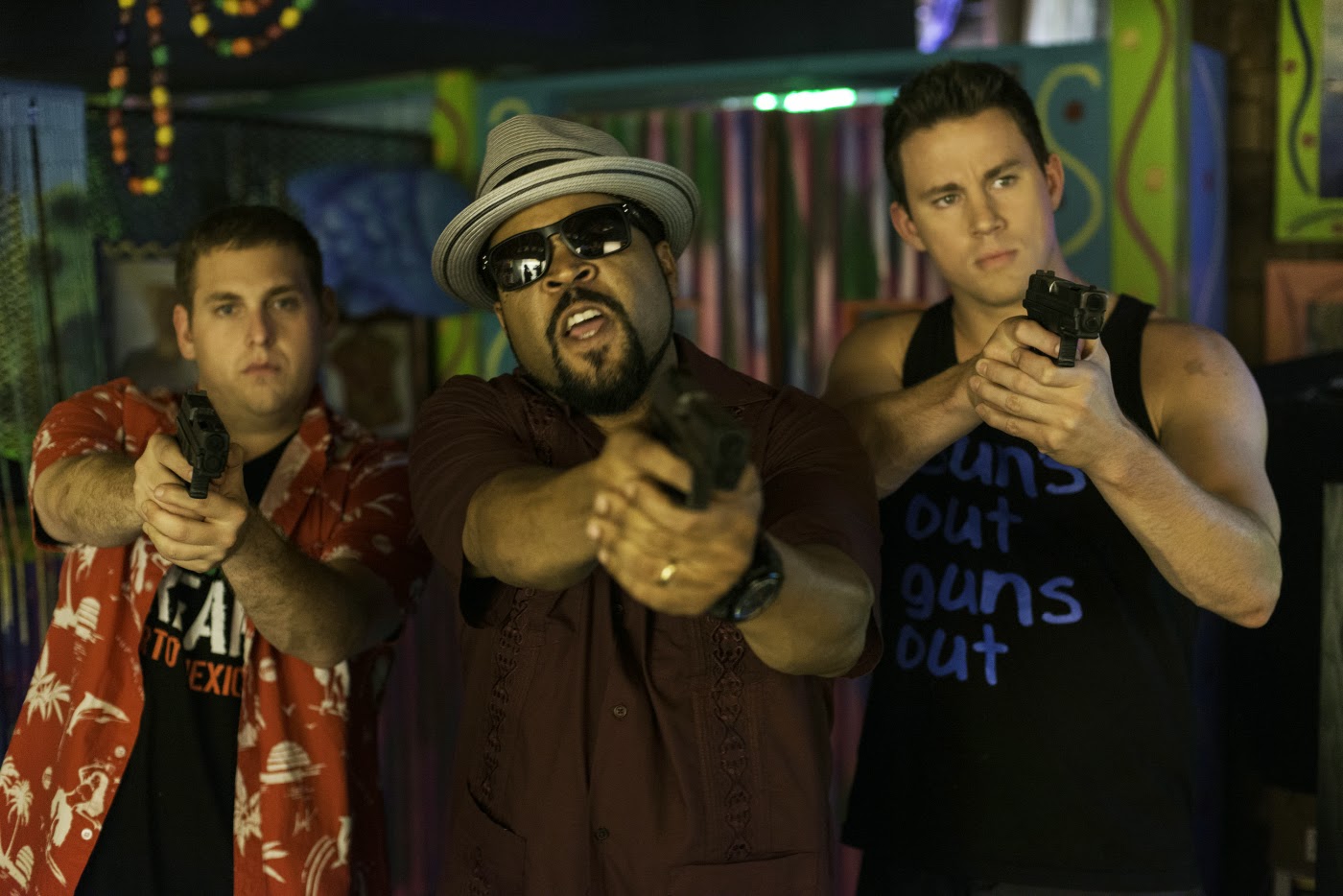
22 Jump Street


**Spoiler Alert**

Director: Phil Lord and Christopher Miller/Starring: Channing Tatum, Jonah Hill, Ice Cube, Nick Offerman and Peter Stormare

Apparently a movie need not be very good to merit a sequel but here we are with 22 Jump Street, which is just that. The cast from the first movie is back with a sprinkle of cameos thrown in for at least decent measure.

The story merely exists to provide context and something resembling a plot but the movie really is just a string of gags, mostly bloodless and dumb but occasionally something that registers as amusing or funny accidentally happens.

Schmidt (Jonah Hill) and Jenko (Channing Tatum) are assigned a new case involving a drug called WhyPhy, which is making the rounds among the students of Metro State, a local college. The two cops go undercover as college students to find the supplier. The joke of course, like the first movie, is that Schmidt and Jenko look a little old to be students; which is the observation of more than just one student.

A student under investigation who died using the drug is seen in a photo supposedly handing it to another student with a tattoo, which is what Schmidt and Jenko use as a lead. While Schmidt's separate investigation leads to a romance with an attractive student named Maya (an intoxicating Amber Stevens), Jenko strikes up a friendship with a football player named Zook (Wyatt Russell). The friendship threatens the quasi-gay relationship Schmidt and Jenko have enjoyed since the first film. So much of the film is a running gag about the homoeroticism involved between Jenko and Zook and though it is played as something natural and unironic, the joke becomes tired, as does the jealous tension simmering between Schmidt and Jenko.

In one of the movie's (few) funnier developments, Maya turns out to be Captain Dickson's (Ice Cube) daughter; setting the stage for a comically tense situation where both Schmidt and Maya's parents meet for lunch. The scene concludes with Captain Dickson angrily and violently helping himself to the buffet, resulting in food being heaped on his plate and flung about with his hands. Ice Cube shows some comic flare in what is probably (for me) one of my favorite moments in the film. I often found the secondary characters more amusing than Schmidt and Jenko. Nick Offerman's Deputy Chief Hardy returns in this movie and I wished he would have been given more screentime because he is funny in the few scenes allotted to him. The same can be said for Jillian Bell's Mercedes; Maya's hostile roommate and Schmidt antagonist. She is given to making fun of Schmidt's age whenever they happen to be in the room together and her barbs are quite amusing.

If only the movie had been consistently funny rather than just a bundle of infrequent, amusing moments. The content of the first movie was pretty thin material on which to launch a second movie. I wondered throughout if the producers might visit another installment on us in the future but a series of bogus trailers for Jump Street movies (everything from Schmidt and Jenko going undercover in seminary school to an equally absurd dance class) hint that 22 Jump Street might mercifully be the end. Please let that be the case.