Tuesday, June 17, 2014

Code Black


Director: Ryan McGarry

Winner of numerous Best Documentary prizes in 2013, Code Black is a powerful, sobering and disquieting film about young doctors and doctor-hopefuls serving on the staff of The L.A. County Hospital. From them we learn much about the past and present state of healthcare in America and how its prohibitive cost is denying the poor and uninsured proper medical attention. But the film is much more than that.

We learn from L.A. County doctors and staff how the old hospital was once the location of one of the busiest emergency units in the country. Nicknamed C-Booth, the room was once a intense hive of activity, with throngs of medical technicians, nurses and doctors all congregated in what resembled a chaotic scrum. According to one doctor, it would only appear that way to someone unfamiliar with the procedures and roles of those involved. We also learn that the unit was once a place where more people died and more people were saved than anywhere else in the country. C-Booth attains a kind of legendary status among those who served and were served in the unit.

Because the old L.A. County Hospital wasn't up to earthquake code, a new building was erected next door, which meant the end of C-Booth and the beginning of a dramatic change not only in environment, but in how medical service was administered. Larger than its predecessor, the new hospital offers more modern facilities but the young doctors and doctor hopefuls learn that much was lost in migration.

The hospital uses a color coding system to discern the number of patients awaiting care. Black (hence the title) is a designation meaning a waiting room filled to capacity. It's sad and tragic to learn that because so many of the poor and uninsured come to the County Hospital for care, the waiting area can become a welter of sick and those who need immediate attention; sometimes waiting as long as 18 hours to be seen.

The young doctors express their frustration with the system and the heavy politicized nature of healthcare in America. We meet the doctors, learn their histories and how they came to medicine--some having once been patients with life-threatening issues--but what is of paramount concern to them is their indefatigable compassion. One doctor remembers watching as a friend with severe brain trauma was given less-than-optimal care, which inspired him to study medicine. In another scene, we see the young doctors gathered around a restaurant table, discussing the impact of reality upon their ideals. It is ispiring to hear them address the nightmarish problem of treating so many--often with little staff and funding--with care and love; the pursuit of hefty salaries of no concern.

Politics and economic constraints are lamented. A chart of the US and the number of county hospitals in the country willing to serve the needy is so appallingly small as to be alarming. One doctor says that because medical care is geared toward the bottom-line, the poor and needy are seen as not being profitable. It is probably not-surprising that so many of those seen waiting are minorities. But as we see later; a caucasian woman in her 50s', left homeless and penniless when her law practice was embezzled, is forced to seek care as one of the needy. It is a heart-wrenching scene; one meant to draw a slender thread between the financially able and the poor. The fact that so many of us are only a hairsbreadth from such a condition is very worrisome.

In a more optimistic turn, the young doctor's analyze the success of the former C-Booth, citing the intimacy of the room and the visibility of the patient as keys to better treatment. They undertake to simulate the old unit and in doing so, dramatically reduce the waiting time of the patients. The hospital also manages to replenish its dwindling nursing staff and re-open wings formerly closed because of economic hardship.

McGarry skillfully weaves the personal with the socio-political effectively; shedding light on a system in need of dire care and repair. The viewer is well-aware that the beseiged doctors face many ferocious adversaries with ever diminishing resources. Though the statistics offer little optimism, the County staffs across the country seem to be valiantly waging a war against the commodification of healthcare, hoping to reinstate humane, compassionate--and passionate--care for the politically and economically marginalized. Code Black is forceful, touching, unsentimental, a kind of call to arms and ultimately a wrenching experience.

Friday, June 13, 2014

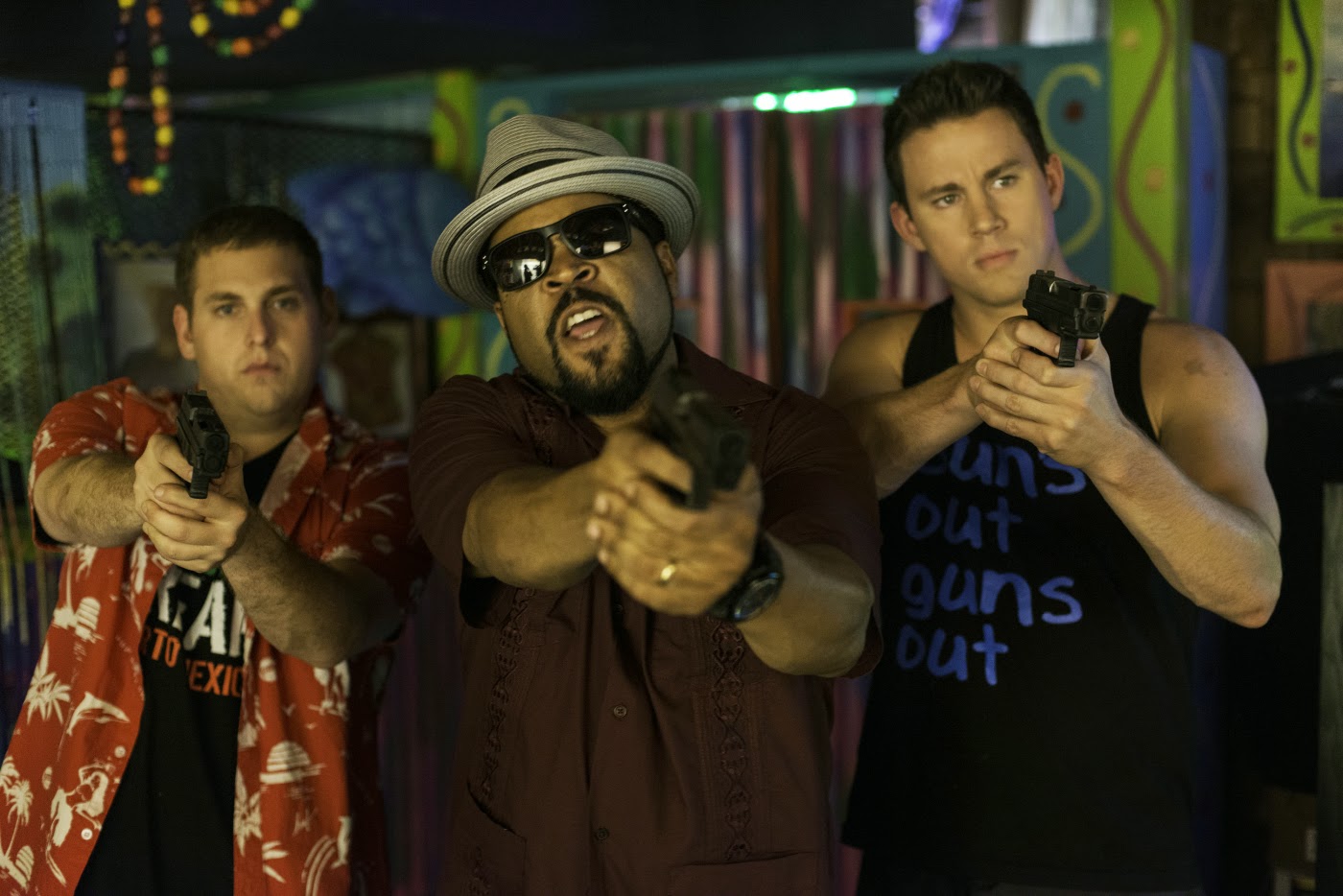
22 Jump Street


**Spoiler Alert**

Director: Phil Lord and Christopher Miller/Starring: Channing Tatum, Jonah Hill, Ice Cube, Nick Offerman and Peter Stormare

Apparently a movie need not be very good to merit a sequel but here we are with 22 Jump Street, which is just that. The cast from the first movie is back with a sprinkle of cameos thrown in for at least decent measure.

The story merely exists to provide context and something resembling a plot but the movie really is just a string of gags, mostly bloodless and dumb but occasionally something that registers as amusing or funny accidentally happens.

Schmidt (Jonah Hill) and Jenko (Channing Tatum) are assigned a new case involving a drug called WhyPhy, which is making the rounds among the students of Metro State, a local college. The two cops go undercover as college students to find the supplier. The joke of course, like the first movie, is that Schmidt and Jenko look a little old to be students; which is the observation of more than just one student.

A student under investigation who died using the drug is seen in a photo supposedly handing it to another student with a tattoo, which is what Schmidt and Jenko use as a lead. While Schmidt's separate investigation leads to a romance with an attractive student named Maya (an intoxicating Amber Stevens), Jenko strikes up a friendship with a football player named Zook (Wyatt Russell). The friendship threatens the quasi-gay relationship Schmidt and Jenko have enjoyed since the first film. So much of the film is a running gag about the homoeroticism involved between Jenko and Zook and though it is played as something natural and unironic, the joke becomes tired, as does the jealous tension simmering between Schmidt and Jenko.

In one of the movie's (few) funnier developments, Maya turns out to be Captain Dickson's (Ice Cube) daughter; setting the stage for a comically tense situation where both Schmidt and Maya's parents meet for lunch. The scene concludes with Captain Dickson angrily and violently helping himself to the buffet, resulting in food being heaped on his plate and flung about with his hands. Ice Cube shows some comic flare in what is probably (for me) one of my favorite moments in the film. I often found the secondary characters more amusing than Schmidt and Jenko. Nick Offerman's Deputy Chief Hardy returns in this movie and I wished he would have been given more screentime because he is funny in the few scenes allotted to him. The same can be said for Jillian Bell's Mercedes; Maya's hostile roommate and Schmidt antagonist. She is given to making fun of Schmidt's age whenever they happen to be in the room together and her barbs are quite amusing.

If only the movie had been consistently funny rather than just a bundle of infrequent, amusing moments. The content of the first movie was pretty thin material on which to launch a second movie. I wondered throughout if the producers might visit another installment on us in the future but a series of bogus trailers for Jump Street movies (everything from Schmidt and Jenko going undercover in seminary school to an equally absurd dance class) hint that 22 Jump Street might mercifully be the end. Please let that be the case.

Tuesday, June 10, 2014

Life Itself


Director: Steve James With appearances by Martin Scorsese, Werner Herzog, Errol Morris, Chaz Ebert, Richard Corliss, A.O. Scott et. al.

It is astonishing to think that a film critic from the Chicago Sun-Times achieved international fame for simply offering his two-cents on films. Roger Ebert was well known to cinephiles and non-cinephiles alike and his appearance on television and in printed media always seemed like a given. A documentary about Ebert seems redundant when one considers the ubiquity of his prescence. But Steve James, the talented documentary filmmaker behind Hoop Dreams, Reel Dreams and Stevie, now offers us a moving, extraordinary biopic on a man I thought I knew.

We first see Ebert in the hospital in what was the last year of his life. His jaw is incurably slack, leaving him with his mouth continuously open; his non-existent lower palate a grim reminder of his thyroid cancer, which made intraveneous feedings necessary and left him barely able to walk. It is Ebert's insistence that he be filmed in this state though it is often difficult to watch.

James' film alternately visits Ebert's past and present and in doing so leaves us with a startling contrast. Much of the film's narration is taken from Ebert's memoir Life Itself and what I thought was a recording of Ebert is actually actor Stephen Stanton, whose voice is almost indistinguishable from Ebert himself.

We see Ebert in old photographs from his childhood in Urbana, Illinois and hear from friends and colleagues how eager he was to have a by-line. His parents encouraged his writing, which eventually earned him the editor's role in his college newspaper. Ebert's friends remember his time as editor as being exceptional for his coverage of salient events of the day, including the violence surrounding the civil-rights struggles in the south.

The film moves on to Ebert's job at the Chicago Sun-Times; where he was offered his coveted by-line as the film critic; a position he would hold for decades. Even the prestige of the Pulitzer prize and lucrative job offers from the New York Times and the Boston Globe couldn't lure Ebert from his position at the Chicago Sun-Times.

From here we enter a darker period of his life, focusing on Ebert's alcoholism, which he remembers as a very real agent in his near-destruction. From the narration, we learn that if not for his terrible hang-overs, he may not have overcome his illness in the late 70s'. By then he was already well on his way to achieving celebrity status with his famous counterpart Gene Siskel on the syndicated movie-review show, which underwent numerous name-changes over the years.

A more humorous, obscure episode in his life was his work as screenwriter for Beyond the Valley of the Dolls, a film for which Martin Scorsese offers a tentative endorsement. It is also touching to hear Scorsese talk about Ebert's review of his first feature film, which brought the filmmaker attention, if not acclaim. Later we listen to Scorsese discuss a bleak low-point in his life and career in the late 70s' and how a tribute to his work by Siskel and Ebert at the Toronto Film Festival helped extricate the director from a morose phase. To hear Scorsese tearfully recount the experience, we are moved by his gratitude to the two critics. Scorsese's involvement in the film as Executive Producer might reflect this. It is also interesting to hear Scorsese recall Ebert's pan of The Color of Money; an act for which the director holds no grudge. The account underscores how critics and filmmakers share an uneasy and sometimes adversarial relationship.

We also learn about the behind-the-scenes evolution of Siskel and Ebert's show, whose audience continued to swell in the 1980s' and 1990s'. What began as mutual contempt between the critics, morphed into a close, fraternal relationship. It is astonishing to hear how Ebert felt he was closer to Siskel than any other man in his entire life.

One of the key moments in Ebert's life was his marriage to Chaz Ebert, who contributes her own personal accounts throughout the film. Ebert cites his deep, fulfilling relationship with Chaz as a life-impacting experience. We see her as she lovingly attends to his needs, which were many in his physically diminished state.

Many filmmakers weigh in on what Ebert meant to their careers. Errol Morris discusses Ebert's review of his film Gates of Heaven, which helped bring critical acclaim while Werner Herzog speaks fondly of seeing Ebert's star on his strolls on the walk of fame. Critics also have their say; most notably Richard Corliss, who feuded with Ebert over the supposed dumbing down of film criticism, specifically leveled against the syndicated program.

What it all amounts to is a fascinating, touching portrait of a man who achieved fame for something that doesn't normally bestow fame on practitioners. No film critic since has touched such stratospheric heights and most likely ever will again.

James' film is absorbing, sometimes heartbreaking and often unflinching. Whatever one believes about Ebert as a person or critic, one indisputable truth is his love for cinema. The fact that he spent part of the last year of his life watching films attests to the validity of the statement. For someone who grew up reading and listening to Ebert's reviews, I can honestly say everyone who writes about film, including myself, owes him some kind of debt.
It is interesting to see the camera turned on a critic. We are watching a film about a guy who watched films. It is an interesting paradox and for Life Itself, it makes perfect sense.

Monday, June 9, 2014

Words and Pictures


**Spoiler Alert**

Director: Fred Schepisi. Starring: Clive Owen, Juliette Binoche, Bruce Davison and Amy Brenneman

Clive Owen plays Jack Marcus, a private school English teacher who is also a writer of minor renown. When he isn't arriving late for school, he is angry with his class for what he sees as their creative torpor. He also edits the school literary magazine, which is in a slump. The school administration and board threaten to stop publication of the magazine due to the modest quality of the content. Jack contends with a slump of his own in his writing life; a fact weighing against him in his fight to retain the school publication. Compounding Jack's professional misfortunes are his drinking problem and a strained relationship with his estranged son, who he rarely sees but with whom he shares awkward phone conversations.

Enter Dina Delsanto (Juliette Binoche), a painter who has enjoyed some acclaim for her work but has left the city to join the faculty at Jack's school as an art teacher. Her reputation for being difficult precedes her and in the first meeting between Jack and Dina, she coldly resists the playful game he enjoys (and which members of the faculty find annoying) where he asks players to come up with multi-syllabled words. The two share some repartee but Dina mostly gives him the cold shoulder.

If Jack's flaw is his drinking, Dina's is more physical; she has rheumatoid arthritis that is growing progressively worse and which interferes with her work. She often tosses her brush or slashes at the canvass in frustration, unable to maintain motor control.

The movie sets up the characters nicely but they are also too familiar: the hard-drinking writer facing an uninspired class and an artist losing her ability to create. There is more than a whiff of cliche here, which is too bad because Owen and Binoche, two excellent actors with enough screen presence to ignite a haystack, deserve better. They manage to distract the audience from the shortcomings of the writing to keep us watching.

As Jack warms to Dina; the two continue to trade multi-syllabic words in the hallway and her class. A mutual-attraction develops. Adding some color to their budding romance is a debate the two agree to stage where they argue the merits of words versus pictures. Both Jack and Dina have respective moments in class where they hope to convince the students of their arguments. Jack tries to impart an appreciation of the power of words, citing the Declaration of Independence ('We hold these truths to be self-evident...') to underscore the impact of his point. That Jack would use the most famous lines of the Declaration is odd, given their hypocritical nature. He seems to forget that words in political documents can sometimes ring false and hollow if they lack the gold-standard of action to support them. For a professor so bright, this seems like a glaring omission but I guess we are supposed to be in awe of Jack's rhetorical brilliance. In class, the students egg on the teachers, with "Mr. Marcus said' and 'Miss Delsanto said;' which are their pointed attempts to create tension for the coming debate.

The film, like it's nuance-challenged title, makes a stab at the cerebral with its various themes related to words, language, pictures and drawings and the failings of all to sometimes effectively convey meaning and emotion. This could have been explored with some depth but like everything in the film, the themes are worn as fashionable garments; desperately grasping at intellectual credibility.

Again, this is too bad because Binoche and Owen share some fun moments with prickly repartee. Dina's struggle with arthritis could have and should have been a tragic, powerful subplot while Jack's eventual disclosure to the school board that he submitted a poem his son wrote to the new issue of the school literary magazine--an act that threatens his job and fractures his newly-established romance with Dina--seems like another unconvincing, mechanical plot contrivance to show he still has some semblance of integrity. As Jack bears accountibility for his ethical breach and addresses his crippling drinking problem, Dina manages to deal with her arthritis.

Many scenes made me cringe, particularly the one in which the class jerk, Swint (Adam DiMarco) greets Jack outside the school with a salute and 'My Captain, My Captain.' This unwelcomingly recalls Peter Weir's unfortunate, equally cringe-worthy Dead Poet's Society. Another is a sequence where Jack smashes his belongings in his home to further express his frustration, which reads more like the director's we-need-to-show-Jack-losing-control memo to Clive Owen rather than unpredictable, unanticipated behaviour.

And when the debate finally arrives, it's a major disappointment, concluding in what seems to be minutes. Nothing of any importance is exchanged; only interesting quotes by notable artists and writers and Jack's platitudinous chatter about how words and pictures are of equal value and importance and blah, blah, blah.

The Owen/Binoche chemistry is incandescent but the script, Schepisi's stubborn sentimentality, and the film's lazy, cotton-candy intellectualism scuttle what promise the movie had. If movies were merely words and pictures, then an infant's haphazard scribblings would serve just as well as a screenplay. Maybe that's what the cast had to work with.

Sunday, June 8, 2014

We Are the Best!


**Spoiler Alert**

Director: Lukas Moodysson Starring: Mira Barkhammar, Mira Grosin and Liv LeMoyne

Swedish cinema in a Summer of Hollywood blockbusters is a strange sight, but hardly an unwelcome one.
Lukas' Moodysson's We Are the Best! takes place in Stockholm, early 1980s'. Two young Swedish friends named Klara and Bobo, are dissatisfied with their parents and home-lives, which they find uncool. Both love punk rock and sport hairstyles to match their musical taste. The girls are social outcasts and are mostly ridiculed at school but what they have is each other. When Klara (Mira Grosin), the feistier of the two, hears some vexing rock music blaring from a youth center, she and Bobo (Mira Barkhammar) barge into the place, demanding equal time to practice their music. The problem is, their band is non-existent though they don't divulge that crucial fact. The band they heard, made up of older guys, are miffed that the girls demand time for themselves but the men organizing the center grant them a weekly time-slot.

Unable to play a single note, Klara and Bobo wield their instruments incompetently but manage to make noise suitable to their punk taste. Klara, ever the leader and the provocateur, begins fashioning lyrics about her disdain for authority figures, like their gym teacher, who forces the unathletic duo to participate in team sports.

Bobo contends with a home-life with a mother who seems to be drawn to every man who is wrong for her while her father is mostly absent from her life. Klara has little patience for her family, who often barge into the her room where the girl's brain-storm lyrics for their songs, insisting they accompany them musically. Her father comically employs a clarinet; an instrument incongruously un-punk. Though the girls improve with repeated jamming sessions, their music remains very raw.

One day they see a classmate perform a classical guitar piece in a school talent show. Though her talent is conspicuous, Klara hates the classical piece, but the booing the girl endures strikes a sympathetic chord with the girls. They approach her the next day at lunch and strike up a friendship. They learn her name is Hedvig (Liv Lemoyne) and eventually recruit her not only into their misfit outfit, but also into their band.

Hedvig is as much an outcast as Klara and Bobo. It isn't long before the girls, while dining with Hedvig's family one night, decide to punk-ify Hedvig's long, plain hairstyle. It is startling to see the transformation, as if Hedvig's former identity is lost in the new coif.
With Hedvig's musical guidance, the band's sound slowly evolves from the discordant to more palatable noise.

As the girl's rebellious streak runs deeper, they begin to show more signs of social mischief, if not disobediance. Hedvig, the reserved voice of reason in the friendship, eventually embraces Bobo and Klara's punkish ethos. One school cafeteria lunch degenerates into a food-fight between the girls as their perplexed schoolmates look on.
As boys become a fact of life, Klara and Bobo's friendship becomes frayed when the two fall for the same boy, which calls for Hedvig to intervene and restore order.

The film is very much driven by the performances of the actors, who are superb in what sometimes seem improvisatory scenes. The girl's impending musical performance is a vague destination in the film while their growth as true rebels--the kind the boy rock band in the film could only dream of being--progresses to disruptive acts. We see the girls in the final credits upsetting patrons in a fast-food establishment by climbing into a large, cardboard box while an angry manager and staff person forcefully remove the girls from the premises. It is apparent the scene is real; the girls unleash their characters on an unsuspecting crowd.

The three girls call to mind the Russian punk-performance band Pussy Riot, which is most likely Moodysson's intention. Punk music is only one weapon in the girl's arsenal of anti-social expressions and the more they act out, the more society seems staid and conformist. When the girls are booed and targeted with projectiles during a performance, they defiantly proclaim they are the best, as the title suggests. It is a good thing art can still imitate life; it would be a sadder world if humanity were free of people like Klara, Bobo and Hedvig roaming the planet, protesting major and minor injustices. And the world of cinema would be sadder if it didn't remind us sometimes that rebelliousness can still find expression in a world where everyone seems to be intoxicated with hand-held devices and the hyper-ephemerality of the internet.

Saturday, June 7, 2014

Edge of Tomorrow


**Spoiler Alert**

Director: Doug Liman Starring: Tom Cruise, Emily Blunt, Bill Paxton and Brendan Gleeson

Tom Cruise, a sci-fi story, Summer movie season...sound familiar? Given his track record the last few years, it would be reasonable to expect one more tiresome Cruise movie but I was surprised to find he disappointed me--in the most pleasing way. Edge of Tomorrow isn't an assault on the ears and eyes with techno-mayhem straining movie-screen borders, but an exciting, edgy thriller with brains and heart. Sure, it has its moments of destruction and violence but with a terrific script by Christopher McQuarrie, Jez Butterworth, and John Henry Butterworth; based on the novel All You Need is Kill by Hiroshi Sakurazaka, it is all a part of the story-fabric rather than an end.

Tom Cruise plays Major Cage, a PR military officer of sorts whose sole responsibility is luring recruits for a war with an alien race called Mimics who have occupied most of Europe though they are contained for the moment. Cage travels to London to meet with General Brigham (Brendan Gleeson), who commands the British/American forces in the war. Brigham orders Cage to join the D-Day-like invasion of the beaches of France to film the combat for recruitment purposes. Cage balks at the idea; demonstrating an appalling lack of spine. Before he can leave the building, Brigham has him tasered and arrested for desertion. Cage wakes to find himself being ordered about by a tough Master-Sargeant named Farell (played amusingly by Bill Paxton) on a military base (formerly Heathrow Airport). Cage is treated as a deserter and stripped of his rank while forced to join a shabby unit who are scheduled to join the invasion force the next day.

His brothers-in-arms have little respect or patience for his un-trained, ill-prepared condition and let him know it; mocking him at every turn. Cage continues to resist the deployment but it proceeds as planned as the aircraft transporting the unit takes enemy fire, forcing the soldiers to leap willy-nilly from the craft's interior.
On the beach, destruction and chaos reign as soldiers are crushed by flying craft shot down from the sky and riddled with enemy rounds. Cage wanders about, afraid and tentative until he comes face to face with the alien enemy: a kind of octopus/spider hybrid; all tentacles and spinning, lethal aggression. While the tentacled creatures batter the humans about, including Cage, he manages to kill a nastier, bigger Mimic known as an Alpha, which drenches him in blood. Cage is also killed in the process. Or is he?

In time Cage learns that Mimic blood has given him the ability to re-live the day from the moment he arrives at the Heathrow base and in doing so, he learns the invasion will fail regardless of military intervention. He tries to convince the soldiers in his unit of his ability and what it means for them but it all has little effect.

While reliving the invasion, Cage meets a soldier who has become the face of the resistance; a no-nonsense woman named Rita (Emily Blunt), who can be seen in recruitment posters with the nickname "Full Metal Bitch."
After several loops where Cage saves Rita from a Mimic attack, she says to him "come and see me when you wake-up." Cage manages to find Rita during her rigorous training with Mimic-facsimiles. She is wary of him at first but understands his predicament. We learn thereafter that she too had his ability once but a blood transfusion dispelled the alien hemoglobin, rendering her unable to loop. Rita explains to Cage that the Mimics are controlled by a centralized mind called an Omega and because his blood has mingled with the aliens, they can attach a transponder--designed by Rita's tech go-to guy Dr. Carter (Noah Taylor)--to Cage that will allow them to locate the Omega. Rita also explains that if the Omega isn't destroyed, the Mimics will win the war because an enemy that knows the future can anticipate any attack. The Omega sends them on a wild-goose chase to a false location but after more looping and Cage's Mimic-ispired visions, they locate the alien mind, which rests underwater inside the subterranean chambers of the Louvre. In a clever twist, Cage also loses his ability to loop, which adds a tense, exciting wrinkle to their final mission.

The film is well-paced, very well-acted and exceptionally plotted. Because Cage relives one particular day, a la Groundhog Day, opportunities for humor abound and pervade what is mostly a dramatic, sci-fi story. It is amusing to see Cage anticipate Master-Sargent Farell's commands and befuddle his hostile unit with facts about their lives.

Blunt and Cruise share some glowing onscreen chemistry. It is refreshing to see Blunt's character as decisive and proactive while Cruise's Cage often follows her lead. Cage and Rita eventually establish an egalitarian bond that runs contrary to the male-always-leads default setting common in most Hollywood action films.

The skein the film creates with its wonderful plot is kept tangle-free though it also keeps one alert. I really liked the ending, which returns the story to something more human after the intensity of the climax. I also had to chuckle, seeing Paris and the Louvre reduced to stone detritus and the Eiffel Tower woefully toppled onto its side. Why Paris seems to always be the whipping boy in many sci-fi action movies is a mystery. I guess Hollywood filmmakers feel American audiences would rather the French suffer the devastation of an alien invasion than New Yorkers or Angelenos.

Doug Liman has given us Go with it's multiple threaded storyline and the hyper-kinetic Bourne Identity and here he gives us a little of both. One can only hope the rest of the Summer offerings will be as entertaining and intelligent. I left the theater feeling the current movie season at the multiplex might not be a bummer after-all. But it's only June.

Tuesday, June 3, 2014

Maleficent


**Spoiler Alert**

Director: Robert Stromberg Starring: Anjelina Jolie, Elle Fanning, Sharlto Copley, Imelda Staunton, Lesley Manville, Juno Temple, and Sam Riley

Maleficent, the former nether-hellion from Cinderella, is back but with a character make-over that is both sympathetic and more nuanced. She is also now an anti-heroine and I found myself cheering her on and frowning at the wrongs visited upon her.

Starring a well-cast Anjelina Jolie in the title role, Maleficent is a fairy in a nature-friendly kingdom that is the very incarnation of utopian perfection. Almost adjacent to the kingdom is another; inhabited by humans and ruled by King Henry (Kenneth Cranham) who is determined to destroy everything Maleficent and her kind call home. Tangling this development is Maleficent's love for a human prince named Stefan (Sharlto Copley), who once reciprocated her love.

Maleficent's kingdom suffers an unprovoked attack but the humans are no match for the fairy Queen and the formidable creatures she can summon; including tree-like entities who resemble Tolkien's Ents. Maleficent can also vent her fury on the humans with frightening wings that can cause powerful gusts and batter humans senselessly. The attack is repelled but King Henry on his deathbed promises the crown to whomever can slay Maleficent; a task Stefan undertakes but with reluctance and reservation.

Stefan returns to Maleficent, downplaying his role in the attack and in doing so, charms her. As she slumbers, Stefan slices her wings from her body, which severely diminishes her power in literal and figurative ways.

In presenting the wings to the king, Stefan secures the crown and adding grievous insult to ignominious injury, marries another woman who bears him a beautiful daughter named Aurora. On the day she is to receive magical gifts from three fairies Flittle (Lesley Manville), Knotgrass (Imelda Staunton) and Thistletwit (Juno Temple), Maleficent arrives to curse the child (you know how) and vex King Stefan in the process.

The fairies hide Aurora in the forest but Maleficent's raven/humanoid assistant Diaval (Sam Riley) is able to locate the princess-protection program, thereby allowing the Queen access to the baby. But in a refreshing departure from the conventional story, Maleficent guides rather than menaces Aurora, becoming a maternal figure of sorts. It is King Stefan, in this story, who is the nemesis and baddie. The film leads to a showdown between the adversaries, which is yet another departure from the Cinderella story we all know.

I really liked Anjelina Jolie is this role, which she wears like a comfortable, sexy, cashmere coat. She relishes the mannerisms and her otherworldly facial beauty almost steals the show. Her characteristic high cheekbones are accentuated by prosthetics, which lend her face a sinister beauty while her false-color contacts only mesmerize.
I've tired of her recent roles where she plays CIA-like operatives who can leap from bridges and run up walls to deliver bad-ass kicks. Maleficent is a welcome change for Jolie and she performs beautifully. The supporting cast are quite terrific also: Manville, Staunton and Temple bring bumbling humor to the fairy roles while Sam Riley--always the dark, brooding, edgy presence in other films--has the opportunity to shine in a lighter, more amusing role as Maleficent's factotum. Elle Fanning is the precious innocent, who contrasts nicely with Anjelina Jolie's demonic appearance.

In Cinderella, women are either threatening or frivolous or passive things in need of true love's kiss but this 21st century revisionist take will have none of that. Maleficent is the misunderstood and wronged party and it isn't her rage and thirst for vengeance that threatens the peace but King Stefan. It seems entirely natural that Maleficent would take Aurora under her wing (if you forgive the expression) and guide her rather than dispatch her with a spindle from a spinning wheel.

We root for Maleficent now. It will be nigh impossible to watch Cinderella again without pulling for the woman who was heretofore known as the story's antagonist. Maleficent is a pleasant surprise. It is hardly earth-shaking but it is fun to watch and much of the credit for that goes to Anjelina Jolie, who seduces us with her beauty and wields power the way she wields her wings; with judicial authority and feminine resolve.