Thursday, April 30, 2015

The Water Diviner


**Spoiler Alert**

Director: Russell Crowe/Starring: Russell Crowe, Olga Kurylenko, Yilmaz Erdogan, Cem Yilmaz, Jai Courtney and Dylan Georgiades

The Water Diviner is one of those films directed by a major star which purportedly tells a true story; one that should be fairly compelling but is only competently told. Of course I'm also thinking of Angelina Jolie's relatively recent Unbroken, another middling story attempting to address the horrors of war. One might have expected Russell Crowe's feature film debut to garner as much attention and advance notice but curiously, I never saw one trailer for the film nor is it currently playing in more than one local theater. It arrives almost stillborn and it's easy to see why Warner Brothers had little confidence in the film; a promising beginning gives way to flaccid storytelling. What should have been a visceral experience became an okay history lesson; one that might only hold a passing interest to viewers.

Based on the story of an Australian man named Joshua Connor, whose three sons died in the Gallipoli Peninsula during the British and Australian armies bloody clash with the Turks in WWI. The Water Diviner, based on a book of the same title by Andrew Anastasios and Meaghan Wilson-Anastasios, tells the story of his quest to find and return his son's remains to Australia.

When the film begins, we see Connor (Russell Crowe) using a divining rod in the arid Australian desert to locate a water for a well. Wielding it with great skill, Connor is able to pinpoint an underground source; calling on a mystical sense that proves to be crucial later in the story. Connor returns home to his wife, who still insists her husband read The Arabian Nights to the three empty beds his sons once occupied.

The story takes a tragic turn when Connor's wife Eliza (Jacqueline McKenzie), still tormented with grief four years after her son's deaths, takes her own. Bereaved, Connor decides to honor his wife's wish that her son's bodies be returned to Australian soil by traveling to Turkey.

Connor encounters many difficulties when he arrives. Not only must he contend with the exotic local culture, but Connor runs into a near impenetrable British and Australian military bureaucracy that forbids any civilian contact with the former battlefield. Fiercely determined to accomplish his mission, Connor is helped along by a family who runs the Istanbul hotel in which he lodges. A wife of a soldier who was reported lost in the battle, Ayshe (Olga Kurylenko), her young son Orhan (Dylan Georgiades) and her brother-in-law Omer (Steve Bastoni) play host to Connor while he tries to overcome the British army's restrictions. Ayshe is naturally averse to Connor's presence when she learns of his quest. But with the family's help, Connor is able to secure passage to the former battlefield, where Australian soldiers and two Turkish army officers lead the search for soldier's remains. The search proves to be an uneasy collaboration; foreign army presence and a battle that is still raw in Turkish memory complicate the effort. Though the Australian officer Lt. Col. Hughes (Jai Courtney) barely conceals his impatience with Connor's request to find his son's remains, the two Turkish officers, Major Hasan (Yilmaz Erdogan) and Cemal (Cem Yilmaz) are more sympathetic. As Major Hasan explains, "He is the only father who came to the battlefield." Hughes reluctantly allows Connor to assist in the search for his sons.

The wounds of war run deep for both sides as Major Hasan, a participant in the former battle, offers Hughes specific, geographic details about fighting itself.

As he wanders the battlefield, Connor's uncanny water-divining skills serve him well as he manages to locate the remains of two sons. Puzzled as to why his third son isn't among the remains, the search resumes.

While the exhumations continue, the Turkish officers receive word that the Greeks have attacked the Turkish coast, which triggers nationalistic fervor across the country and a renewed contempt for English and Australians alike.

With his unerring sixth sense, Connor determines his third son may be alive and though Major Hasan and Cemal initially refuse additional assistance, they eventually relent.

Meanwhile, Connor becomes embroiled in Ayshe's domestic troubles. Ayshe tries desperately to fend off Omer's aggressive efforts to marry; her objections stemming from her belief her husband could still be alive. Connor unwisely intervenes in a violent exchange between the two; inadvertently inviting an assault upon his person by Omer and his thuggish friends.

Connor eventually learns of the monastery where his son may be kept and with the help of Major Hasan and Cemal, he joins them and other soldiers on a battle-bound train, which results in a small disaster.

The end of Connor's search leads to what seems like a forgone conclusion though a twist of sorts provides some surprise. And-by-the-way subtitles about WWI casualties and those missing in battle precede the end credits but they seem unnecessary. Don't we know by now that WWI was the 20th century's first major meat grinder?

Why doesn't this story work? Where did Crowe fail? Alas, skilled actors rarely make good directors and though Crowe gives the old college try, he can't transmute material with great potential into dramatic gold. It isn't difficult to capture the Australian outback and Turkish landscape in breathtaking long shots or the inside of mosque, where Connor stares transfixed at a beautiful, blue cupola. More challenging is drawing strong, convincing performances from a cast, which he does reasonably well though Dylan Georgiades is little more than a cute kid.

The battle scenes, where we see two of Connor's sons meet their demise, should be horrific and yet they could be any WWI combat sequence from any war movie. Of course the film will evoke memories of Peter Weir's splendid Gallipoli; whose depiction of the battle was attended by a wrenching immediacy, which left the audience with a profound sense of loss and futility.

The Water Diviner belongs on television as a Showtime or HBO original, not as a theatrical release. It might be a very welcome presence on a small screen, where its modest narrative ambitions and sweeping visuals might beguile a late night audience. But on a multiplex screen, it makes for mediocre matinee fare.

Tuesday, April 28, 2015

Dior and I


**Spoiler Alert**

Director: Frederic Tcheng

Films about fashion designers; a genre that has come into its own the last decade, has a new entry called Dior and I by director Frederic Tcheng. Though one might expect the film to be a Christian Dior biopic, Tcheng uses the famed designer's career as a point of departure to tell a more contemporary story. The focus of the film is Belgian fashion designer Raf Simons; the former Creative Director for the Jill Sanders label, as he takes on a career-changing role as Creative Director for Dior. With little experience in haute couture, Raf's move from ready-to-wear fashion to dress design for the world-renown label is seen not only as a bold and risky personal venture, but a creative leap of faith for the design house as well.

We're given some background on Christian Dior and his founding of his fashion house, which has its origins in post-war France in 1946. Having established the name the world knows today, it is interesting to learn Christian was only involved with the house for a mere ten years before his untimely death in 1957. But this biographical information only serves as a prelude to the story at hand.

Tcheng makes us immediately aware of what's at stake for Raf as the daunting task of designing a line of dresses has far-reaching implications in the fashion world. The enormity of what lay before him is enough to make even a lay person like myself shudder with acute anxiety. Tcheng establishes suspense early as we see Raf meet the staff of Dior; an impressive, industrious assemblage of men and women who help bring the designs to life. A ticking clock is always a useful narrative tool in fictional films and it is no less effective in documentaries. The fact that Raf must have his collection completed and ready for the fashion world's judgement in 6-8 weeks creates a situation that is tailor-made (forgive the expression) for this story-telling device.

So we know the who and the what, all we need is the how, which makes up the rest of the film. Watching Raf in action is quite astonishing. He draws not only on his feverish imagination to realize his vision but on inspiration, as we see Raf wander art galleries, drawing ideas from paintings. We see him become enamored of a Sterling Ruby painting, whose colors and patterns he appropriates for one of his own designs.

But Tcheng's film isn't only about Raf, we also meet his collaborators and staff, who work long hours and must demonstrate exceptional flexibility to contend with the demands of the designer's caprice.

I was particularly pleased with how Tcheng avoided the conventional and intrusive talking head approach to his documentary, which would have stunted the film's natural kineticism. Conversations with Dior staff provide us behind-the-scenes exposition without stunting the film's rhythm. He also doesn't drown the film's natural sounds with voice-over narration.

That Dior granted the filmmakers so much access to the production is particularly astonishing.

The preparation for his show is just as fascinating and we get a sense of Raf's expansive, creative mind as he imagines the physical space for the show. We also see the show's emotional impact on Raf and of course, we see his creations on the runway itself, which is quite exciting and nail-biting; knowing how much rides on a successful outcome.

Tcheng doesn't spoil the afterglow with yammering interviewees or platitudinous, fawning praise from industry luminaries; the images and reactions are enough.

In showing us Raf Simons' first collection for Dior, we learn something about the fashion house's lofty ideals and standards and why it has shared the couture summit with few peers. The thrills and anxieties of creative pursuit are here, as are the glimpses of the indispensable work of those who don't get to walk the post fashion show runways in triumph.

Dior and I illuminates a world seldom seen and makes for a compelling and satisfying film.

Monday, April 27, 2015

The Age of Adaline


**Spoiler Alert**

Director: Lee Toland Krieger/Starring: Blake Lively, Harrison Ford, Ellen Burstyn, Kathy Baker and Michael Huisman

Every time I saw the trailer for Lee Toland Krieger's film, I would change the title in my head to The Age of Asinine. After seeing The Age of Adaline, I feel my title would have been more appropriate. And it is one of those films that gets dumber in recollection. I'm not sure what story screenwriters J. Mills Goodloe and Salvador Paskowitz had in their heads when they penned this travesty but if what plays onscreen is an accurate reflection of their artistic intent, we know who to blame.

Krieger's film doesn't have the whimsy and playfulness of his comedy Celeste and Jessie Forever, which is too bad because how he and the screenwriters could tell such a gimmicky, earnest story without a wink or a smirk is beyond me.

And the story is Gimmicky (that's right, a capital G is in order). A woman named Adaline Bowman (Blake not-so Lively); born in early 20th century America, nearly dies in a car accident when she is flung from her vehicle. She becomes submerged in water, unconscious. The god-like narration explains in minute, scientific detail just how she not only manages to survive, but also how her body stops aging. Of course this phenomenon is accomplished with a lightning bolt and some processes that are explained with technical mumbo jumbo.

Though the story is set in 2015, much of the story takes place in Adaline's past as we see how this extraordinary phenomenon affects her life. Though the idea of immortality may be appealing to many, Adaline finds arrested aging comes with much unpleasantness.

Her condition makes it necessary for her to avoid relationships, for obvious reasons, which means her life must also be secretive and lived itinerantly, lest her peculiarity be discovered. Her quest to live anonymously is borne of her fear of becoming a laboratory specimen.

The lone keeper of her secret is her daughter Flemming (the elder version played by Ellen Burstyn, who does penance in this film); now a silver-haired senior who has lived the normal life denied her mother. Their easy rapport tells us they've both accepted the strangeness. Other than being her mom's elder, Flemming doesn't seem to factor in to the story very much. And poor Burstyn; she has to utter awful lines like "You'll always be my momma."

But Adaline has other problems. A youngish stud named Ellis Jones (Michael Huisman), a man who earned his wealth as a college student when he invented an algorithm that had economic applications, falls in love with her. Though she rebuffs him, for very practical reasons, he is persistent and before long, she falls for him against her better judgement.

We see, via flashbacks, how she once fell in love with an American man during an English sojourn in the early 70s'. Later, after the relationship gained momentum, we see her in a cab, en route to her lover, who sits on a park bench with an engagement ring in his hands. She tells the cab driver to motor on; thus abandoning another love; sparing he and herself heartbreak. This moment in her life will figure prominently later in the story.

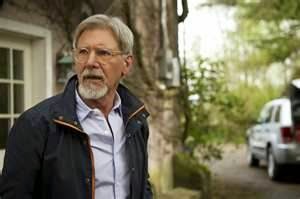
The film reaches a climax during a Jones family weekend get-together when Adaline meets Ellis' parents. His father William (Harrison Ford) and Adaline are dumbstruck when they meet. It turns out (one might have seen this coming earlier in the story) William is the man Adaline left waiting on the park bench. William, stupefied, tells Adaline she bears an uncanny resemblance to a woman he was once close to named Adaline Bowman. Adaline has the presence of mind to explain she is the daughter of the woman and mentions, to William's sorrow, that her mother passed away, years before. The ruse seems to work, though Adaline's presence stirs William to distraction, which causes his wife Kathy (Kathy Baker) great anxiety as she becomes suspicious of her husband's past.

But during the weekend, William catches sight of a scar on Adaline's hand, which he remembers from an accident in the past. The shocking realization prompts a confrontation with William then her flight from the Jones home, which leaves Ellis in despair. And during her escape from the Jones' home, she--wouldn't you know it--gets into an accident. And what do you think happens? Ellis arrives in hot pursuit, hoping to rescue and reclaim his love. During this scene, the annoying, omniscient narrator returns to describe in detail--once again--the miraculous chain of events that follow. I'll leave the rest to you to suss out.

If this all sounds like fascinating material for a great movie, trust me, there is less here than meets your heavy eye-lids.

Among the film's legion of shortcomings is Adaline herself. For a 107 year-old woman in a twenty-something's body, her life is stubbornly ordinary and it leaves one wondering why eternal youth would be wasted on someone so vapid. Yes, we see she can kick butt at Trivial Pursuit during the Jones family weekend and has exceptional powers of perception but so what? What else is there? Other than being unable to have normal relationships, what does her condition mean to her? To her daughter? Might there be advantages in being a hundred year-old twenty-something? Sure, it would be a hassle to have to change one's identity every so often but would it be such a drag to be perpetually in one's sexual prime? The film doesn't have the imagination to explore any idea the premise might engender. Harold Ramis' Groundhog Day shows us what it might be like to live one day over and over again in a very inventive and clever way. I wish The Age of Adeline had one second of that film's wit and whimsy.

I found little things vexing too. The fact that William gave up medicine to become an astronomer is a big deal in the story, as is his discovery of a comet. So why does Ellis have a book on astrology in his bedroom? Wouldn't the son of an astronomer know the difference between his father's field of study and a pseudo-science? What's that about? I realize it's a trifle, but it seemed glaring to me.

Blake Lively's performance is one of the film's major handicaps. She doesn't explore her character or go deeper than looking pretty. Maybe the script called for an incurious bombshell who kicks butt in board games? I also found her voice to be quite odd. She sounded somewhat stiff, as we sometimes hear when British actors or actresses affect an American accent. This might be a first in American cinema; an American actress putting on an American accent.

I felt sorriest for Ellen Burstyn. An actress with her talent and exceptional career playing second banana to an underwhelming, blonde yo-yo like Lively must feel like a career low, I'm sure.

So what do we learn from Adaline and her situation? Not much. Nor did I come away moved from the flick in any way. Makes sense, nothing seems to move her much either, other than a garage that was formerly a movie theater back in her day. The canopy of stars that once graced the ceiling is shown to still be intact, which she proudly shows Ellis on a date. Oh, I almost forgot, she also loves her dog. Geez, I don't think I can handle all her layers.

Wait a second; there is one lesson to be learned from Adaline's experiences: take your date to a garage that was once a movie theater rather than to a movie theater playing The Age of Adaline.

Saturday, April 25, 2015

Ex Machina


**Spoiler Alert**

Director: Alex Garland/Starring: Oscar Isaac, Domhnall Gleeson, Alicia Vikander and Sonoya Mizuno

Alex Garland, known primarily for his novels and screen adaptations, can now add the title of director to his impressive resume. His new film Ex Machina is ferociously intelligent, spellbinding and addresses the subject of artificial intelligence in a new, thoughtfully imaginative way. But is Garland's story also some kind of feminist commentary on male dominance and the maligned "male gaze?" Given the story and symbolism, the question is worth exploring.

The film's emotional default setting is something between dread and paranoia, which is understandable; Garland shows us what may be mankind's imminent future and what we see is quite disquieting.

He doesn't waste a nano-second immersing us in the story. We see Caleb Smith (an excellent Domhnall Gleeson); a coder for a prestigious computer company, who wins an inter-employee contest. The prize; a chance to visit and work with the company founder and genius Norman Bateman (Oscar Isaac, also excellent) in his remote, free-from-civilization compound in an undisclosed location.

Accessible only by helicopter, Caleb is dropped off in a meadow and asked to follow a stream where he finds Bateman's seemingly modest, rustic hideaway, which is nestled in a woodsy area between green rolling hills and crags in what appears to be Greenland. It is clear he intends to keep his whereabouts hidden from the world's prying eyes.

Caleb enters the building after no-one greets him at the door. He wanders inside the ultra-modern, glass and concrete interior to find Norman, working out. Norman greets Caleb and tries to set him at ease, knowing full well his Bill Gates-like fame might be off-putting to the young man.

It isn't long before Norman shows off his high-tech domicile, in which he seems to be the lone occupant. He explains to Caleb isn't a home at all but a research facility, where his top-secret work in artificial intelligence is conducted. Before Norman can divulge his research, he presents Caleb with a confidentiality agreement. Caleb refuses at first to sign, citing his need to have a lawyer present but Norman reminds him that leaving would mean missing out on something revolutionary. Excited and intrigued, Caleb relents.

As a prelude to revealing his work, Norman asks Caleb if he is aware of the Turing Test. After answering in the affirmative, he is asked to explain it. As exposition and for the audience's benefit, Caleb identifies the test devised by famed computer pioneer Alan Turing in which an interviewer poses a series of questions to two, unseen interviewees, one of which is a computer. Based on the responses, the interviewer then determines which subject is the computer. If the interviewer fails to distinguish the computer from the human, the computer can be said to have passed the test (I hope I got this reasonably right).

Norman then shows Caleb his creation; an android-like entity with advanced artificial intelligence that wears a human face, a transparent skull, torso and appendages named Ava. Dazzled by Norman's work, Caleb gazes at Ava in awe while she stares back.

The film is divided into sessions; subtitled onscreen as Ava 1, Ava 2, etc., and serve as chapters in the narrative. Caleb beings to apply the Turing test in his conversations with Ava. Because Norman created Ava with a pretty face and a shapely, synthetic female figure, a sexual dimension is introduced into the proceedings. Whether it is part of a deliberate attempt to distract Caleb while the test is conducted is a concern he voices early.

Caleb discovers Ava has charm and a sense of humor. Before long, a mutual attraction forms though Caleb is suspicious of its sincerity; believing Ava's attraction to him could have been part of Norman's programming.

As the testing continues, a sense of mistrust begins to seep into Norman and Caleb's working relationship. Caleb also becomes aware of a more disturbing side of Norman's life in his lab. When Norman isn't monitoring all interaction between Caleb and Ava with a Big Brother intensity, he is found mostly working out and getting drunk. Caleb also notices a beautiful woman he hadn't seen before named Kyoko (Sonoya Mizuno) who serves as Norman's assistant. Norman warns Caleb that any attempt at conversation with Kyoko is futile. He explains her inability to speak English as a theft preventative; an indispensable quality for his top-secret research. But Caleb notices Norman's cruel treatment of Kyoko and her odd stoicism in the face of verbal abuse.

The audience is always well aware that something is not quite right in Norman's well-surveilled environment. And as Caleb becomes more attracted to Ava, he becomes sympathetic to her passion to see the outside world and escape from the cold concrete and glass environs. During the center's frequent power outages, which Ava says she controls, Caleb hatches a plan for their escape. The plan involves getting Norman drunk and incapacitated then stealing his pass card, which allows him access to all restricted areas. Caleb then plans to reprogram the security system, which would allow all doors in the laboratory to open, thus freeing Ava (and himself).

In gaining entry to Norman's inner sanctum and computer, Caleb makes another disturbing discovery, one that causes him to question his own identity, which leads to a frightening moment of self-doubt and examination. The scene is one of the best in the film.

How the drama between Norman, Caleb and Ava plays out is a surprise and how one sees the outcome, whether as tragic or exhilaratingly liberating, depends solely on where one's sympathies lie.

Garland's script is smart, as are his characters, who are in a constant mental state of parrying and thrust.

Oscar Isaac has proven to be the new, prodigious talent in American acting and his performance as a paranoiac who is too brilliant and not brilliant enough for his own good is yet another marvelous tour de force. When Norman tells Caleb that artificial life may look back on humanity a few million years hence, the way we look upon our distant, arboreal ancestors, Isaac delivers his lines with such chilling futility. The statement is powerful and ominous. Gleeson is outstanding as a would-be dupe who proves to have sharp mental resources of his own. Vikander is mostly denied the use of her body in her performance; her lovely face becomes the focus of her expression, which carries both innocence and cunning.

Garland, though making his directorial debut, shows remarkable skill with a camera and demonstrates an instinctual feel for creating mood and tension. The film's foreboding score also helps keep us on edge and alert to sinister developments.

Artificial intelligence is the subject of the film but it appears Garland is also using it to tell an allegorical story about female debasement. Along with Ava, Caleb finds other prototypes, who are all female in appearance and all sexualized in one manner or another. It is telling that none of the artificial life forms are male.

I think Garland's film is one of first great films of the year. It is intelligent, riveting, thought-provoking and has an appropriate and touching ending. The film has much on its mind, which is good thing as we head into a season where intellect and wit will be in short supply.

Wednesday, April 22, 2015

Felix and Meira


**Spoiler Alert**

Director: Maxime Giroux/Starring: Martin Debreuil, Hadas Yuron and Luzer Twersky

Watching Maxime Giroux's Felix and Meira made me think of Boaz Yakin's 1998 drama A Price Above Rubies, which also dealt with a wife unhappy in the confined, oppressive world of an orthodox Jewish home. Giroux's film is hardly original, but it manages to be no less moving. One of its strengths is its minimalistic approach to storytelling.

Set in modern-day Montreal, where Yiddish, French and English intermingle in everyday discourse, the story focuses on Meira (Hadas Yuron), the wife of a Hasid; Shulem (Luzer Twersky), who finds her husband's dogmatism a drain on her pursuit of happiness and a more fulfilling life. Even a simple pleasure, like listening to her favorite album, is frowned upon.

During one of her excursions, a man notices her drawing and compliments her. Admiring her skill, he asks her about the drawing, only to be curtly ignored.

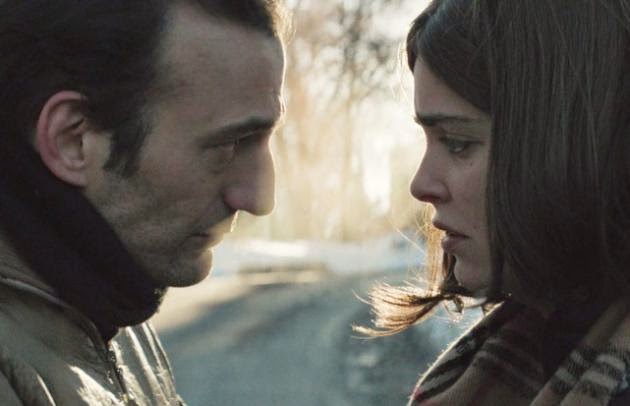
After Meira encounters him again on the streets, she becomes more receptive to his conversation and attention. In spite of the strict Hasid proscription against women talking to men not their husband, Meira finds the friendship and burgeoning romance liberating. She and the man named Felix (Martin Debreuil) begin spending time together. But soon Shulem discovers her indiscretion and orders her to leave for Brooklyn, where her friend--a fellow Hasidic wife--is to put her up for awhile. The temporary exile fulfills a dual purpose: to remove Meira from temptation and time for her to mull over marital duties and commitments. Unfortunately for Shulem, Felix catches wind of the plan and decides to fly to New York to see her.

But the story is also about Felix and his single, unfulfilled life and his failed, familial relationships. Estranged from his father, Felix visits him on his deathbed, hoping for redemption or satisfactory closure, but his father's inability to recognize his son (both literally and figuratively, for sure) leaves both parties dissatisfied.

We see the obvious character parallel; Felix's unhappy relationship with his father and Meira's marital discontent.

The film's pace is very deliberate and Giroux often allows long pauses fraught with dramatic import rather than dialogue to tell the story. Lovely, memorable images abound. One such image is seen in a Times Square Hotel, after Felix and Meira meet in New York. During a moment in Felix's room, we expect passionate release but instead, we see them sit against the window in the dark; the glare of Times Square providing a glow by which their bodies are softly illuminated. It's a beautiful visual uncluttered by a talky exchange. The scene typifies Giroux's visual design.

As Felix and Meira explore Manhattan and Brooklyn's sights and sounds, she awakens to new experiences, like dancing and walking hand in hand with a man not her husband. In another scene that is startling for its touching simplicity, we see Meira try on what may be her first pair of snug jeans, which she models for Felix. His reaction is rapturous, as is ours.

In time, Shulem flies to New York himself and discovers the tryst, which results in a violent street confrontation.

Though Shulem returns to Montreal with Meira, she cannot shake the experience and Felix refuses to give her up. Nothing is simple and neat in how the story plays out. The ending leaves us with many doubts and questions, which reflects Giroux's refreshing determination to leave things messy.

I thought the film showed an even-handedness toward the Hasidic culture. It didn't condemn their mores; it managed to show the joy it imparts to its adherents.

How one assesses Giroux's film will depend mostly on how one handles the deliberate pace and its refusal to resort to conventional storytelling. Giroux does a fine job with the actors; the performances were defined by facial expressions and silent reactions, often without the safety net of dialogue.

I don't know that I can call Felix and Meira great but it is poignant and I found the characters beautifully and humanly drawn. If one craves a story both psychologically and culturally rich, this is the film to see.

Monday, April 20, 2015

True Story


**Spoiler Alert**

Director: Rupert Goold/Starring: James Franco, Jonah Hill, Felicity Jones and Gretchen Mol

The inevitable comparisons to the film Capote and Truman Capote's book In Cold Blood will no doubt plague director Rupert Goold's True Story, which, like Capote's masterpiece, is based on fact. But unlike the aforementioned book, Goold's film is less compelling and can't forge an identity that would have us forget Capote's book or the film starring Phillip Seymour Hoffman.

The cast certainly shows up and is quite good. Jonah Hill, James Franco and Felicity Jones aren't merely along for the ride; they carry the film on their shoulders.

Based on former New York Times columnist Michael Finkel's memoir of the same name, True Story is the story of how the journalist became involved with the convicted murderer Christian Longo and how their literary relationship derailed in the process.

As we see in the film, Finkel (Jonah Hill) finds himself without a job and essentially a blacklisted journalist after an article he wrote for the New York Times was deemed fraudulent. Finkel was accused of attributing several interviews from multiple sources to a single interviewee. In spite of Finkel's reasonable defense of his act, he finds his editors and the journalistic community cannot overlook his ethical breach; his good intentions notwithstanding.

Finkel returns to his wife and home in Montana after being fired from his position. As he desperately tries to submit ideas for articles to the print media in an attempt to recover and maybe rehabilitate his soiled reputation, he finds no takers.

While Finkel contends with his diminished career status, he learns that a man named Christian Longo (James Franco), who is accused of murdering his own wife and kids, has been impersonating him. Intrigued by what a killer might be doing claiming to be a famous/infamous journalist, Finkel travels to the prison facility in Oregon to meet his impersonator.

As Finkel sits before the accused, he listens as Longo's explanation carries a whiff of adulation and flattery for the journalist, which isn't lost on Finkel. Finkel sees Longo's position as not much different than his own and becomes sympathetic. Longo insists he is innocent of his alleged crimes while Finkel believes he too has been judged harshly; by his journalist peers and the news media.

Finkel hits on the idea of writing a book about Longo's case, which he believes could help free the accused and restore his own reputation as a journalist. As Finkel secures a hefty advance for the book, Longo grants him exclusive access to his tragic story.

And as Finkel becomes wrapped up in the book, he sees his wife Jill (Felicity Jones) less and less. Though she knows her husband's book is meant to help exonerate Longo, she begins to see the accused for what he is: a master manipulator who won't accept his own guilt. Finkel, dazzled by the promise of literary success and career rehabilitation, driven by his belief in his subject's innocence and an empathetic regard for Longo's beleaguered state, refuses to believe what may most likely be the truth.

Much of the drama is propelled by the scenes of Finkel and Longo's conversations. Longo's insistence that he is innocent assumes plausibility in Franco's persuasive performance. Audiences may forget how terrific Franco can be in dramatic roles as he certainly is here. Hill has established himself as something more than a comedic actor. His deft performance demonstrates how a seasoned journalist like Finkel might be prey to a master manipulator. The two actors are quite good, as is Jones, though her character is unfortunately more peripheral.

As Longo begins to infiltrate Finkel's life in subtle, sinister ways, Jill finds her husband is becoming more more distant. She also finds herself being manipulated when she happens to speak to Longo on the phone one day when her husband is out. Later, in a face-to-face conversation in the prison facility, she lets Longo know in subtle terms that he is guilty as accused and she is not his psychological pawn.

Finkel's book deal begins to waver when Longo makes both a plea of innocence and guilt in an open court. Finkel is naturally infuriated as he wonders why Longo would jeopardize his own case and the book in pleading guilty to half of the murders.

The closer the film comes to the actual trial, the more suspect becomes Longo's claim of innocence. The film climaxes with Longo's trial, where his true nature becomes conspicuous and his spell on Finkel is dispelled.

As previously stated, the film, though based on true events, doesn't succeed in making the case riveting. Strong performances are a plus but I couldn't help but think that story/film suffered in comparison to Capote and as mentioned, Capote's book. We've seen it all before; the cunning con making a fool of the journalist. A true story shouldn't play as a cliche onscreen.

Even the idea of truth's relativism is hardly new.

The film should have been a fascinatingly dark, psychological melee but its ambitions remain stubbornly tethered to what is on the page.

This is Goold's first feature film. He shows some promise as a storyteller and may surprise us in the future with something more powerful. True Story isn't a bad film, just one that fails to launch.

Saturday, April 18, 2015

Al's Omniflick at 200: 10 Fiendish Femmes


I'm proud to say that I've arrived at yet another milestone in my blogging: my 200th posting. It's been an extraordinary journey and one I hope you have enjoyed. It seems like only yesterday that I posted my 100th. Tempus fugit, as the cliche goes.

I didn't quite know how to celebrate my two-double-aught but someone might recall my promise to post a list of some of my favorite female screen villains sometime back. This posting serves as a bookend to a previous posting, which addressed some of my favorite villains from the movies. Unfortunately only one woman made said list; villainy is mostly a male-only club. But I've managed to cobble together a list of some of my favorite lady-Lucifers. It wasn't easy but I had criteria I felt I wanted to adhere to; one of them was to avoid obvious choices; The Wicked Witch of the West, Cruella De Vil, Maleficent, the alien from Alien, etc. Another was to broaden the parameters of how we might define villain, as you'll soon see. And it will be abundantly clear that I included only one female baddie from a foreign film. If it's difficult finding a selection in American films, it's nearly impossible in films overseas.

Of course, it is always necessary for me to say the group is but a scant representation of a larger pool. As always, they are arranged in no particular order. If I've overlooked some of your favorites, please feel free to list them in the comment section.

Thank you for visiting my blog during these past 200 postings. I hope you return for the next...200?

1.) Janine "Smurf" Cody (Jacki Weaver)--from the film Animal Kingdom
Janine "Smurf" Cody, the matriarch of a family of mostly scary criminals, is also one of its most dangerous and most intimidating. When she sounds sweet and benignly maternal, she is at her most chilling. Of the fiendish society listed herein, she may the most frightening. Jacki Weaver earned a well-deserved Academy Award nomination for her role.

2.) Evelyn Mulwray (Faye Dunaway)--from the film Chinatown
Evelyn Mulwray is more a victim than a heavy. As daughter of the thoroughly evil Noah Cross (John Huston), she comes with more than just a little baggage and skeletons. But in Polanski's film, no one is innocent and no one is free from complicity in wrongdoing. Evelyn withholds information and always knows more than she lets on. She is more a tragic figure than anything else but in Chinatown, she seems be coated in a layer of filth her pretty face and lovely outfits can't mask. Does she really deserve to be on this list? Maybe not but what the hell Jake, it's Chinatown.

3.) Tracy Flick (Reese Witherspoon)--from the film Election
If there was ever a succubus inhabiting the body of an ambitious, high school overachiever it is Tracy Flick. More than willing to play dirty to win a high school election, she also isn't averse to going public with sensitive information about her teachers or threatening legal action. She will get ahead by any means necessary. She is the diabolical antithesis of Max Fischer of Rushmore, who has ambitions but also a soul of platinum. Beneath Tracy's perky disposition lies the heart of a cutthroat. What she eventually becomes is more than just a little disquieting. As funny as Election can be, it's female antagonist is its dark edge.

4.) Bridget Gregory (Linda Fiorentino)--from the film The Last Seduction
Bridget Gregory is my kind of villainess. Bridget's weapons are her deviousness and her hot-as-a-soldering iron sexuality, which she uses to devastating effect. Making abject fools of most every man she seduces, Bridget gets what she wants and isn't bothered by something as silly as scruples.

5.) Mrs. Robinson (Anne Bancroft)--from the film The Graduate
Mrs. Robinson might make any cinephile's villain list but I couldn't resist including her on my own. If she isn't at the summit of feminine malevolence, I don't know who is. It isn't a coincidence that we see her often in animal prints; mostly jungle cats because she is all predator and as slick as any feline. Bancroft's performance is quite brilliant. I'll always remember the scene where she uses violent coercion to exact a promise from Benjamin (Dustin Hoffman) that he won't ask her daughter out. She pulls his hair then, securing his promise, she releases him; only to look over her nails to ensure they're intact. The act is effectively subtle and speaks volumes about her stone-cold demeanor.

6.) Mrs. Eleanor Shaw Iselin (Angela Lansbury)--from the film The Manchurian Candidate
Mrs. Iselin made my former villain list too. She might be what Tracy Flick will become in middle-age. Ambitious and power-mad, she is willing to sell her soul to America's cold war enemies to reign as an evil queen in Washington. Cunning, ruthless and cruel, she is a hawk, eagle and vulture all rolled into one. A most excellent villainess.

7.) Suzanne Brown (Lara Flynn Boyle)--from the film Red Rock West
Suzanne Brown and Bridget Gregory would make a terrific coffee klatsch. Suzanne too knows how to use her feminine wiles like a stiletto and she almost makes a chump out of Michael Williams (Nicolas Cage). Her refrain about running to Mexico becomes a sort of gag. You wouldn't want to turn your back on Suzanne Brown or fall prey to her charms; she's a beauty with horns and a tail.

8.) Summer Wheatly (Haylie Duff)--from the film Napoleon Dynamite
Everyone knew someone like Summer Wheatly in high school and if you're a guy, girls like her made the experience very unpleasant, if not a living hell. Poor Napoleon (John Heder) can't even get her to join him in a game of tether-ball. Her derisive rebuffs are this teen witch's stock in trade. Though she doesn't pursue the school presidency with Tracy Flick's heartless aggression, she still expresses nothing but dismissive scorn for her mild-mannered competitor; Pedro (Efren Ramirez). Her campaign speech is both funny and mildly obnoxious as she takes a swipe at Pedro when she says, "Who wants to eat chimmychangas all the time--not me." Summer might not occupy the lowest circle of Satan's kingdom but Hell's vestibule isn't out of the question.

9.) Marietta Fortune (Diane Ladd)--from the film Wild at Heart
One would be hard-pressed to find good in David Lynch's demoness. She comes on to her daughter's boyfriend then hires assassins to have him killed. She is creepy, slimy and given to painting her face red, which gives her a more malign appearance. It's amusing to listen to Marietta wrap her southern belle gentility around what is essentially a venomous spirit.

10.) Katharine Parker (Sigourney Weaver)--from the film Working Girl
Nothing worse than a boss who plays nice to your face then steals your ideas behind your back then uses them to get ahead. Even worse when said boss denigrates you in subtle ways, such as the scene in the film when Katharine has Tess (Melanie Griffith) make the rounds at a party with a hot, steaming cart of Chinese dumplings, which leave her face a sweaty mess. Katharine Parker is the avatar of Reagan-era opportunism and she embodies it well. She could make you believe a glass of arsenic is really cherry syrup before you're undone by your error.

Many more evil chicks could have made this list and much more could be said about the people on it. I hope you enjoyed this brief romp around my selection. I also hope it made a worthy subject for my 200th posting.

Looking forward to having you back soon.

Animal Kingdom, Chinatown, Election, The Last Seduction, The Graduate, The Manchurian Candidate, Red Rock West, Napoleon Dynamite, Wild at Heart and Working Girl.