Showing posts with label Carmen Ejogo. Show all posts

Tuesday, March 22, 2016

Born to be Blue


**Spoiler Alert**

Director: Robert Budreau/Starring: Ethan Hawke and Carmen Ejogo

Jazz great Chet Baker is the subject of director Robert Budreau's new film Born to be Blue. The story is part of a new breed of film bios that eschew the traditional cradle-to-grave arc we've come to expect in biopic narratives. The new trend in biographical storytelling on film--and a welcome one at that--is to depict the subject at a pivotal juncture or character-defining time in his/her life; emphasizing essence rather than forming a portrait from a series of experiences. But in spite of Budreau's best directorial efforts, the film somehow seems incomplete; as if mood and character (the movie has a surplus of both) have superseded emotional concerns.

Ethan Hawke plays Chet Baker, who we see just before he takes the stage at a Los Angeles nightclub, 1966. Though his reputation in the jazz world has already been established, Baker is nonetheless anxious about the gig; partly because his rival and nemesis, jazz legend Miles Davis, is on hand to gauge the talent. Though the performance proceeds smoothly, the post-gig conversation between the trumpeters is less than amicable. Davis is dismissive of Baker's playing; suggesting he "come back when he has lived a little." More than a little miffed, Baker is reminded a shortly thereafter that Davis' negative response is most likely borne of professional jealousy.

Days later, following a gig at another nightclub, Baker meets a beautiful, African-American actress named Jane (the gorgeous Carmen Ejogo) and though Baker makes a move on her, she initially resists his attentions until she eventualy succumbs to his magnetism. But Baker finds that his darker past is waiting for him outside a bowling alley; a group of black toughs beat him mercilessly as retribution for delinquent payments on heroin; an addiction Jane quickly becomes aware of.

As he recuperates in the hospital, he finds that his upper, front teeth have been knocked out; a critical, physical deficiency that threatens his ability to play trumpet. Facing a possible career-ending injury, Baker decides to leave California with Jane to visit his parents in Oklahoma; a move that leaves him at the mercy of his parole officer, who is unaware of his departure.

Baker finds a cool reception waiting for him upon arrival, particularly from his father, who looks mildly askance at Jane's color. He also wastes little time expressing mild contempt for his son's musical career, which he sees as an avocation, rather than a means to gainful employment. As his parents begin to accept their presence, Baker begins to practice his trumpet extracurricularly. But as he (and we) might expect, his dentures prove to be an impediment to his playing. Ever determined, he continues to practice, hoping to return to Los Angeles with his ability restored.

After Baker and Jane return to L.A., she finds acting roles are scarce and her color an obstacle in the white-controlled movie industry. Meanwhile, Baker's confidence in his playing leads to extensive gigging in the studio, which also serves as a ploy to demonstrate to his parole officer that his music has earning potential and to music industry movers and shakers that he is ready to record and gig. Like Baker's father, the parole office isn't entirely convinced the trumpeter is capable of earning a living with his music. As Baker convinces onlookers of his abilities, his ambitions to record and play a gig at the formidable Birdland become his immediate goals. Providing Baker a confidence boost is Dizzie Gillespie, who visits the studio to find the trumpeter has found his original form.

But in pursuing his come-back, we see that Baker's personal and professional neediness have marginalized Jane and her own career goals. She also remains unconvinced that he has kicked his heroin habit. Put off by his narcissism and his noncommittal attitude toward their relationship, she leaves him, in spite of his needy protestations and his demands that she be present for his Birdland gig. The performance at Birdland serves as a kind of Waterloo in Baker's career; a make or break deal. The looming gig also serves as dramatic tension and a tense build-up to the film's climactic scene. Though Jane is fully aware of the significance of the Birdland performance, she leaves him anyway.

Having so much at stake and so much to prove, Baker proceeds to his Birdland gig, where he finds Miles Davis and significant members of the jazz community are present to hear his performance. The gig provides definitive answers about Baker's music but it also settles questions about his commitment to Jane, who happens to attend the show.

As the movie is mostly fictional; facts are interspersed among a slew of fabrications and character composites. In Budreau's film, essence precedes reality. He gives us an imagined Chet Baker, rather than something entirely literal. I like this method but does the film capture Baker's essence or is the story merely feeble approximations of his character and life? Though we hear Baker's music in the film, how much do we actually learn about it? I would have liked to have learned more about his formative, musical education; the origins of his love for his instrument and jazz.

I'm glad the film doesn't romanticize his heroin addiction. We learn he never overcame his drug-dependency and in fact counted on the drug to allow him to "get inside the notes."

The film never attains any dramatic power; we sympathize with Baker but Budreau never really shows us why the jazz great should matter to us. He only shows us a character movie-goers have come to know so well: the talented, junky-musician who fails at relationships and struggles with a self-destructive streak. The forthcoming Miles Davis biopic might be more of the same though I hope not. Baker was great, but why does he still matter, if he still matters at all? Such is the question I put to Budreau and his screenwriters, which they mostly fail to answer.

But in spite of the film's flaws, I found the performances to be a major selling point. Ethan Hawke is quite terrific as Baker; capturing the man's egoism and his duplicity but also his self-determination; his refusal to allow his physical shortcomings to end his career. I felt Carmen Ejogo nearly stole the film. Ejogo allows us to see Jane's inner strength and her heroic self-emancipation from Baker's self-destructive ways. Ejogo's acting is given firm support by her powerful presence.

After seeing Bruce Weber's excellent 1988 documentary, Let's Get Lost, I always felt a narrative film on Baker's life might be superfluous, which is how I feel about Budreau's biopic. Do I need to know about his life and career? Does this new film illuminate or clarify or dispel myths about the man? What will a lay audience come away with?

I think Born to Be Blue is a fine performance film, but hardly more than that. It may inspire movie-goers to seek out Baker's music or learn more facts about his life but I doubt the film will leave anyone in awe, which is too bad, because he deserves attention and more than just a so-so biopic.

Saturday, January 10, 2015

Selma


**Spoiler Alert**

Director: Ava DuVernay/Starring: David Oyelowo, Carmen Ejogo, Tom Wilkinson, Giovanni Ribisi, Wendell Pierce, Dylan Baker, Tim Roth, Cuba Gooding Jr., Oprah Winfrey and Martin Sheen

It seems no matter how many times we see the historic Selma to Montgomery march depicted in movies or documentaries, it never fails to stir and inspire wonder. That so many were willing to risk their lives to right a wrong and so many were willing to kill to preserve the unjust status quo leaves one with a sense of awe. We've seen many demonstrations and marches since then in this country, but so few have had as much at stake as the Selma to Montgomery march Martin Luther King Jr. led in 1965.

What distinguishes this film from others on this subject? For one, none of them had the ferociously talented actor David Oyelowo in the role of King himself and none had a female African-American in the director's seat. But DuVernay's film is distinctive in other ways, for it dramatizes Dr. King's opposition quite poignantly and shows us a powerful leader who wasn't infallible.

DuVernay shows us widespread, systemic racism; political bodies that permitted the flagrant disenfranchisement of blacks, particularly in the south.

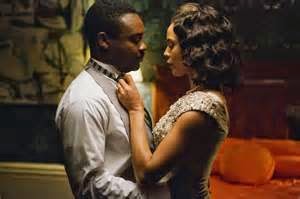
Contrasting scenes open the film; in one, we see Dr. King preparing to receive his Nobel Peace Prize award; fussing with his fancy tie while his wife Coretta (the lovely and talented Carmen Ejogo) listens to her husband talk about how his fancy suit might be regarded with suspicion back home. In the other scene, we see young black girls in their Sunday best, descending church stairs. As they chatter innocently about hair styles, a shocking bomb blast not only obliterates the church but takes the lives of the little girls. We see their dead bodies amid the rubble and ruin that was once their house of worship.

The beginning is very effective; we see the world honor an American black Reverend while in another part of the world, an oppressive, white culture metes out violent aggression against black children. The act of brutality is a powerful reminder of the virulent anti-black sentiment that gripped the south in the 20th century and how determined local and state governments were to deny blacks even basic rights, such as the right to vote.

It was voting issue that was foremost on Dr. King's mind as he and his fellow activists hatched a plan to protest the denial of black voting rights in the south. In a scene where Dr. King and President Lyndon Johnson (an excellent Tom Wilkinson) discuss the issue, Dr. King is reminded that the right to vote is law though he is quick to remind Johnson in turn how that right is flouted by southern white-dominated governments.

As the idea of marching from Selma, Alabama to the capitol in Montgomery develops, we see what King and his followers faced as Johnson dithered, FBI Director and Dr. King opponent J. Edgar Hoover (Dylan Baker) tapped civil rights activists phones and monitored their activities (with Johnson's consent), and Alabama Governor George Wallace (Tim Roth) brainstormed with his aides on how to thwart both voting rights and black activism in his state.

We also see some dissension among black leaders about how best to demonstrate; knowing every protest invites violence and murder.

I found DuVernay's King to be refreshingly human and anti-hagiographic. Though we see Dr. King's impressive attributes; eloquence, diplomacy, restraint in the face of violence, fierce determination, and compassion; we also learn something about his infidelities. In a scene where Dr. King and Coretta listen to an FBI-crafted tape recording intended to intimidate and humiliate the Reverend, we hear what is supposed to be one of his numerous affairs in progress. Though King denies the affair, Coretta knows better; she realizes she can only salve her wounded pride by eliciting a vow that he isn't emotionally involved with the other women.

The scenes between Dr. King and Johnson are also illuminating. Though Johnson did support civil rights legislation, he also resisted the Reverend's frequent pleas more vigorous action. I really liked Wilkinson and Oyelowo in the White House scenes; both actors are compelling as the exchanges between Johnson and Dr. King become increasingly heated and tense.

The early marches without Dr. King prove to be violent. The first march is halted at the Edmund Pettus Bridge; demonstrators are chased, beaten and shot and in a subsequent, ill-advised march where the press was absent, protestors were again beaten and at least one murdered. Dr. King organizes a another march from Selma to Montgomery but halts the procession on the Edmund Pettus Bridge. In a subsequent scene, he explains the halt as a safety measure, citing the authority's ability to cut off the group from support if the bridge is crossed.

Meanwhile, the televised news broadcasts of the first march causes widespread outrage, galvanizing more people, black and white, to join Dr. King's third march, to which both Wallace and Johnson are vehemently opposed.

The climax of the film is the last march and it is interesting to see how many whites and clergyman joined the procession. Some whites, including a Boston priest, lost their lives in the marches. One woman was murdered by Klansmen when driving a car full of protestors afterward.

Throughout the film, we see subtitles unfold across the screen, which give us documented details of Dr. King and his group's activities, culled from FBI surveillance. The information establishes historical fact but also alerts us to the ubiquitous, Big Brother-like monitoring Dr. King and his associates were subject to.

I found much of the film moving. DuVernay wields a camera skillfully; she doesn't get in the way of the story or get cute with elaborate camera angles that might call attention to themselves and which might distract us from the story.
The dialogue was fine but sometimes it seemed a little too self-aware, as if the characters were declaiming on a stage rather than conversing in the real world.

I think Selma is one of the better films I've seen on the 1960s' Civil Rights struggles. Without sacrificing dramatic credibility, it reaches for historical accuracy and shows us a President who hardly wore a halo and a towering historical figure who was hardly blemish-less.

The rash of police brutality in the U.S. in the past year, where the victims were all black, lend DuVernay's film sociopolitical relevance. So much was accomplished in the march on Montgomery, but recent news events tell us we haven't entirely shed the racist skin that was more firmly entrenched back in 1965.

I don't know if Selma is a great film. You might ask me about it in six months. But for now, I think it has power and superb acting and it gives one of the most explosive events in American history the respect it deserves without rendering it an abstract, stately, marble mausoleum of holy icons and one dimensional antagonists.

No matter what one might think of the film, David Oyelowo's brilliance seems axiomatic. I hope Hollywood has the good sense to give this guy more, challenging material.

Monday, July 21, 2014

The Purge: Anarchy


**Spoiler Alert**

Director: James DeMonaco/Starring: Frank Grillo, Carmen Ejogo, Zach Gilford, Keile Sanchez and Zoe Soul

On the heels of the silly The Purge comes The Purge: Anarchy which matches the first's silliness quotient but manages to be entertaining if one simply ingests the preposterous plot like marshmallow fluff. If you've come seeking biting commentary on the socio-political climate in America, you might be in for an interminable 103 minutes. I wondered near the end of the movie why the story had to be so heavy-handed and obvious about its political grudges but then I caught a glimpse of the producer's credit, which read: Michael Bay. I ceased to wonder shortly thereafter. If that name doesn't immediately subtract 50 IQ points when conjured, it might be because your brain is encased in protective lead.

The story takes place in 2023 America, some years after the first film. The Purge; the government's bizarre solution to cleansing America of its aggression and violence, is a ritual whereby all violent crime--including murder--is legal for eight hours, one night of the year.

As the film begins, we learn the Purge is but two hours away, which prompts everyone not participating to hurry home behind (hopefully) locked, reinforced doors and barred or sealed windows. Frank Grillo, an emerging action-movie star with tough-guy charisma, plays a mysterious man who keeps an arsenal in his apartment. Is he a former cop? Soldier? We don't know, but we can ascertain from his weapons and granite biceps he means business.

Also making haste to be home is Eva Sanchez (Carmen Ejogo), a diner waitress who wants to hit up the owner for a raise, which will help pay for her father's medication. She arrives home to be with her teenage daughter Cali (Zoe Soul-great name!) and said father (John Beasley) who are busy preparing for what is called the Commencement; the beginning of the Purge.

Figuring into this multi-character salad are Shane and Liz (Zack Gilford and Keile Sanchez), a young couple about to announce their break-up to his sister (why this would be something his sister would need to know before the Purge is anybody's guess) when their car stalls on a bridge. The couple had earlier encountered a scary group of masked, African-American men who silently menaced them in a store parking-lot. The couple realizes, while stranded on the bridge, their car was sabotaged earlier by the masked men; an effective means to keeping the couple on the street.

While those not Purging barricade themselves indoors, the mysterious man sets out into the dangerous streets in a Mad Max-like armoured muscle car. Why he would deliberately expose himself to danger is revealed later in the film.

We see that Eva's father has left the apartment, then strangely enters a limousine. Sometime later we see him sitting in a chair inside the home of a wealthy, white family. A letter he's left behind explains that he has sold himself as a Purge victim for a substantial sum that will help his daughter and granddaughter.

Only a short-time later, Eva and her daughter's modest sanctum is violated first by the doorman; who is angry about being allegedly dissed by the two woman, then by men in military uniforms, who drag the two out into the street. As Eva and her daughter are being jerked toward the government semi-trucks, the mysterious man comes to their rescue, dispatching the armed soldiers. Shane and Liz happen upon the group while running desperately through the streets, seeking sanctuary from the the masked men. The mysterious man then finds himself the reluctant caretaker of the mother and daughter and Shane and Liz. Promising the mysterious man a car to replace his own, which was left incapacitated by armor-piercing bullets fired by one of the soldiers, the group makes its way to Eva's friend's home where a suitable auto awaits. To reach their destination will mean overcoming what the Purge promises; violence and death.

I thought this was a fun development; somewhat reminiscent of Escape from New York and The Warriors, as the group navigates through a deadly, urban labyrinth to reach their objective. It also gives us an opportunity to care about them as characters, as broadly-drawn as they are.

Though the group is mostly indifferent to the Purge, Cali is vehemently opposed, seeing it as a way to eliminate the poor to secure the wealthy elite's way of life. Again, the film's clumsily conspicuous way of managing this commentary on the economic state in America almost becomes a theme. The film's message always rings loud and clear, particularly in a scene where a white-collar Purge victim is crucified above the door of a city bank. One of the characters mumbles something about how he got what he deserved, which makes the scene more humorous than trenchant.

Question: if all crime is legal for eight hours, why bother murdering people when one could busy oneself removing bars and other obstructions from the doors of commercial establishments (with a tow-chain and a Ford F-150 maybe?), thus allowing one access to store safes and merchandise? In something as criminally permissive as the Purge, one could legally steal anything. If theft is legal, then it stands to reason one could reasonably claim money and items were legitmately obtained. Maybe the filmmakers thought this idea denied the viewers their fix of violence and blood. Too bad; it seems like it would be a more constructive use of one's Purge time.

As the film moves along, we learn the masked Purgers who were pursuing Shane and Liz earlier are not participants but a group who round up non-Purgers on the street for sale to the wealthy in the city, who hunt them for sport. We're also finally made privy to the military's interest in the Purge; leader explains that people were becoming unwilling to kill one another, which necessitated the government's violent intervention.

The story continues to a violent climax, as expected, where we finally learn the mysterious man's motive for joining the Purge, which is one of the few plot developments that makes sense.

I particularly enjoyed Frank Grillo's performance and wished his character would have been fleshed out a bit more. The performances, especially Ejogo and Soul's, were convincing and managed to remain untarnished by the plot-absurdities the film sometimes stumbled over. I think Grillo may have a future as an action star, or at least the lead in the next installment. Will there be a next? Some post-narrative subtitles on the screen hint as much.

The Purge: Anarchy certainly isn't a winner, but it was fun when not being unintentionally dopey. It has something on its mind, but how that message is administered is something akin to a piano dropping on a sidewalk from a ten story building. If the film were distributed in the welter of the late-year, award-grubbing movie season, its monumentally modest ambitions would be shockingly glaring. But in my abysmally low expectations of the Summer movie season, it has many peers, so it isn't exactly the worst of the lot. At least Michael Bay knows its place.