Showing posts with label Giovanni Ribisi. Show all posts

Sunday, June 28, 2015

Ted 2


**Spoiler Alert**

Director: Seth MacFarlane/Starring: Mark Wahlberg, Seth McFarlane (Voice), Amanda Seyfried, Jessica Barth, Morgan Freeman, Giovanni Ribisi and John Carroll Lynch

If you found the foul-mouthed, pot-smoking teddy bear from Ted amusing, Ted 2 will most likely be your creme brulee. I thought there was no way I would ever see a sequel after the gag response I had during the first movie. I really don't mind a bear who swears and tokes; the idea seems like fun but there was something revolting about Ted that I can't quite put my finger on. It isn't the crude, moronic humor--hell, most American movie comedies have that in common. At least this iteration was more gleeful in its pursuit of the obscene. I don't know if the sequel is better or I was better prepared to expect less, but Ted 2 seems less painful and bit more palatable than its predecessor. It's still imbecilic, mind you, but it manages to coax a few chuckles.

All you need to know about the story is that John (Mark Wahlberg) and his teddy bear chum Ted (Seth MacFarlane-voice) are still paling around, watching T.V. together and pulling sophomoric stunts, like pelting joggers and bicyclists with apples from a building rooftop. Their banter is often crude, as you might expect but they manage to be funny every so often.

Ted and his human wife Tami-Lynn (Jessica Barth) have set up a home in their modest apartment while earning a meager living as grocery store clerks. When the film begins, we see their marriage has hit a rough patch. Unsure of how to remedy marital strife, Ted seeks the counsel of a co-worker, who suggests the couple have a baby. Excited by the prospect of being parents, Ted and Tami-Lynn search for a sperm donor (Ted is unable to share procreative duties, for obvious reasons).

Ted hatches a hair-brained scheme to steal a sample of New England Patriots' quarterback Tom Brady's semen for his wife's fertilization. Ted and John break into Tom Brady's mansion, where they find the snoozing quarterback, only to be caught and literally thrown out. The scene is fairly amusing, as Brady's recent scandal also takes a satirical jab. Ted then approaches Sam Jones (he of Flash Gordon fame) to solicit his seed, only to be told his years of drug use have rendered him unable to comply. Further travails ensue when Ted learns Tami-Lynn's womb is overly stressed from years of drug use, which makes artificial insemination moot. Adoption becomes the logical alternative.

But Ted and Tami Lynn's problems only accrue when they learn the state refuses to recognize him as a human being, thus denying him the opportunity to adopt. Ted's diminished citizen status also means cancelled credit cards and terminated employment.

Undeterred, John and Ted hope to sue the state for his civil rights by seeking legal representation from a novice lawyer named Samantha L. Jackson (Amanda Seyfried); whose name becomes a source of merriment. Her woeful lack of pop culture knowledge also makes her a target for John and Ted's ridicule.

A trial by jury follows, which ends badly for Ted, as he is denied person status. Still determined to prove otherwise, Ted, John and Samantha seek out the legendary lawyer Patrick Meighan (Morgan Freeman) for more high-profile representation. Meighan's impassioned speech, which compares Ted's situation to the infamous Dred Scott case, tests the boundaries of good taste. Somehow it manages to not seem like a transgression in a film that often skirts the periphery of offensive, ethnic humor.
The film also comes close to being misogynistic but it manages to narrowly avoid that pitfall too.

While a smoldering romance between John and Samantha begins to blossom, Ted's fate hangs in the balance (not really, is it ever in doubt?).

The gags and jokes in the first half of the film wane in the second as the earnestness of Ted's civil rights case assumes center stage. As aforementioned, the jokes are mostly puerile but to quibble about that would be ridiculous. No one comes to a Ted movie expecting Moliere-like wit.

The numerous cameos are fun. One of my favorites involves an appearance by Liam Neeson as he queries Ted about buying a box of Trix cereal while standing in the checkout aisle.

Mark Wahlberg is a real sport for his willingness to muck about in a film that celebrates dumbness in all its incarnations. Ditto for Amanda Seyfried and Morgan Freeman, who manage to emerge with their dignity intact. Maybe I'm being too stodgy. Ted 2 is too harmless and inconsequential to be pilloried further.

It really isn't necessary for me to say more; the trailer says it all. Mr. MacFarlane, can we bury the teddy bear once and for all, please?

Saturday, January 10, 2015

Selma


**Spoiler Alert**

Director: Ava DuVernay/Starring: David Oyelowo, Carmen Ejogo, Tom Wilkinson, Giovanni Ribisi, Wendell Pierce, Dylan Baker, Tim Roth, Cuba Gooding Jr., Oprah Winfrey and Martin Sheen

It seems no matter how many times we see the historic Selma to Montgomery march depicted in movies or documentaries, it never fails to stir and inspire wonder. That so many were willing to risk their lives to right a wrong and so many were willing to kill to preserve the unjust status quo leaves one with a sense of awe. We've seen many demonstrations and marches since then in this country, but so few have had as much at stake as the Selma to Montgomery march Martin Luther King Jr. led in 1965.

What distinguishes this film from others on this subject? For one, none of them had the ferociously talented actor David Oyelowo in the role of King himself and none had a female African-American in the director's seat. But DuVernay's film is distinctive in other ways, for it dramatizes Dr. King's opposition quite poignantly and shows us a powerful leader who wasn't infallible.

DuVernay shows us widespread, systemic racism; political bodies that permitted the flagrant disenfranchisement of blacks, particularly in the south.

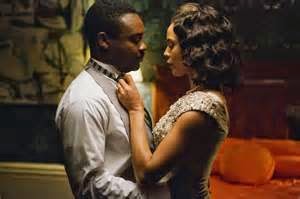
Contrasting scenes open the film; in one, we see Dr. King preparing to receive his Nobel Peace Prize award; fussing with his fancy tie while his wife Coretta (the lovely and talented Carmen Ejogo) listens to her husband talk about how his fancy suit might be regarded with suspicion back home. In the other scene, we see young black girls in their Sunday best, descending church stairs. As they chatter innocently about hair styles, a shocking bomb blast not only obliterates the church but takes the lives of the little girls. We see their dead bodies amid the rubble and ruin that was once their house of worship.

The beginning is very effective; we see the world honor an American black Reverend while in another part of the world, an oppressive, white culture metes out violent aggression against black children. The act of brutality is a powerful reminder of the virulent anti-black sentiment that gripped the south in the 20th century and how determined local and state governments were to deny blacks even basic rights, such as the right to vote.

It was voting issue that was foremost on Dr. King's mind as he and his fellow activists hatched a plan to protest the denial of black voting rights in the south. In a scene where Dr. King and President Lyndon Johnson (an excellent Tom Wilkinson) discuss the issue, Dr. King is reminded that the right to vote is law though he is quick to remind Johnson in turn how that right is flouted by southern white-dominated governments.

As the idea of marching from Selma, Alabama to the capitol in Montgomery develops, we see what King and his followers faced as Johnson dithered, FBI Director and Dr. King opponent J. Edgar Hoover (Dylan Baker) tapped civil rights activists phones and monitored their activities (with Johnson's consent), and Alabama Governor George Wallace (Tim Roth) brainstormed with his aides on how to thwart both voting rights and black activism in his state.

We also see some dissension among black leaders about how best to demonstrate; knowing every protest invites violence and murder.

I found DuVernay's King to be refreshingly human and anti-hagiographic. Though we see Dr. King's impressive attributes; eloquence, diplomacy, restraint in the face of violence, fierce determination, and compassion; we also learn something about his infidelities. In a scene where Dr. King and Coretta listen to an FBI-crafted tape recording intended to intimidate and humiliate the Reverend, we hear what is supposed to be one of his numerous affairs in progress. Though King denies the affair, Coretta knows better; she realizes she can only salve her wounded pride by eliciting a vow that he isn't emotionally involved with the other women.

The scenes between Dr. King and Johnson are also illuminating. Though Johnson did support civil rights legislation, he also resisted the Reverend's frequent pleas more vigorous action. I really liked Wilkinson and Oyelowo in the White House scenes; both actors are compelling as the exchanges between Johnson and Dr. King become increasingly heated and tense.

The early marches without Dr. King prove to be violent. The first march is halted at the Edmund Pettus Bridge; demonstrators are chased, beaten and shot and in a subsequent, ill-advised march where the press was absent, protestors were again beaten and at least one murdered. Dr. King organizes a another march from Selma to Montgomery but halts the procession on the Edmund Pettus Bridge. In a subsequent scene, he explains the halt as a safety measure, citing the authority's ability to cut off the group from support if the bridge is crossed.

Meanwhile, the televised news broadcasts of the first march causes widespread outrage, galvanizing more people, black and white, to join Dr. King's third march, to which both Wallace and Johnson are vehemently opposed.

The climax of the film is the last march and it is interesting to see how many whites and clergyman joined the procession. Some whites, including a Boston priest, lost their lives in the marches. One woman was murdered by Klansmen when driving a car full of protestors afterward.

Throughout the film, we see subtitles unfold across the screen, which give us documented details of Dr. King and his group's activities, culled from FBI surveillance. The information establishes historical fact but also alerts us to the ubiquitous, Big Brother-like monitoring Dr. King and his associates were subject to.

I found much of the film moving. DuVernay wields a camera skillfully; she doesn't get in the way of the story or get cute with elaborate camera angles that might call attention to themselves and which might distract us from the story.
The dialogue was fine but sometimes it seemed a little too self-aware, as if the characters were declaiming on a stage rather than conversing in the real world.

I think Selma is one of the better films I've seen on the 1960s' Civil Rights struggles. Without sacrificing dramatic credibility, it reaches for historical accuracy and shows us a President who hardly wore a halo and a towering historical figure who was hardly blemish-less.

The rash of police brutality in the U.S. in the past year, where the victims were all black, lend DuVernay's film sociopolitical relevance. So much was accomplished in the march on Montgomery, but recent news events tell us we haven't entirely shed the racist skin that was more firmly entrenched back in 1965.

I don't know if Selma is a great film. You might ask me about it in six months. But for now, I think it has power and superb acting and it gives one of the most explosive events in American history the respect it deserves without rendering it an abstract, stately, marble mausoleum of holy icons and one dimensional antagonists.

No matter what one might think of the film, David Oyelowo's brilliance seems axiomatic. I hope Hollywood has the good sense to give this guy more, challenging material.

Sunday, June 1, 2014

A Million Ways to Die in the West


**Spoiler Alert**

Director: Seth MacFarlane, Charlize Theron, Liam Neeson, Amanda Seyfried, Giovanni Ribisi, Sarah Silverman, Neil Patrick Harris, and Wes Studi

One wouldn't see Seth MacFarlane's A Million Ways to Die in the West for the sweeping vistas or characters with contradictions and dark, ulterior motives usually found in John Ford westerns. But if you happened to be looking for a film that lampoons westerns with crudely-served scatalogical humor, or skewers the prevailing myths of the old west in the same manner, then A Million Ways to Die in the West is what you're looking for.

From an original script by MacFarlane, Alec Sulkin and Wellesley Wild, A Million Ways to Die in the West tells a revisionist, deconstructive story of the west that is gleefully anachronistic. One knows what one is in for with Seth MacFarlane, particularly from the theatrical trailer, so no illusions about sophisticated humor, please.

Set in Arizona in the 1880s', Seth MacFarlane plays a cowardly sheep-farmer named Albert who detests everything about living in the frontier and says so in a soliloquy itemizing the kind of things that can kill you in the west in a way that is more perspective-from-the-future. It is a running gag in the film that Albert is a terrible sheep-farmer, as his herd is usually scattered all about, including the roof of his home.

Albert is in love with his sweetheart Louise (Amanda Seyfried) but the relationship sours when she grows tired of his character flaws and his inability to be a competent sheep-farmer. She falls in love with the town dandy, Foy (Neil Patrick Harris) who owns a shop that serves men with mustaches. Albert's lack of facial hair is a subtle jab at his lack of masculinity, which Foy exploits one day when Albert wanders in the mustache shop. MacFarlane always cuts a strange figure in movies with his bizarre, blemishless, alabaster complexion but it serves him well here; his smooth skin a comic reminder that a hairless face is something to be avoided in the frontier west

Unable to win Louise back, Albert is helped by a tough, tall, beautiful blonde named Anna who enters the town to rescue her brother from the jailhouse. Anna is married to the most ruthless, intimidating gunfighter named Clinch (Liam Neeson) who discovers his wife has kissed Albert, which leads to a High Noon-like confrontation later in the story. In the meantime, Anna helps Albert to overcome his love for Louise.

The story is secondary, most of the time, to the sight gags and jokes about the old west and the culture. One of them-and an amusing one-is the talk about having one's picture taken and how noone is supposed to smile. Albert shares a story about how he heard someone in Texas actually smiled during a photo, which seems outlandish and unbelievable to Anna and Albert. Another involves Albert's best friend Edward (Giovanni Ribisi), a morally upstanding young man who refuses to bed his fiancee Ruth (Sarah Silverman) before their wedding though she is a town prostitute who is visited at least ten times a day by clients--a fact known to everyone and Edward alike. It is quite funny to listen to Edward and Ruth talk wholesomely about saving themselves for marriage then hear her called gruffly by a saloon patron upstairs for sex, to which she promptly and dutifully complies; leaving Edward sitting pathetically at the table. The jokes are hit and miss and for the latter half of the movie, the story's almost serious narrative kills the momentum of the comedy as if MacFarlane forgot the movie is supposed to be a raunchy farce.

A Million Ways to Die in the West has its inspired moments but they seem too scarce. I'm not averse to humor dealing with bodily functions but films like MacFarlane's seem to use it as a crutch; betraying the famine of ideas that must have beset the screenwriting. A scene involving a duel between Foy and Albert, which ends up with the former defecating in the street seems borrowed by scores of gross-out comedies, including the recent Bridesmaids.

The cast rides along with the raunch and silliness. Sarah Silverman is quite amusing, as is Wes Studi's Cochise and Neil Patrick Harris with his foppish, annoying, handlebar mustache.

The film does have its John Ford, sweeping vistas of the desert southwest, which are breathtaking and unusual for a farce like MacFarlane's.

It made me chuckle at times but not enough. The film is one more missed opportunity but I've seen worse, which isn't exactly olympian praise but hardly a categorical dismissal. I'd like to see him try again, but next time remember to be more generous doling out the gags.