Showing posts with label Cate Blanchett. Show all posts

Tuesday, March 15, 2016

Knight of Cups


**Spoiler Alert**

Director: Terrence Malick/Starring: Christian Bale, Cate Blanchett, Natalie Portman, Wes Bentley, Brian Dennehy, Antonio Banderas, Armin Mueller-Stahl and Cherry Jones

Terrence Malick has certainly earned his place in the American Directorial Pantheon. His visual stylings can be breathtaking, as in Tree of Life and films from his past, like Badlands, Days of Heaven and The New World meld his stunning visual aesthetic to powerful drama. But in his new film; Knight of Cups, as in his last film To the Wonder he seems to have become tethered to a storytelling mode that has become self-parodying. Many of the storytelling elements seen in his last few films are conspicuously present here: whispery voice-overs, protagonists drifting through beautifully surreal urban and desert landscapes, and fantastic images that almost overpower the narrative. Though opinions on the Tree of Life were ferociously polarized, I myself found it to be moving and ambitious but with Malick's follow-up projects, he seems to have become smitten with a style that is no longer new and visionary. His new movie carries all the aforementioned stylistic tics without breaking any new ground. Only the characters have changed.
If the film has a selling point, it's in its striking images, but two hours of incomparable beauty without a solid narrative feel like Koyaanisqatsi. I don't know that I want to see one more Terrence Malick film where a character walks slowly through the desert; contemplating whatever they're supposed to be contemplating while a mumbly voice-over whispers stuff like "find your way through the darkness." That which seemed so poetic in Tree of Life now seems almost satirical. Mr. Malick, thou hast drawn from the same well once too often.

The film, to its credit, doesn't follow conventional plotting, but tries to paint a portrait of a man through a series of images rather than dialogue and action. The man; Rick (Christian Bale), is a Hollywood something or other (forgive me if I missed what may have been obvious to you); actor or writer; I couldn't tell. Having failed in his marriage to a doctor named Nancy (Cate Blanchett), Rick finds himself lost in a world of Hollywood excess. Images of bacchanalian chaos in Los Angeles mansions and nightclubs, where Rick wanders among the beautiful bodies like a ghost, are a common sight.

When Rick isn't a presence at parties, we see him in various locations around Los Angeles, engaged in thoughtful walkabouts. I don't know that I've ever seen a film set in the City of Angels look lovelier. The skyline, streets, and the beaches we've seen in a million other films suddenly seems new and strange. Malick's brilliant cinematographer, Emmanuel Lubezki, who has also done fine work on Alejandro Innaritu's recent films, makes Los Angeles seem otherworldly. My guess is he accomplished this visual feat with a wide-angle lens.

We also see Rick's brief relationships with a series of women; none of whom seem particularly exceptional save for their looks. It is me or does every respective shot of the women consist of frolics on the beach or inside apartments? The only woman of any substance is Nancy; a doctor who we see treating the less beautiful citizens of the city. The only real dialogue we hear Rick share with any woman is also with Nancy, who still suffers emotional wounds from their failed marriage.
And finally we meet Rick's brother Barry (Wes Bentley) and his father Joseph (Brian Dennehy), who can never be in the same room together unless they're bickering. Again, we never really hear them interact, we only see them in various phases of their troubled familial relationship. We can see Barry bears more rancor for his father than Rick and isn't shy about expressing it. Toward the end of the film Rick seems to achieve some sort of reconciliation with his father, while Joseph; atoning for his failures as a father and husband, seeks spiritual absolution.

As Rick drifts from woman to woman, we see one has fallen deeply in love with him though she be married: Elizabeth (Natalie Portman). How do we know she's in love? Because we hear say as much in her own whispery voice-over (yes, everybody in this film has a whispery voice-over; even Rick's goatee--no, not really) and because she too (sarcasm alert) runs along the beach.

So, do all the beautiful images, which encompass city-scapes and southern Californian deserts and Las Vegas and Rick's innumerable women and the film's scant drama cohere into anything resembling a poignant whole? You be the judge. Do we care about Rick, who never seems to work but has plenty of time to chase women and walk around aimlessly? I can't say I did. Can a man be said to have troubles when he can partake of legions of sexy, beautiful women who come and go like the tide? If he was suffering, it wasn't obvious to me.

Malick's film is a lot like the women Rick romances; great to look at but superficial. But an hour and a half into the film, even the beautiful images, like the women, become tedious. Malick certainly has made great films and may again if he takes leave of the style he can't seem to let go of. Knight of Cups isn't an embarrassment but it falls well short of being an achievement.

Monday, December 14, 2015

Carol


**Spoiler Alert**

Director: Todd Haynes/Starring: Cate Blanchett, Rooney Mara, Kyle Chandler, Sarah Paulson, Jake Lacy and John Magaro

Already widely acclaimed is Todd Haynes' Carol; his powerful adaptation of Patricia Highsmith's The Price of Salt. Haynes' fascination with the rigid moral landscape of 1950s' America was evident in his film Far From Heaven, which not only explored the thorny issue of race relations but the closeted world of homosexuality. The inherent drama in watching characters from a far less tolerant time risk social condemnation is also the subject of his new film. It's easy to understand why he would find storytelling potential in the period's social landscape.

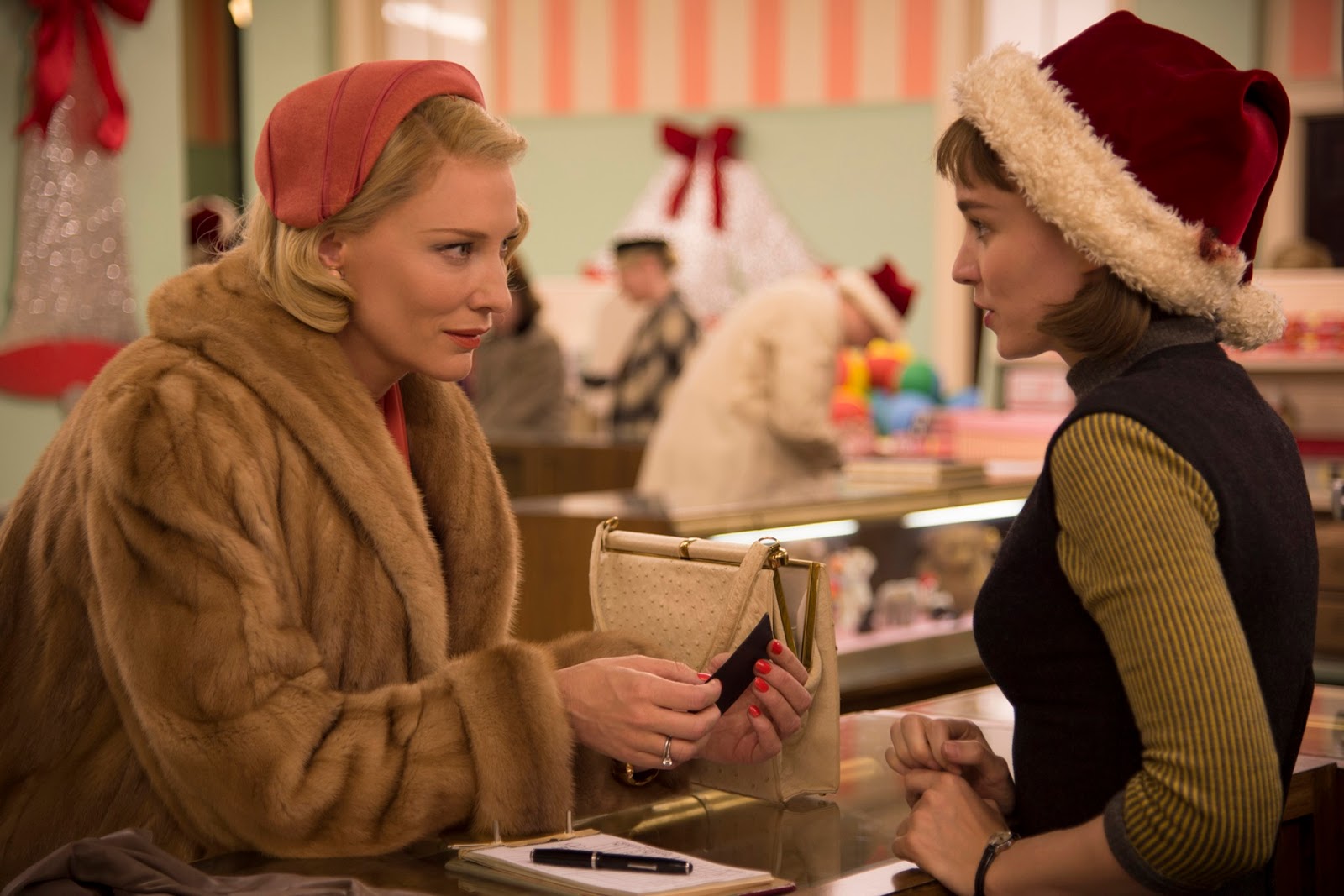
Rooney Mara plays Therese Belivet; a young woman working as a clerk at a toy store in New York City in the early 1950s. While waiting behind the counter, her eyes come to rest on an elegantly dressed, strikingly beautiful woman. The woman approaches the counter to inquire about merchandise but buys a toy train set after Therese makes a soft sales pitch. The fact that two women would negotiate the sale of a train set; a toy almost exclusively the domain of boys, tells us the two women are hardly bound by conventions. The train serves as kind of foreshadowing, for in the transaction, we see ample evidence of a mutual attraction, especially after the woman compliments Therese on her silly Santa hat.

The woman calls Therese a few days later after the train is delivered to invite her to lunch, which she eagerly accepts. Outside her job, we see that Therese is involved in a shaky relationship with a young man named Richard (Jake Lacy); who almost seems passive in his courting efforts. Therese also finds herself an object of affection for Richard's friend Dannie (John Magaro), who attempts to kiss her late one night in the newspaper office where he works.

Richard gives Therese a camera to pursue her interest in photography, which she hopes to parlay into a job at a local paper as well as an artistic endeavor.

Sometime after, we see Therese and the woman; Carol (Cate Blanchett) sitting in a restaurant; making small talk before their lunch. When Carol orders a martini with her lunch, Therese's innocence and indecision become glaring when she hesitates to order for herself. Therese's callow charm seems no match for Carol's seductive elegance but the two women are drawn to one another, nevertheless. When Carol asks Therese what she wants from life, the young woman offers an honest assessment of her own life when she says "I don't even know what I want for lunch."

We see Carol's personal life is in flux as she and husband contend with their separation. Though Carol seems intent on a divorce, her husband Harge (Kyle Chandler) tries to save their marriage, only to be dismayed by her resistance. Her husband's ire is partly inspired by Carol's attraction to women; one of which involves her old friend Abby (Sarah Paulson). Her preference for women results in Harge restricting access to her daughter; an unpleasant development that will fester as the story unfolds.

Things become more serious when Carol invites Therese over to her home. During the evening, the women learn much about one another. Carol is made aware of Therese's artistic side as the younger woman avails herself of the piano and demonstrates her interest in photography.

Carol's casual-seeming sex appeal, which is partly conveyed by form-fitting dresses, casts a spell on Therese. Physical contact finds its way into the evening festivities; particularly during a scene where Carol stands behind Therese; an ostensibly innocent shoulder-touch becomes charged with sexual potential. Though such a gesture would hardly seem shocking to our 21st century eyes; the act carries risk and danger in a 1950s' milieu.
The evening is interrupted by Carol's angry husband, who is well aware what is happening between the two women. Harge, infuriated by the sight of Therese, tries desperately to reclaim his wife's affections while making veiled makes threats to Carol about their daughter's custody. The women's evening is cut short after Carol becomes distraught after her heated exchanges with Harge.

As their relationship becomes more involved, Carol invites Therese to take a road trip to Chicago; another invitation she readily accepts. The trip strains Therese's relationship with Richard, who sees Carol as nothing more than a crush. When Richard tries to dissuade her from leaving, Therese becomes uncharacteristically defiant as she asserts her independence.
The scenes between Carol and Harge and Therese and Richard highlight the ways men once exerted their socially-sanctioned authority over women with impunity.

We can guess what will transpire on the trip, as the two women consummate their relationship; their passion finding full expression in bed. But the women also discover their time together has been monitored by a private detective in Harge's pay. The damning evidence of Carol's relationship is to be Harge's means to gain full custody of their daughter.

As their relationship is threatened and reduced to a state of ambiguity, the final scene powerfully and wordlessly captures the deep emotions the two women share. Therese and Carol fix their gaze on one another across a crowded room and though their future together is uncertain, the scene itself is beautiful and moving.

We can attribute part of the film's excellence to Cate Blanchett and Rooney Mara, who fearlessly inhabit their respective roles. I expected nothing less than tour de force acting from Blanchett but Rooney had much to prove to me. In previous roles, she's always seemed emotionally stiff, as if she rejected the Stella Adler and Stanislavsky methods for the Asperger's School of acting. But here she nails the role; showing us Therese's transformation from a young woman who isn't sure what she wants to becoming an assertive woman who is more than equal to her more worldly lover.

But of course the film's artistic success is also due to Haynes' impeccable direction and camera work. His habit of filming conversations where one actor is blocked out of the picture reminded me Edward Hopper's paintings, where we sometimes see the face or body of only one interlocutor. I also noticed how he nearly pushes a character off the screen by having them occupy a frame's edge.

The film's production designer should also receive a lion's share of credit. I was often astonished at how no detail of the period was left to chance.

We might forget that films about gay/lesbian/transgender issues have become more common these days and as a consequence; less shocking. A film like Carol; which will play shortly in multiplexes across the country, will probably raise few eyebrows, which is compelling evidence of progress.
Haynes has never shied away from material about the socially marginalized. Films like Poison, Safe, Far From Heaven and now Carol, feature characters who either live in self-imposed social exile or are forced to. I'm sure future his projects will be no different.

Haynes' film will no doubt figure into most critics top-ten lists for the year. It certainly earns a place in each.

Saturday, March 21, 2015

Cinderella


**Spoiler Alert**

Director: Kenneth Branagh/Starring: Cate Blanchett, Lily James, Richard Madden, Helena Bonham Carter, Stellan Skarsgard, Derek Jacobi, Nonzo Anozie, Holliday Grainger, Ben Chaplin and Sophie McShera and Rob Brydon

With myriad iterations of the Cinderella in film and television, one might expect a live action interpretation to be superfluous and unnecessary. But Kenneth Branagh's Cinderella proves any fairy tale can re-told if inspiration and heart serve as guides. I'm happy (and surprised) to say this version succeeds amiably, which is no small accomplishment, given the universal fondness for the Disney version. How Branagh pulls off this creative coup is due in part to breathtaking visuals, fine casting and maybe best of all, outstanding costumes, which are beautifully designed spectacles of color and texture.

I must admit that I came to the film with low expectations. Re-tellings or re-interpretations tend to be drearily revisionist, CGI nightmares or misguided attempts to make said stories seem contemporary and hip. Some horrific examples from recent years are Tim Burton's Charlie and the Chocolate Factory and Sam Raimi's Oz the Great and Powerful. I realize both films are more retellings that anything else, but the two films share an awareness of their more successful predecessors, which doesn't help.

If one is to take on a beloved story like Cinderella, it helps to cast actors with presence and quirky charm. Who better to fill the shoes of the iconic wicked stepmother than Cate Blanchett, who plays the character as if she invented it. Of course we need a disarming couple to play the put-upon heroine and the charming prince. Lily James from Downton Abbey and Richard Madden from Game of Thrones make an attractive, fairy tale pair who don't rely solely on their youthful comeliness to give their characters warmth and spirit.

Branagh doesn't tweak the story or characters much, which is a sound approach. We see Ella (the Cinder appendage comes later) and her loving family residing in their idyllic country home. Ella enjoys harmonious relations with nature and as one would expect (demand?) her mice are always about to provide companionship. But tragedy befalls the family when Ella's mother passes away. Her father (Ben Chaplain) remarries and suddenly Ella's halcyon life is upended when her new stepmother (Blanchett) and her insufferable new stepsisters Drisella and Anastasia (played with diabolical glee by Sophie McShera and Holliday Grainger) become permanent fixtures in her home. Unfortunately for Ella, her father is often away on business, leaving her in the company of her step-family, who have little love for their new digs and even less for their new step family member. When an accident claims her father's life, Ella suddenly finds she is little more than a scullery maid for her new step-family.

Slaving around the clock, Ella manages to escape the cottage one day for a ride in the forest. There, she encounters a handsome prince (Madden) who is busy leading a stag hunt. Incensed by the idea of a woodland creature being stalked, Ella convinces the Prince to halt the hunt. Fairy-tale sparks fly and though Ella returns home knowing very little about the prince, she feels a resonant buzz from the encounter.

Back home among her wicked step-family, Ella's ash-soiled face becomes the butt of her stepsisters jokes, which earns her the sobriquet Cinder-Ella.

The rest of the film is more or less faithful to the classic story; the invitation to the ball, which serves as a means for the prince to choose a princess, Cinderella's confinement during the ball, the fairy godmother's fateful appearance, etc.

So what does Branagh's Cinderella do to earn its own relevance? Simple: it cares about the characters more than CGI. But what CGI we do see is deployed with discretion and taste.
Branagh, as a seasoned director of Shakespearean adaptations, understands stimulating characters and dialogue make for more compelling drama than the visual rubbish. Having directed big budget, CGI-dependent Hollywood fare like Thor and live action drama like Henry V, with its Kurosawa-like battle scenes, it's probably safe to say Branagh respects humans more than special effects wizardry.

Another quality in this production are the memorable costumes. The staggeringly beautiful designs make a powerful impression. Cate Blanchett was quite striking in her various dresses, which not only suggested elegance but sex appeal. This wicked stepmother had some delicious curves the dresses accentuated quite nicely. Blanchett's lovely blue eyes and camera-loving red hair must be a cinematographer's delight and a costumer designer's muse. Costumer designer Sandy Powell, whose impressive resume includes many Scorsese films and the costume dramas Shakespeare in Love and Hugo, intoxicates our eyes with vivid, tactile colors. Though I wasn't a fan of Hugo, I can still recall Powell's gorgeous costumes. In Cinderella one can admire the beautiful finery; the shiny embroidery, the stunning ball gowns that blossom like flowers, Cinderella's other-worldly blue dress and the offbeat humor of Anastasia's and Drisella's polka-dotted skirts. Though Lily James is quite lovely in her ball gown, I wanted to see more of Blanchett in the seductive green she always seems to be wearing.

Fairy tales are only as good as the villains who inhabit them and the film is well served by Blanchett, who is deliciously diabolical. Her slithery saunters are sexy; she's a witch in satiny fabrics and she's pleased to be so. She has a lot of fun with the role and she doesn't waste the opportunity. Helena Bonham-Carter as the fairy godmother is another bit of inspired casting. Her ever-eccentric presence is perfect for the character and she is quite amusing.

I enjoyed Cinderella. I'm hardly conferring masterpiece accolades on Branagh's film but it is true to its fairy-tale status. It has humor and aesthetic appeal and will beguile both the young and old.

Monday, December 22, 2014

The Hobbit: The Battle of the Five Armies


**Spoiler Alert**

Director: Peter Jackson/Starring: Ian McKellen, Martin Freeman, Richard Armitage, Luke Evans, Cate Blanchett, Orlando Bloom, Christopher Lee, Ian Holm and Billy Connolly

So we've come to the end of a trilogy, that quite frankly, is something of a non-event. I can't remember ever seeing a Jupiter-sized budgeted franchise with a plot predicated on adventure and thrills fail to deliver much in the way of...well...er...uh, adventure. The total expenditures for the trilogy--the latest estimates anyway--are close to $800 million. If I were to use a precious gem simile, I might say the series looks like a diamond but cuts like Cubic zirconia.

Peter Jackson's other trilogy was armed with bloated budgets but it delivered as promised. So much seemed at stake in Middle-Earth in those films. With The Hobbit: The Battle of the Five Armies, I only felt impatience and relief that such a middling series was finally coming to an end.

The film is no cheap-jack production. With its turgid budget, one expects a film to at least meet high visual standards and it succeeds on that count admirably. In retrospect, as I thought about Laketown burning in the opening scene, I asked myself who really got torched; the citizens of that charred municipality or those of us who shelled out the scratch to sit through the flick? Yeah, I know Pete Jackson didn't coerce me into seeing his movie, but I had hoped the series might conclude satisfactorily and redeem the other film's mediocrity.

I can't imagine anyone would need a synopsis for a story so universally familiar. As one might expect, the Battle with Smaug carries the opening sequence. Bard the Guardsman (the charismatic Luke Evans) manages to free himself from Laketown's jail to take on the terrible dragon single-handedly. Unfortunately his arrows glance off Smaug's impenetrable, scaly chest. As the beast reduces the town to cinders, the legendary Black Arrow manages to find its way into Bard's hands via the desperate exertions of his son. Aware of the vulnerable spot on Smaug's nigh-impregable chest, he takes aim. We all know what happens next.

Meanwhile, the dwarves occupy Lonely Mountain. Thorin resists the company's and Bilbo's pleas that he satisfy the conditions of the dwarves' Laketown contract with the promised gold payment. The staggering cache of gold seduces Thorin, leaving him deaf to entreaty. Before long, the townspeople, lead by Bard himself and the Wood Elves, represented by Thranduil (Lee Pace) lay claim to part of the treasure, which creates a combustible situation which is hardly ameliorated by Gandalf's intervention.

Overcome with gold delirium, Thorin chooses war over the dwarves', woodelves' and the men's reasonable claims to a portion of the treasure. But as the armies assume battle positions outside the gates of Lonely Mountain, Thorin's hopelessly outnumbered company is joined by his cousin Dain's force, which arrives just as the battle is to commence. While the dwarves, former Laketown inhabitants and the woodelves wage war over the treasure, legions of orcs, lead by the brutish Azog, make their way to Lonely Mountain to forcefully establish their own claim to the treasure. And as the three armies' blades and arrows are drawn, Azog's invasion force arrives. After an initial melee, the orc army pivots to assault the abandoned town where the Laketown residents temporarily reside. Bard organizes the defense of the town as all armies clash, while Thorin and Bilbo race to the hill where Azog views the battle in an attempt to slay him; an act they hope will weaken the automatous orc army. The attempt on Azog's life leads to an inevitable showdown between Azog and Thorin, which shares screen-time with the battle at large. The various outcomes need not be mentioned here.

Aside from a few moments in the early battle and the impressive CGI we've come to expect from Jackson's Middle-Earth series, everything seems pro forma. Part of the problem is trying to feel the tension of battles already beautifully and excitingly depicted in the Rings Trilogy.

We've seen it all before. We've already seen the orcs and their nightmarish, mindless titans laying siege to bastions. Are we watching The Hobbit or The Lord of the Rings? I sometimes couldn't tell the difference.

The arrival of the Eagles in the novel was something miraculous, but in the film their appearance is anti-climactic, as are the goblins that arrive late to join the fray.

I never cared for the liberties Jackson visited on the story, such as Legolas' presence and the contrived romance between Kili (Aidan Turner) and Tauriel (Evangeline Lilly). I don't know why Jackson felt it necessary to connect The Hobbit and The Lord of the Rings when each could have easily stood alone. Yes, there is a subtle connection in the books but nothing that would call for what Jackson perpetrates. I realize it isn't really that big a deal. My real beef is the story and how it fails to seduce us as Frodo's quest did for three epic-length films. And of course the criticism that Jackson split one novel into three films has always been a valid gripe.

Too bad, I thought as I left the theater, but also good riddance. I think I've had more than my fill of Middle-Earth. 6 epic-length films in thirteen years have worn me out. I feel I'm ready to retire to the Shire too.

I'm sure I'll revisit the Rings Trilogy again and again but as for this trilogy--I don't think so.

I think Jackson is a very talented director and I'm eager to see what he pursues next. I'm sure he's quite ready to move on, as we all must feel. I'm relieved Tolkien has nothing significant for Jackson or anyone else to adapt, though I wouldn't discount someone's ill-advised attempt to bring The Silmarillion to the screen.

As of this blog-post, the film's opening, worldwide receipts are somewhere in the neighborhood of $350 million--a number that will no doubt swell obscenely with more box office. I'm sure the millions have entranced MGM and New Line Cinema execs as the mountains of gold mesmerized Thorin. As the bromide goes; the end justifies the means...at least for the guys in suits.

If only those grosses had bought an absorbing experience.