Showing posts with label Diane Lane. Show all posts

Wednesday, March 30, 2016

Batman v Superman: Dawn of Justice


**Spoiler Alert**

Director: Zack Snyder/Starring: Ben Affleck, Henry Cavill, Amy Adams, Jesse Eisenberg, Diane Lane, Laurence Fishburne, Jeremy Irons, Holly Hunter and Gal Gadot

It's difficult to expect something new from a flick like Zack Snyder's Batman v Superman: Dawn of Justice, now that superhero movies have become multiplex repertory. And what two superheroes have been depicted on T.V. and movie screens more than the Caped Crusader and The Man of Steel? Spiderman and the X-Men come close but still fall short of the exposure the DC comics characters have garnered over the years.
What more do audiences need to know about Clark Kent and Bruce Wayne; their super alter-egos and their respective origins? Snyder's film knows we know all about them yet his story still draws from their familiar pasts for psychological motivation, particularly Bruce Wayne's.

But what can one say about the film, with its requisite carnage, deafening sound effects and its heroes turning city skylines into mounds of steel and concrete? Does Snyder's film offer a refreshing take on the characters or a new, exciting story; something to renew audience interest in the overly familiar? My answer to the afore-posed question is a resounding no, but that doesn't mean it isn't fun to watch. The movie relies on our curiosity about what might actually happen if Batman and Superman tangled more than our fascination to keep us in our seats.
In spite of its cacophonous incoherence and it's more-of-the-sameness, the movie manages to be an enjoyable two-and-a-half hour spectacle. I guess I had better find it passably entertaining; there is surely more to come.

In the film's opening scenes, we are immediately dropped into the action, as Batman/Bruce Wayne (Ben Affleck) watches as Superman (Henry Cavill) wreaks havoc on city skyscrapers while battling an alien ship and his nemesis; fellow-Kryptonian General Zod, who he manages to defeat and kill.
Though Superman's exploits are highly regarded by the city news-rag The Daily Planet, Batman looks askance on his destructive impact on the city. It isn't long before the two superheroes find their respective crime-fighting pursuits clash, bringing them face to face in a stay-out-of-my-way confrontation that almost comes to blows.

But unbeknownst to them, a young tech CEO named Lex Luthor (played eccentrically by Jesse Eisenberg) has drawn on General Zod's attack as a pretext to plan his own defense of the planet against more of Superman's kind. When a chunk of Kryptonite is found on General Zod's downed ship, Luthor seeks U.S. Senator Finch's (Holly Hunter) consent to allow its importation. Unsure of Luthor's real motives, she refuses him, though we know he will hardly be thwarted by government regulations. Able to test the effects of Kryptonite on cell samples of Zod's body, Luthor discovers Superman's vulnerability. He wastes little time in putting his discovery into effect, as does Bruce Wayne, who manages to make a similar find. Luthor, having run afoul of Batman, devises a devious plan to make Superman and Batman fight, hoping for a scenario of mutual assured destruction.

Though Luthor succeeds in his nefarious endeavor, the two heroes finally realize they are fighting on the same side. When Luthor's plan fails, he devises an alternate plan to destroy Batman and Superman using the technology on General Zod's ship. Mingling his blood with that of the dead Kryptonian, he creates a monstrous creature whose strength proves to be too much for Superman, Batman and Wonder Woman (Gail Gadot); whose timely arrival is prompted by the unfolding crisis. Though the heroic triumvirate fights valiantly, they find the creature almost invulnerable. Superman's love; Lois Lane (Amy Adams) demonstrates some heroics of her own when she repurposes a Kryptonite-tipped spear of Batman's design for the fight against Luthor's monster.

It isn't difficult to plot the rest of the movie and as we're allowed teasing glimpses of other superheroes, we know the film is headed to franchise paradise.

The film has so much working against it, particularly our over-familiarity with the characters. Another of its many flaws are the performances by Cavill and Affleck, which are mostly wooden. Cavill, who can usually be counted on to be lifeless onscreen, makes the usually unexpressive Affleck look as though he's overacting. Amy Adams is a welcome sight, as is her performance, which is one of the few that isn't leaden. More relief from the stiff acting comes from Eisenberg, who gives Luthor a nerdy genius makeover.

What usually makes a long superhero seem longer is nonsensical, urban destruction, which becomes almost a joke. If I were a city official, I might regard Batman and Superman's heroics as more of a menace and nuisance than Luthor's nefarious deeds. How does the city tolerate so much destruction? Oh well, I guess Gotham's urban planners, architects and contractors will always have work.

Snyder and the writers try hard to introduce moral and ethical angst into the film as the question of vigilantism is posed and briefly pondered, but this seems like a tired subject for a superhero movie.

At 155 minutes, the film should be intolerable but surprisingly, it isn't. It also isn't great or even particularly good, but it is entertaining enough, which is the new modified high-praise assessment audiences have reserved for superhero movies now. What the movie needed was a smattering of Deadpool's humor to liven up Gotham. Too bad it's too serious to have moments of levity.

In spite of its shortcomings, I have a mild, grudging affection for the movie. I wouldn't dissuade anyone from paying to see it, but I wouldn't urge anyone to hurry to the multiplex either. It's dumb fun, which is preferable to just dumb. If you don't know what I mean, just watch Miracles from Heaven. Amen.

Sunday, November 22, 2015

Trumbo


**Spoiler Alert**

Director: Jay Roach/Starring: Bryan Cranston, Helen Mirren, Diane Lane, Louis C.K., John Goodman, Elle Fanning and Michael Stuhlbarg

The sordid history of the Hollywood blacklists has been well documented and dramatized in cinema. Two notable films on the subject; Martin Ritt's The Front (1976) and Irwin Winkler's Guilty by Suspicion (1991); come to mind. But unlike the aforementioned fictitious films, director Jay Roach's Trumbo is based on the real-life experiences of a legendary screenwriter who endured the unforgiving and unconscionable political witch-hunts that left so many unemployed and unemployable. Dalton Trumbo, played beautifully and with much artistry by Bryan Cranston, stands as one of the more talented writers in movie history but because his communist ties were seen by the House Un-American Activities Committee as suspicious and possibly seditious, he, along with other screenwriting peers, were barred from submitting work to the studios. Deprived of their livelihood, many found their economic situations severely stressed and their lives and reputations ruined by one of the more diabolical political movements in American history.

In Trumbo, the screenwriter's experiences serve as a testimony to the indignities and humiliations visited on a group whose membership in the communist party was borne of humanitarian concerns.

Early in the film, we see Trumbo sitting before legendary studio executive Louis B. Mayer, basking in praise and the promise of being the highest paid screenwriter in Hollywood. Unfortunately for Trumbo, a new contract comes with an ominous warning about his political affiliations. Unconcerned, he spends his days writing and enjoying time with his family and screenwriting friends.

But we also see the machinations of anti-communist forces, led by the powerful Hollywood gossip columnist Hedda Hopper (Helen Mirren) and a government committee hellbent on expunging traitorous elements in the film community. In one scene, Hopper stands before a full auditorium of like-minded "patriots" with actor John Wayne (David James Elliott). After rousing the audience with bile-spewing rhetoric about political subversives in Hollywood, Hopper and Wayne encounter Trumbo and his fellow-screenwriters outside the auditorium, where their leaflets about constitutional rights are left untouched by the those exiting the venue. Wayne and Hopper are unmoved by and dismissive of the writer's pleas for tolerance, while Trumbo counters Wayne's bullying with a biting question about the actor's war service.

But Trumbo finds more powerful forces marshaled against him, as a subpoena served to him during a family picnic demands that he testify before the House Un-American Activities Committee in Washington D.C. to address issues about communist propaganda finding its way into Hollywood films. Refusing to answer questions they deem intrusive, Trumbo and his screenwriting cohorts--known as The Hollywood Ten--are convicted of contempt of Congress and subsequently arrested.

We see Trumbo in the following scene standing before a prison guard. He is forced to strip naked, exposing his privates for examination. The degradation he endures for his views says much about the political climate of the time. In prison, he is hardly exempt from the hard labor demanded of inmates.

While serving his time, Trumbo stays in contact with his wife Cleo (Diane Lane) as she tries to hold the family together. Trumbo (and the audience) experiences a wonderful moment of comical irony when he discovers the man who led the witch-hunt against him in Hollywood is also serving time in the same prison for tax-evasion.

But upon being paroled, Trumbo discovers his problems have only begun. He finds being blacklisted to be another punishing sentence as he is effectively shut-out from Hollywood. Public humiliation becomes common. Trumbo is accosted in a movie theater after a patron sees his face in a newsreel about The Hollywood Ten, whereupon a drink is splashed in his face.

Trumbo finds a way around the blacklist by writing scripts with non-blacklisted writer's names on his work. He writes Roman Holiday but attaches the name of his screenwriting peer Ian McLellan Hunter (Alan Tudyk} on the front page. Though his screenplay wins an Oscar, Trumbo is unable to accept the award while Hunter is loathe to keep the statue.

Soon Trumbo discovers writing under a pseudonym to be an effective way of earn a living. As the Trumbo family is forced to move into more modest digs, Dalton is also forced to work for a schlock movie company run by brothers Frank (John Goodman) and Hymie (Stephen Root) King, who churn out low-budget pot-boilers. Though Frank and Hymie make objections about not being able to afford Trumbo, the writer gladly accepts lower pay to keep his family fed. Unlike the major studios, the King brothers don't see the Black List as an impediment to hiring a black-listed writer. Friend and fellow blacklister Arlen Hird (Louis C.K.) sees his writing junk-scripts as insulting while Trumbo sees writing under a pseudonym as an effective way of circumventing the blacklist. Soon Trumbo enlists the talents of his fellow blacklisters for the King brothers, sometimes with humorous results. One scene that is particularly funny involves a space alien story over which Frank and Arlen lock horns.

As betrayal is the overarching theme in the film, we see its many incarnations. One instance involves screen legend Edward G. Robinson; who proves to be a sympathetic ally to Trumbo and his friends before he too is forced to sit before a committee to answer questions about his dubious affiliations. Other liberal figures in the industry pledge fealty to the Trumbo and his fellow communists, until they also turn their backs on the vilified Ten.

We also see how betrayal can take the form of familial alienation. Trumbo's obsessive writing schedule drives a wedge between himself and his family. Though Cleo feels he is guilty of neglect, the person it affects most acutely is his daughter Nicki (Elle Fanning). She tries to get her father to join the family gathering for her 16th birthday, only to find him in the bathtub with his typewriter; hostile to all entreaties.

Trumbo's career takes a dramatic turn when he discovers actors and directors who are willing to defy the blacklist to work with him and more importantly, include his name on scripts. Two such people; Kirk Douglas and Otto Preminger, help dismantle (though not eradicate) the Committee and Hedda Hopper's influence, thus extricating Trumbo from the blacklist's pernicious hold.

If the film ends with vindication, it also carries the bitterness of injustice. Though we see Trumbo accepting an award years after the blacklist's wane, he is quick to point out that all who suffered through its noxious influence were forever changed by it, mostly for the worse. Closing subtitles inform us credit for Trumbo's work on Roman Holiday and The Brave One, both Oscar-winning screenplays; were awarded only later; the former posthumously.

The film's showcase is Bryan Cranston, whose performance here should soundly establish him in movies. Cranston shows us a highly principled man whose unwavering loyalty to his colleagues and his unassailable political convictions came with a fiery resolve. He is a wonder in this role.

But one can't walk away from the film not having noticed Helen Mirren, John Goodman, Louis C.K. and Michael Stuhlbarg all doing exceptional work as well.
John McNamara, whose writing credits have been mostly relegated to television, contributes a solid, intelligent script. His dialogue is smart and witty and his hero wonderfully nuanced.

The Hollywood Black Lists will forever inspire dramas; it's a subject that never seems to get musty. Jay Roach's film proves the history can still be mined poignantly. The film also shows that Dalton Trumbo was long overdue for a biopic of his own.

Thursday, June 25, 2015

Inside Out


**Spoiler Alert**

Director(s): Pete Docter, Ronaldo Del Carmen/Voices: Amy Poehler, Bill Hader, Phyllis Smith, Richard Kind, Lewis Black, Mindy Kaling, Kaitlyn Dias, Diane Lane and Kyle MacLachlan

It isn't often I post my impressions of a Disney/Pixar animated film, which is mostly due to my impatience I feel for most of the stories. It's been some time since I blogged about any animated release (Peabody and Sherman may have have been the last) but then Pete Docter and Ronaldo Del Carmen's excellent Inside Out came along last weekend and not only entertained me but inspired me to post something about the movie.

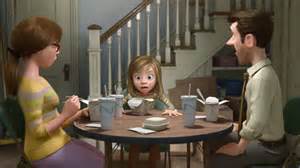
Inside Out tells the story of a little girl named Riley (voice:Kaitlyn Dias), who, with her her mother and father (voices: Diane Lane and Kyle MacLachlan, respectively), are on a move from their home in Minnesota to San Francisco. A trying enough experience for any child, we literally get to know how her emotions shape her impressions, which are personified as five entities: Joy (Amy Poehler), Anger (Lewis Black), Fear (Bill Hader), Sadness (Phyllis Smith) and Disgust (Mindy Kaling). The group presides from a command center inside Riley's mind. The ever effervescent Joy serves as a kind of leader; always aggressively pushing her agenda of happiness while the participation of the other emotions is highly regulated and subject to her intense but buoyant scrutiny. Allegorized further, Riley's memories are connected to each emotion and preserved as small spheres assigned a correlative color: Joy (bright yellow), Sadness (blue), Anger (red), Fear (lavender) and Disgust (green). The vast number of spheres are stored in either long term and permanent memory storage, or short term.

The emotional command center is connected to theme-park-like villages that represent vital functions in Riley's life, such as Family, Goofy land (all the goofy moments shared with her parents) and her passions, like hockey. The park-like places are separated from the command center by very narrow bridges and are nourished by Riley's experiences and emotions. In time, we see the theme-villages are only as sturdy and upright as their importance in Riley's life.

The whole allegory is such an intelligent way of communicating to children how crucial our emotions are in forming memories and determining how strong or fragile our relationships with family will be. I thought the film might make the egregious misstep of pushing a joy-only message but the story wisely veered away from this conceit.

But as Riley faces the uncertainty and fear of a new home and school, Joy finds her task of keeping her happy and positive exceedingly difficult. We see the new home from Riley's point-of-view, which initially appears dark and dismal. Fear and Disgust share some responsibility for her perspective. Riley becomes apprehensive when her parents inform her their belongings won't arrive for another week. Joy manages to regain control when she taps into Riley's imagination; helping her to form a mental picture of her dreary-looking room as it might be with furnishings and decorations, thus restoring a lighter mood.

The characters in animated movies are only as engaging as the actors who lend their voices. Inside Out fields an exceptional voice cast. We know Amy Poehler can be funny, but here she is able to show her dramatic side as Riley finds herself in less-than-joyous situations. Mindy Kaling is quite amusing as Disgust, as are Lewis Black as Anger and Phyllis Smith, whose Sadness plays a crucial role in the story.

As school proves to be a lonely ordeal and her favorite extracurricular activity--hockey--proves to be a source of frustration, Riley begins to lash out at her parents, much to the consternation of Joy, whose influence begins to decline.

The story takes a troubling turn when Joy and Sadness are accidentally sucked into the pneumatic tube reserved for emo-spheres then jettisoned from the command center and into the world of Riley's psyche. The film becomes very suspenseful and takes on a maddening sense of urgency as Joy and Sadness seem to encounter every obstacle en route to the command center. They eventually become separated. Joy is accidentally plunged into the abyss where Riley's faded memories accumulate. Escape seems impossible.

Desperate to regain the happiness she and her family established in Minnesota, Riley in-advisably buys a bus ticket for her old home while Anger, Fear and Disgust do everything in their power to upset her plans, only to find they lack the appropriate emotional response to deal with her problem. In an attempt to rescue Riley from a possible monumental blunder, Sadness, rather than Joy, becomes the heroine we didn't anticipate.

Docter, who also co-wrote the script, shows a sure hand in sustaining a high level of suspense and urgency. I found myself squirming; wondering how Joy would extricate herself in time to help Riley in her darkest hour.

Inside Out is rich in symbolism and psychological allegory. The story is an effective synthesis of light and dark and its lessons are quite compelling. I like the way the story stressed the importance of the less desirable emotions of Fear, Anger and Disgust and their role in Riley's self-preservation. Life can never be and will never be solely joyous. A healthy psyche integrates all the emotions in carefully calibrated proportions; or so the film seems to say.

The film isn't without humor. It is quite funny to see Riley's mother and father's own "control centers." The father's is especially amusing, which sometimes works hilariously at cross-purposes with the mother's.

The film also shows that some of what we carry around in youth warrants disposing, such as Riley's imaginary best friend, Bing Bong (Richard Kind). Useless but oblivion-resistant memories, like a chewing gum jingle, surface inappropriately but amusingly throughout the story.

The story seems so simple yet so much is at stake. A little girl coping with a move and a new school doesn't seem like a promising premise on which to build a story but any plot can be absorbing if the the director has the imagination to realize it. We can credit Docter being such a filmmaker. But he isn't only creative; he also asks that his young audience be alert and attentive to his mildly cerebral story.

One can gauge the failure or success of Disney or children's cinema by the restless energy of the audience. I was pleased to say the audience was mostly rapt; silence reigned supreme.

The film is at once a crowd-pleaser and a good animated film. But it will no doubt charm a more mature audience too. Thank goodness. Another afternoon of Tomorrowland would have been excruciating.

Inside Out should enjoy a healthy run at the multiplex. Give it a chance; you might find it enchanting.