Showing posts with label Bill Hader. Show all posts

Tuesday, May 10, 2016

Maggie's Plan


**Spoiler Alert

Director: Rebecca Miller/Starring: Ethan Hawke, Greta Gerwig, Julianne Moore, Maya Rudolph, Bill Hader, Wallace Shawn, Travis Fimmel and Mina Sundwall

Rebecca Miller's Maggie's Plan is a difficult film to review (I still consider my posts more impressions than reviews) because it seems to have strengths and weaknesses in equal measure. Its flaws aren't necessarily crippling but they keep an otherwise interesting movie from being totally satisfying. It's pleasing to know a female director has been able to make films on her own terms without having to compromise her vision or standards, but I have to admit, I've never been a fan of Miller's films. They always seem important for a moment but never leave a lasting impression. In fact, I can't remember the titles of any of her former films and chances are, I'll forget this film in a few months time too but I also have to admit her latest is one of her better efforts. It doesn't always work but her cerebral characters are well-drawn, with distinctive personalities that betray insecurity and weakness. If the situations, characters and the story feel too much like vintage Woody Allen filtered through Noah Baumbach, it mimics their films well enough to be entertaining. Maggie's Plan isn't as funny as Woody's best work but its humor is subtle; aiming for sophistication and wit.

The film doesn't waste a moment establishing character as Maggie Hardin (Greta Gerwig; uncharacteristically non-irritating) meets her close friend Tony (Bill Hader) on the street. In their exchange, we learn Maggie's search for a sperm-donor has born fruit though Tony is disdainful of her choice; a pickle-entrepreneur by the name of Guy who was also their college classmate. We also learn Maggie--by her own admission--has never been able to maintain a long-term relationship; hence her need for a sperm donor.

When Maggie later shows up at the school where she serves as a liaison to the business community for artistic students looking to market their work, she learns her paycheck is delinquent. She meets another faculty member who shares a similar last name; John Harding (Ethan Hawke) who is also short a paycheck. They suggest to the difficult clerk their similar names may be responsible for the mix-up. The clerical error allows them to meet and make small talk. During their conversation, we learn John is a highly respected academic in the esoteric field of ficto-critical anthropology. Later, during a lunch in the school cafeteria, Maggie catches sight of him then again in Washington Park, where they stroll and become more acquainted. In the course of their conversation, John talks about a novel he is writing and when Maggie shows interest, he asks her to read the first chapter, to which she eagerly agrees. After Maggie praises Tony's novel to the heavens, their friendship and the story thickens.

In a subsequent scene, we get a taste of John's home life, where we meet his wife and colleague Georgette (Julianne Moore, having fun with a thick, Icelandic accent); an icy intellectual who seems indifferent to her husband's creative pursuit.

One night, after the pickle entrepreneur, Guy (Travis Fimmel), visits Maggie sans the sperm sample she requested, he suggests impregnating her the old fashioned way, which elicits a polite rejection. Having selected Guy as a donor because of his mathematical background, he explains to Maggie why he rejected a life as an academic to operate his own business. He expresses what he finds beautiful about mathematics--and though it sounds poetic; it also sounds unconvincing as movie dialogue. When he steps out of the bathroom, sample in hand, he sees her dance around her apartment and watches, enchantedly; his adoration of her palpable.

His visit precedes John's as the academic/writer-manque arrives to say he's been inadvertently locked out of his house. During his visit, he professes his love to Maggie and mentions the end of his marriage. Following their mutual declarations of love, the two act on their passion and shortly after the film moves forward a year as we see Maggie with her small child, her motherhood secured.

Though the film is described in ads as being screwball, it's hard to see the film as such. There is no shortage of comedy but the story's poignant, dramatic moments make the film's screwball appellation seem strange. The humor is also far too subtle at times to be legitimately screwball. Screwball tends to not be very subtle. But let's move on.

The story becomes a triangle of sorts as John and Georgette's kids spend time between two homes, while his daughter with Maggie brings a tangle to the equation. Though Georgette accepts the situation, she naturally sees Maggie as a homewrecker.

The triangle becomes a quagmire when Maggie begins to see John as self-involved and selfish; his novel an excuse to avoid his family and parental duties. She accepts the sad truth that he was most likely better off with Georgette and sets about concocting a plan to return him to his former wife, thus extricating herself from her unhappy marriage. Of course the plan involves Georgette; who wants nothing more than to have him back. The story's third act involves the plan's impact on both families.

But another issue, hinted at earlier, addresses the question as to who Maggie's daughter's father might truly be.

I thought Gerwig was quite good as Maggie. Though her character bears a close resemblance to many others she's played in films past, she seems more real here. What is particularly interesting about Maggie is the dubiousness of her victim status. As much as John seems to blame for their unhappy marriage, her claim about not being able to maintain a relationship for longer than six months makes us wonder if she is indeed an agent of her own misery.

Julianne Moore is able to find pathos and humor in her role, which was no mean feat considering her accent evokes memories of her character in The Big Lebowski. Georgette seems more like someone we would find in a Woody Allen movie; a character we might laugh at for her lofty, intellectual pretensions. Georgette comes awfully close to being cartoonish but Moore is able to make us forget the accent and focus on the character.

Ethan Hawke has done some fine work in film lately. He was terrific in Born to Be Blue and is again as an academic who believes he has a great novel in him and is prepared to sacrifice his and everyone else's happiness to achieve his goal.

The film made me smile at times and chuckle once or twice but the its best quality are its dramatic moments, which are at times very compelling.

Like the characters in Noah Baumbach's films, Miller's aren't people I feel I would want to know but they aren't tedious either. Tiresome sometimes, but not tedious. I think Miller had the good sense to restrict her story to a 90 minute running time so as to not give us too much of their company. She does a great job satirizing the intellectual world without making her characters seem buffoonish. Maggie's Plan is her most accomplished work yet, in my opinion. It's certainly her most enjoyable movie to date.

Thursday, June 25, 2015

Inside Out


**Spoiler Alert**

Director(s): Pete Docter, Ronaldo Del Carmen/Voices: Amy Poehler, Bill Hader, Phyllis Smith, Richard Kind, Lewis Black, Mindy Kaling, Kaitlyn Dias, Diane Lane and Kyle MacLachlan

It isn't often I post my impressions of a Disney/Pixar animated film, which is mostly due to my impatience I feel for most of the stories. It's been some time since I blogged about any animated release (Peabody and Sherman may have have been the last) but then Pete Docter and Ronaldo Del Carmen's excellent Inside Out came along last weekend and not only entertained me but inspired me to post something about the movie.

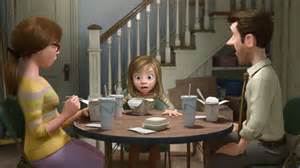
Inside Out tells the story of a little girl named Riley (voice:Kaitlyn Dias), who, with her her mother and father (voices: Diane Lane and Kyle MacLachlan, respectively), are on a move from their home in Minnesota to San Francisco. A trying enough experience for any child, we literally get to know how her emotions shape her impressions, which are personified as five entities: Joy (Amy Poehler), Anger (Lewis Black), Fear (Bill Hader), Sadness (Phyllis Smith) and Disgust (Mindy Kaling). The group presides from a command center inside Riley's mind. The ever effervescent Joy serves as a kind of leader; always aggressively pushing her agenda of happiness while the participation of the other emotions is highly regulated and subject to her intense but buoyant scrutiny. Allegorized further, Riley's memories are connected to each emotion and preserved as small spheres assigned a correlative color: Joy (bright yellow), Sadness (blue), Anger (red), Fear (lavender) and Disgust (green). The vast number of spheres are stored in either long term and permanent memory storage, or short term.

The emotional command center is connected to theme-park-like villages that represent vital functions in Riley's life, such as Family, Goofy land (all the goofy moments shared with her parents) and her passions, like hockey. The park-like places are separated from the command center by very narrow bridges and are nourished by Riley's experiences and emotions. In time, we see the theme-villages are only as sturdy and upright as their importance in Riley's life.

The whole allegory is such an intelligent way of communicating to children how crucial our emotions are in forming memories and determining how strong or fragile our relationships with family will be. I thought the film might make the egregious misstep of pushing a joy-only message but the story wisely veered away from this conceit.

But as Riley faces the uncertainty and fear of a new home and school, Joy finds her task of keeping her happy and positive exceedingly difficult. We see the new home from Riley's point-of-view, which initially appears dark and dismal. Fear and Disgust share some responsibility for her perspective. Riley becomes apprehensive when her parents inform her their belongings won't arrive for another week. Joy manages to regain control when she taps into Riley's imagination; helping her to form a mental picture of her dreary-looking room as it might be with furnishings and decorations, thus restoring a lighter mood.

The characters in animated movies are only as engaging as the actors who lend their voices. Inside Out fields an exceptional voice cast. We know Amy Poehler can be funny, but here she is able to show her dramatic side as Riley finds herself in less-than-joyous situations. Mindy Kaling is quite amusing as Disgust, as are Lewis Black as Anger and Phyllis Smith, whose Sadness plays a crucial role in the story.

As school proves to be a lonely ordeal and her favorite extracurricular activity--hockey--proves to be a source of frustration, Riley begins to lash out at her parents, much to the consternation of Joy, whose influence begins to decline.

The story takes a troubling turn when Joy and Sadness are accidentally sucked into the pneumatic tube reserved for emo-spheres then jettisoned from the command center and into the world of Riley's psyche. The film becomes very suspenseful and takes on a maddening sense of urgency as Joy and Sadness seem to encounter every obstacle en route to the command center. They eventually become separated. Joy is accidentally plunged into the abyss where Riley's faded memories accumulate. Escape seems impossible.

Desperate to regain the happiness she and her family established in Minnesota, Riley in-advisably buys a bus ticket for her old home while Anger, Fear and Disgust do everything in their power to upset her plans, only to find they lack the appropriate emotional response to deal with her problem. In an attempt to rescue Riley from a possible monumental blunder, Sadness, rather than Joy, becomes the heroine we didn't anticipate.

Docter, who also co-wrote the script, shows a sure hand in sustaining a high level of suspense and urgency. I found myself squirming; wondering how Joy would extricate herself in time to help Riley in her darkest hour.

Inside Out is rich in symbolism and psychological allegory. The story is an effective synthesis of light and dark and its lessons are quite compelling. I like the way the story stressed the importance of the less desirable emotions of Fear, Anger and Disgust and their role in Riley's self-preservation. Life can never be and will never be solely joyous. A healthy psyche integrates all the emotions in carefully calibrated proportions; or so the film seems to say.

The film isn't without humor. It is quite funny to see Riley's mother and father's own "control centers." The father's is especially amusing, which sometimes works hilariously at cross-purposes with the mother's.

The film also shows that some of what we carry around in youth warrants disposing, such as Riley's imaginary best friend, Bing Bong (Richard Kind). Useless but oblivion-resistant memories, like a chewing gum jingle, surface inappropriately but amusingly throughout the story.

The story seems so simple yet so much is at stake. A little girl coping with a move and a new school doesn't seem like a promising premise on which to build a story but any plot can be absorbing if the the director has the imagination to realize it. We can credit Docter being such a filmmaker. But he isn't only creative; he also asks that his young audience be alert and attentive to his mildly cerebral story.

One can gauge the failure or success of Disney or children's cinema by the restless energy of the audience. I was pleased to say the audience was mostly rapt; silence reigned supreme.

The film is at once a crowd-pleaser and a good animated film. But it will no doubt charm a more mature audience too. Thank goodness. Another afternoon of Tomorrowland would have been excruciating.

Inside Out should enjoy a healthy run at the multiplex. Give it a chance; you might find it enchanting.

Monday, September 22, 2014

The Disappearance of Eleanor Rigby: Them


**Spoiler Alert**

Director: Ned Benson/Starring: Jessica Chastain, James McAvoy, Viola Davis, William Hurt, Isabelle Huppert, Bill Hader and Ciaran Hinds

The Disappearance of Eleanor Rigby: Them is a variation of the film's two other incarnations; Her and Him, which tells the same story but from the different perspectives of the respective characters.

The film already suffers from an unfortunate title. If one had never seen a preview for director Ned Benson's feature film debut, one could think the story a sequel to the Yellow Submarine or a film related to the Beatles.

Jessica Chastain plays Eleanor Rigby, who was christened so after her father showed up for a Beatles reunion that turned out to be a hoax. I guess we can be grateful she wasn't named after some other Beatles' song; I don't think The Disappearance of Rocky Raccoon carries the same gravitas.

After the opening scene where we see Eleanor and her husband Conor Ludlow (James McAvoy) being carried away in the throes of love, we're immediately jarred by what follows. We see Eleanor in an over-the-shoulder shot as she walks along a bridge. She stops, then disappears offscreen. A bystander becomes horrified at what he sees and runs to prevent what becomes a suicide attempt though he fails to reach her in time. She narrowly escapes death after she is pulled from her would-be watery grave.

At this point we don't know why someone so in love would try to off themselves and it is to Benson's credit that he witholds the information, which keeps us intensely curious.

Eleanor, in a delicate emotional state, returns to her parents suburban home to convalesce. Her parents; Julian and Mary Rigby (William Hurt and Isabelle Huppert, respectively) her sister Katy and her nephew provide emotional support as Eleanor recovers.

Meanwhile, her estranged husband Conor desperately tries to keep his failing restaurant in the city afloat but he finds it difficult when his friend and underachieving, uninspired and apathetic chef Stuart (Bill Hader) is more an obstruction than an asset.

As Conor tries to reestablish contact with his wife, Eleanor tries to distract herself by enrolling in a class at city college. Her professor, Lillian Friedman (Viola Davis) was once a colleague of her father's. Lillian is suspicious of Eleanor's motives for taking her course, thinking it might be a lark but accepts her anyway. The two form a friendship over the course of the semester, meeting for coffee after class.

During a moment of subtle exposition, we learn the motive behind Eleanor's suicide attempt: the tragic death of her infant son.

The film does well introducing so many characters; arranging them like satellites around the main protagonists. Eleanor is drawn into the dramas of her family, which are slowly teased out; her father's fear of not providing proper paternal support, her mother's regret about giving up her music to raise a family and her sister Katy's single parent status. But we also learn a little about the people in Conor's life, particularly his father Spencer (Ciaran Hinds); a successful restaurateur who is the object of his son's scorn for his supposed disregard for Conor's mother.

One might think the loss of a child and the subsequent frayed marriage would be enough drama for one film but story insists everyone have their story, which deal with themes of parenting or the lack thereof. This poses a problem for the director; we're asked to feel empathy for so many characters whose stories deserve more time and attention than the film can possibly devote. Though Viola Davis is a powerful presence and her character worthy of screentime, Professor Friedman is little more than a repository of world-weary wisdom for Eleanor but in the end, she dispenses very little that is useful. The same problem applies to the other supporting actors; the three H's: Hurt, Huppert and Hinds, whose stock-in-trade is playing well-rounded characters with depth. If you cast actors as talented as H3, you better serve them characters deep as the Marianas Trench. But given their limited screentime, they are still fun to watch.

The same can be said of Jessica Chastain and James McAvoy. Chastain is a riveting presence in any film. Her luminous beauty and striking red hair almost distract us from her performance, which is typically accomplished. James McAvoy is equally fine but the film as a whole doesn't utilize any of the considerable talents to great effect. It creates interesting situations and backstories but somehow it only touches on them timidly.

It's an error in judgement to sell this movie as a romance. A critic's endorsement is seen on many of the movie posters for the film that read "One of the most romantic love stories ever." Aside from being ridiculous, hyperbolic praise, the statement is also misleading. I wouldn't call a film about a couple dealing with death of their infant a romantic love story, would you? Not that a movie of this ilk needs to avoid romance altogether but this isn't Roman Holiday. Maybe I'm being too unreasonable.

And I have no idea what the Beatles' song has to do with the themes or the narrative in the movie. The use of an iconic rock song in the title smacks of a gimmicky ploy to lure a certain audience. Aside from a few references, the song plays no thematic role in the film.

But ultimately, the problem with the film isn't its silly title. One of the film's major failings is its inability to make one feel anything--aside from a little pity--for Eleanor and Conor's emotional plight and shaky marriage. But I felt little else. I wasn't even interested in the will-they, won't--they issue the final scene addresses definitively.

The song Eleanor Rigby asks, "All the lonely people, where do they all belong?" My response: in a movie that isn't emotionally flat; one better suited to the considerable talents of the cast.

Sunday, September 21, 2014

The Skeleton Twins


**Spoiler Alert**

Director: Craig Johnson/Starring: Kristen Wiig, Bill Hader, Ty Burrell and Luke Wilson

The Skeleton Twins is pure independent cinema in every atom of every frame. That isn't a knock but it often feels like it was fitted for an independent film suit before it became a movie. But director Craig Johnson's film can't be shrugged off or dismissed as cliched independent fare, for it is humorously morose and terrifically acted. One might expect Saturday Night Live alums Kristen Wiig and Bill Hader to be in over their heads playing twins who have suicidal issues but the most refreshing surprise about the film are the performances, which are affecting, sometimes funny and convincingly somber.

Bill Hader and Kristen Wiig are Milo and Maggie; said twins whose relationship has been displaced by time and geography. We learn the twins haven't seen one another for ten years; estranged not from rancor or a slight but from the natural drift siblings experience over time.

Maggie has just been called to L.A. from her suburban, New York home to be at her brother's side after his failed suicide attempt. It seems a little too coincidental that Maggie should be contemplating suicide just when she receives the phone call about her brother but it's plausible enough, given the eery, almost supernatural bonds twins often share.

She invites him to stay with her in New York and is welcomed by Maggie's husband Lance (Luke Wilson), who seems to be the complete anithesis of everything gay in Milo's personality. As Milo settles into his stay, the siblings and Lance are joined one night for dinner by their new age-besotted mother Judy (Joanna Gleason), whose hokey, spiritual nonsense the twins regard with little more than weary contempt. Maggie makes a point of expressing her disdain for Judy's lousy maternal record, which her mother acknowledges but without contrition. During the course of the film, we learn Milo and Maggie's father committed suicide; a family tragedy from which the twins inherit much psychological baggage.

As Milo finds himself back in his hometown, he visits a former lover, Rich (an excellent Ty Burrell); a former school teacher now bookstore manager. Rich lost his teaching job after his illicit affair with Milo, who was a mere teen-ager at the time. Though the scandal was kept underwraps, Milo's feelings for Rich endure. Rich's reaction to Milo's presence is dismissively hostile, especially after he makes his huband/father status known to him. This hardly discourages Milo as continues to pursue his former lover throughout the story.

We discover Maggie is no happier in her life. Her repeated efforts to have children with Lance have come to naught, which we learn she has sabotaged by secretly taking birth control pills. Though Lance is a good husband--though blandly so--Maggie's dissatisfaction with her marriage is palpable. Maggie also takes classes as an anodyne to the boredom suburban life visits on her. One such class leads to a romance that develops between Maggie and her scuba-diving instructor; a handsome, tattooed Australian or the male incarnation of everything a bored, unfulfilled housewife might desire.

As the story progresses, we see how screwed-up and unhappy the twins are and how they only have objective clarity when considering the other's problems, never their own. Maggie becomes incensed when she learns Milo is seeing his former teacher; a person she sees as seedy while Milo can't understand why his sister witholds truths about her marriage and reluctance to be a mother from Lance.

Some very interesting developments arise. Instead of the film building to a sentimental explosion of forced, tidy outcomes, more unhappy upheaval ensues. A crumb of hope remains but the story clings to messy, open-endedness, which feels truer to life.

We expect Wiig and Hader to handle the film's funnier moments, which they execute with ease but I didn't expect the actors to negotiate the gloomier, more dramatic scenes with power and restraint. Ty Burrell brings so much to the film; his scenes with Hader have urgency, longing and the shame of a life lived dishonestly.

The film makes an honest assessment of the characters and though they seem weighted down by their problems, they are never less than real and make very stupid and very human decisions for which we can empathize. In Craig Johnson's film, we're never allowed to rest where Milo and Maggie are concerned. They are volatile and we're never quite sure how they'll respond to disappointment or the more tragic realities of their lives. Wiig and Hader's performances make for a satisfying film experience even after an ending that seems a little deus ex machina. If it's the film's most glaring misstep, it doesn't scuttle or trivialize what comes before.