

**Spoiler Alert**
Director: David O. Russell/Starring: Jennifer Lawrence, Bradley Cooper, Robert De Niro, Virginia Madsen, Edgar Ramirez, Isabella Rossellini, Diane Ladd and Elizabeth Rohm
Jennifer Lawrence gave us not one but two strong characters in 2015; one of course was Katniss Everdeen, while the other is from David O. Russell's late year release, Joy. Katniss was always the reluctant leader and hero of her story while Lawrence's new character; Joy Mangano, is hardly shy about asserting her authority. Both women epitomize female empowerment but though Katniss is a terrific fictional character, Joy is based on the real life inventor/entrepreneur who overcame considerable resistance to realize her dreams and ambitions.
But don't mistake Russell's film for an uplifting, sentimental, Horatio Alger story. Joy is a beautifully-acted, powerful drama with its share of triumphant moments. The film's brilliant focal point is Jennifer Lawrence's marvelous performance. Lawrence is quickly laying claim to the title of America's best actress.
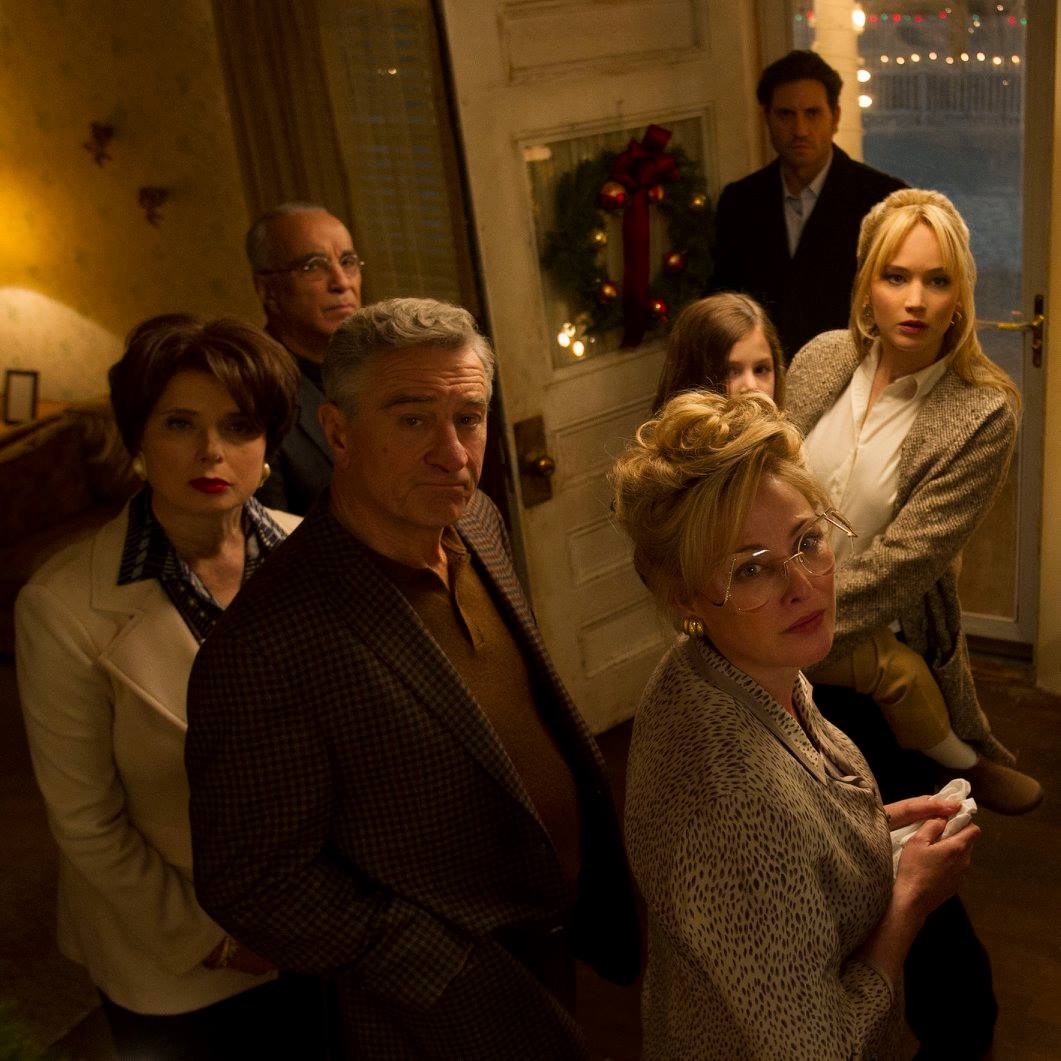
Based on the real life experiences of Joy Mangano, Russell's film opens in late 70s' New York. We see Joy struggle to support her mother Terry (Virginia Madsen), her ex-husband Tony (Edgar Ramirez) and two children. While Terry does little all day but watch soap operas, Tony clings to a fading dream of becoming a singer. In spite of their divorce, Joy tolerates Tony's presence in her house; an issue that irks her father Rudy (Robert De Niro). While Terry and Tony do little to help financially, Joy finds it necessary to take on all tasks and chores related to her house; including home repairs and maintenance.
Long divorced from Joy's mother, Rudy meets Trudy (Isabella Rossellini); an Italian woman who has just inherited her late husband's fortune.
Demonstrating an innate flair for invention, Joy designs a self-wringing mop which she draws up--utilizing her daughter's crayon--in a primitive sketch. Having parts crafted from her design by some of her father's shop workers, Joy is able to create a working prototype but lacks the capital to proceed with production. Tapping into Trudy's inheritance, she is able to hire workers to assemble the various parts in mass quantity.
Before she can patent her invention, Trudy recommends Joy consult a lawyer of her acquaintance to investigate the possible existence of a similar invention elsewhere--which elicits a warning from Tony, who thinks it a mistake to involve someone who doesn't specialize in patent law. The lawyer informs Joy that a similar patent does indeed exist, which makes royalty payments necessary. Joy then hires a company used by her co-patent holder to manufacture the parts she needs for her mops.
Joy's workers create a stock of mops but she discovers that generating interest in her invention is exceedingly difficult. An impromptu demonstration in a K-Mart parking lot draws few buyers and worse still, the store management has the police force her from the premises but not before confiscating her mops.
Having taken out a mortgage to pay her workforce, Joy's debts begin to accumulate but an opportunity to bring her mops to the public's attention is made possible by Tony, who for once manages to be useful to his ex-wife. Tony arranges a meeting for Joy with Neil Walker (Bradley Cooper); an executive for QVC; the home-shopping network, at their company headquarters and studios in Pennsylvania. The meeting goes swimmingly; as Walker is impressed not only with Joy's invention, but her gumption. After Joy's awkward demonstration before QVC personnel, Walker agrees to have her mop on a QVC broadcast. But when the product goes live, she discovers to her horror that the man chosen to present the mop on air bungles the demonstration, which results in zero sales. Furious, Joy drives to Pennsylvania, where she barges into a QVC executive meeting to confront Walker. She demands that her mop be given a second demonstration, performed by herself. Walker reluctantly agrees.
After some cosmetic and sartorial preparation--Joy rejects the latter for her own choice of on-screen attire, she goes live on QVC. She stammers at first but then eases into the demonstration. Moments later, the sales display lights up, causing Joy's family and friends watching at home to rejoice. The joyous, heady moment is a wonderful moment in the film.
But still more setbacks await when Joy discovers her half-sister Peggy (Elizabeth Rohm) has conducted business with the company manufacturing the mop parts, making payments to offset rising interest costs. Joy angrily tells her sister to never conduct business on her behalf again.
The various relationships in Joy's life have some effect, negative or positive on Joy's ambitions. While Peggy proves to be a sibling competitor with ambitions of her own, Terry is a constant burden and Tony a vexing impediment to her success until he proves otherwise. The one anchor in her life is her grandmother Mimi (Diane Ladd--where has she been?); a motivating influence whose unshakable faith in Joy remains a constant to her grave. And though Rudy is initially encouraging, he shows his true colors after Joy is forced into bankruptcy when she discovers the mop part manufacturer refuses to pay for its shoddy work; a problem exacerbated by their unlawful appropriation of her molds. In a moment that calls for fatherly support, Rudy instead expresses his regrets about ever encouraging Joy.
Faced with almost certain defeat, Joy summons her natural smarts and tenacity to look further into the patent claims by the rival company. To her dismay and delight, Joy discovers that no competing patent was ever filed which prompts a meeting with the man who made a competing claim on the patent. The scene where Joy confronts the man responsible for said fraudulent patent claim is riveting. Attending the meeting with confidence and resolve--and a dramatic hair self-styling, Joy secures from the man a sizable payment for the crime committed on herself and company.
The story ends happily for Joy, though subtitles tell us members of her family saw fit to sue her for various reasons. The final scene where Joy sits at desk, listening to a prospective female inventor pitch a product brings the story full circle and is a touching end to a powerful film.
David O. Russell is an actor's director. Though plot is never an afterthought in his films; people are always Russell's main concern. Supporting Lawrence's superb performance is Robert De Niro, who has done his best work in recent years under Russell. The same can almost be said for Bradley Cooper, who never hits a false note. It was great to see Rossellini, Madsen and Diane Ladd, who all made their presence felt. Edgar Ramirez probably redeems himself for the unfortunate Point Break remake.
Russell's film could serve as a metaphor for the plight of actresses in Hollywood; who, in their struggles to be cast in choice roles, always run into a near impenetrable wall of male power that seeks to diminish them rather than allow their talent to flourish.
What the movie ultimately celebrates is female empowerment; Joy's persistence in the face of resistance. The shot of Joy walking toward the camera; looking bad-ass in sunglasses and leather jacket, tells us everything about her refusal to be anyone's fool or doormat.
Russell's film is well on its way to the award empyrean but awards really mean little in the broader scheme of things. What really counts most is a film's endurance. I hope the film resonates with movie audiences.


