Showing posts with label Jack Huston. Show all posts

Wednesday, August 24, 2016

Ben Hur (2016)


**Spoiler Alert**

Director: Timur Bekmambetov/Starring: Jack Huston, Toby Kebbell, Morgan Freeman, Rodrigo Santoro, Pilou Asbaek, Ayelet Zurer and Sofia Black-D'Elia

I've lost count of all the Ben-Hur film adaptations in the 20th and 21st centuries but let's face it; the gold standard still remains the 1925 film version, which starred Ramon Novarro though most people regard William Wyler's grandiose but fun 1959 iteration as the real deal. Taking on Lew Wallace's famous story now is Russian/Kazakh director Timur Bekmambetov; who gave us the incomparable Abraham Lincoln: Vampire Hunter (did you catch the heavy sarcasm?). I suppose Bekmambetov (let's just call him Bek hereafter, shall we?) won't be the last director to adapt the Wallace's book but I wish he were. After Wyler's film, did we really need all the versions that followed, including the animated flick in 2003?

If you were lucky enough to avoid the trailer, you missed the almost imperceptible groans heard throughout the theater. The trailer promised neither excitement nor a moving re-imagining. What one saw was another unnecessary interpretation; cast with actors who looked better suited to playing in a boy band than adversaries in ancient Judea. As you may have heard, box-office receipts were tragically minuscule (gee, how did that happen?) so audiences obviously shared my trepidation. But they, unlike me, had the good sense to lay their green paper elsewhere. So why did I bother? I just had to, folks; I couldn't help myself. I like a chariot-wreck as much as the next chariot-race enthusiast.
Needless to say, Bek's film is dull, silly, often dopey yet one or two scenes almost worked. Almost.

Set in 25 C.E. (no more A.D.), Jack Huston (yes, from the Hollywood Huston dynasty) plays the titular Ben-Hur. Though most of us are well aware of the story, the viewer will find it has been revised somewhat. Messala (Toby Kebbell), is a Roman officer in former adaptations while in Bek's version, he is a Roman orphan adopted by the house of Ben-Hur; making him Judah's step-brother. This, of course, goes a long way to explaining their otherwise unlikely connection.

Early on, we see the brotherly rivalry that defines their mostly loving relationship. While engaged in (literal) horseplay, their dangerously vigorous equine race prefigures their perilous chariot race later in the movie.

A weak, romantic angle has been worked into the story as both young men pursue some of the local Jewish tootsies. I had a hard time drawing a distinction between Judah's sister Tirzah (Sofia Black D'Elia) and the other women in the film. An insipid sameness afflicts the women; rendering them extraneous, pointless characters.

The story then follows a more traditional course as the two men suddenly find their lives working at cross purposes. While Jewish zealots resist Roman Rule, which threatens the uneasy peace between the native population and the occupiers, Judah tries a more conciliatory tack, as he tries to steer the malcontents away from violent protest.

We see Messala join the Roman army, seeking the fortune he hopes will impress his love at home. While Messala campaigns with a legion in Germania, Judah tends to his life of wealth and prestige in his Judean community. But as he sees his Jewish brethren become more impatient with Roman rule, he makes the acquaintance of a Jewish carpenter who preaches the virtues of loving one's neighbor--and enemies--named Jesus (played with Biblical indifference by Rodrigo Santoro, who woefully lacks a messiah's presence). To the film's credit, watching Jesus actually use carpenter's tools is one moment of originality. Usually in films, we only see Jesus standing on a rock, preaching to a gathering of shepherds and hippy-esque Judeans. His message to Judah is so vapidly touch-feely, it's a wonder Ben-Hur doesn't say, "yeah, well, I think I hear Moses calling; I got to go."

Of course we know Messala's return, which happens to coincide with more militant acts of zealot mayhem, will be a major bummer for Judah. Caught between his step-brother's allegiance to the oppressive Roman occupiers and his own cultural imperatives, the two men find themselves hostile adversaries. Messala asks Judah to calm the people during the Roman prefect Pontius Pilate's visit to Judea. Judah is reluctant though the tension in Judea reaches a critical mass when a zealot chooses to kill a Roman officer during the army's procession through town. Though he escapes, Judah claims responsibility in a moment of self-sacrifice (a very Christ-like act, no?), which invites the angry enmity of his brother and the Roman authorities. Messala orders his step-mother and step-sister to be taken away while he consigns his step-brother to abject servitude aboard a Roman ship.

Judah is forced to join the ranks of rowers who sweat and suffer below decks but a clash with Mediterranean pirates causes the destruction of the ship on which he serves; leaving him floating helplessly on logs which suspiciously resemble a cross. From an aerial point-of-view, we see Judah resting on the cross beam; the shot unmistakably a mock crucifix. Any chance we're supposed to draw a connection?

Rather than rescue a Roman officer as in previous interpretations, Judah washes ashore in what must be Jamaica. Why Jamaica? Because the man who rescues him; Ilderim (Morgan Freeman; his appearance in the film an unanswerable riddle) resembles a Rastafarian. Ilderim even sports natty dreads. I asked myself; did the Romans colonize Jamaica too?

Ilderim threatens to fink on the castaway until Judah convinces him otherwise. It also helps that Judah is able to help Ilderim's ailing, white, Arabian horse, which is one of four he keeps for the chariot races. In time, Judah earns Ilderim's friendship and trust while training the horses for the races. Ilderim convinces Judah the best of way to oppose Rome is to defeat Messala in the chariot races. Judah agrees.

Meanwhile, Judah's sister and mother rot in a prison; their leprosy a horrid consequence of Messala's hateful vindictiveness. Judah's thirst for vengeance grows as the imperial races approach.

The race comes, and if anything is certain, it's the outcome, which I need not mention. I will say that it was done well, as the line between CGI and live action was expertly blurred. Liberties were taken with the actual race, for Pontius Pilate attends as kind of an Emperor-surrogate, urging Messala on. A moment of unintentional comedy takes place during the race when Messala asks Judah; "are we having fun yet, brother?" Are you kidding me? If you're going to utter an anachronistic taunt, then why not something more cold-blooded, like "are you feeling me, bitch?" The film is overrun with modern expressions.

Messala survives the race, which leads to a hokey, heart-warming reconciliation; clearing the way for the finale on Golgotha, where Jesus endures needless torture and Judah's mother and sister wash themselves with divine rainfall, which clears up their skin considerably; even better than Clearasil could.

The most I can say about the film is that it's competent. It looks sufficiently ancient-Judea-like and the costumes are imaginatively designed though they look a little too modern at times. In one scene, Judah appears to be in jeans, while one of the women wears what look like white slacks.

Huston and Kebbell make an earnest attempt to play hoary characters but the listless script and even more listless direction can't rescue them from what is an out and out bomb. They aren't entirely to blame; after all, who really wanted to see another 21st Century retelling? Definitely not me. Some, if not all movies, are better off not being re-imagined. Hear that, makers of the forthcoming Magnificent Seven?

In Bek's telling, he reaches for something less grandeur and more earthbound, which is a good impulse but it proves ineffective. Abraham Lincoln: Vampire Hunter didn't work too well either. So it goes. Maybe this box office defeat will discourage future productions, unless someone chooses to reinterpret the story as a comedy. That could be fun. But for now, I've had enough of Judah Ben-Hur and his leprous family.

Thursday, February 11, 2016

Pride and Prejudice and Zombies


**Spoiler Alert**

Director: Burr Steers/Starring: Sam Riley, Lily James, Charles Dance, Sally Phillips, Lena Headey, Douglas Booth and Jack Huston

There are certain novels and plays that have been adapted--over-adapted--for the big screen. Two of them; Hamlet and Pride and Prejudice, have been interpreted so many times as to be nauseating. With Jane Austen film adaptation fatigue now in full effect, along comes Pride and Prejudice and Zombies; a re-imagining of the Austen classic which pits the now-famous characters against--what else; zombies. The idea seemed inspired and fun and I thought it would be a sure winner. Director Burr Steers' film, based on the novel by Seth Grahame-Smith, may remind one of another film adapted from another of the author's works: Abraham Lincoln: Vampire Hunter. Unfortunately, like AL: VH, Steers' film lacks what it needs most: a mirthful, tongue-in-cheek spirit that has little time for earnestness. The title in Steers' film suggests that nothing in the story will be serious, yet that is the direction to which the narrative stubbornly leads; to my personal regret and the filmmaker's peril.

Having read Austen's novel in college and having sat through several big screen iterations, the last thing I need in my lifetime is another straight interpretation. Though I really like film adaptations of Austen's other novels, I feel I've had my fill of corsets, rigid social customs and women fixated on finding their ideal mates. What I wanted to see was something satirical and funny. To sum up the major flaws in this film: it's too serious and too unaware of its need to be outrageously silly. What I wanted was Monty Python but what I got was, well, more Jane Austen.

I won't synopsize the story because I feel most people have some knowledge of the characters and plot from the book or other filmic adaptations. I'll try to just explain how zombies figure into the narrative.
We learn at the beginning of the film that the robust, 18th century sea trade brought a plague to England's shores. Quickly reaching pandemic proportions, the plague spread, causing those infected to become living, breathing corpses hell-bent on devouring the non-infected populace. During this time, a massive wall was erected around the city of London to protect its citizens from the roving, zombie hordes.

Because the upper classes found themselves essentially imprisoned, distractions became an imperative. As a result, a self-improvement movement began in earnest in the form of martial arts. While the gentry became adept in the Japanese martial arts, the less genteel; such as the Bennet sisters, chose the Chinese varieties.

One of the more inspired scenes in the film is our first glimpse of the Bennet sisters; a few of the protagonists of Austen's story. Rather than sitting around, crocheting or knitting or reading poetry, as Austen's female characters are wont to do, Steers' Bennets are bad-asses who sit in a circle; maintaining weapons; sharpening long blades and tending to pistols. Underneath their proper, period-appropriate dresses, the young women wear sheaths for their blades on their very sexy stockings.

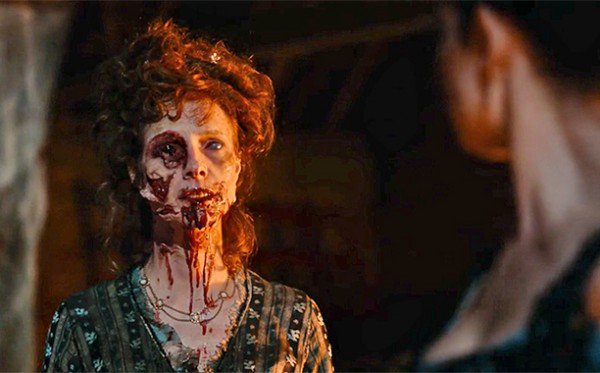
It is quite amusing to hear the narrator mention a zombie attack during a game of whist; the default card game of 19th century European novels. While the Bennet sisters and guests enjoy a hand; Austen's dour, male hero; Mr. Darcy (Sam Riley), barges into the room and unleashes a vial of flies. He explains to the bewildered gathering that the flies will immediately alight on rotting flesh, thus enabling the party to identify any zombie in their midst. When the flys' buzzing stops, the ominous silence alerts everyone to the presence of an infected party, which Mr. Darcy dispatches without much remorse or regret.

As the novel's narrative particulars proceed, the un-dead threaten to overrun the countryside and the country itself. Before long, Mr. Darcy and Elizabeth Bennet (Lily James) begin to see four mysterious, black-clad horsemen. It is explained in the story that the riders may be the biblical Four Horsemen, whose appearances may herald the coming of a zombie apocalypse.

When not concerning themselves with their romantic pursuits, the Bennet sisters apply their considerable martial skills to slashing and smashing zombie skulls.

As the zombies overrun London and the countryside, the only safe haven for the living lies across a river where only a single bridge serves as means of protection from the un-dead legions. A climactic moment takes place on said bridge as Mr. Darcy and Elizabeth try desperately to cross before the army detonates explosives, which serve as a fail-safe method for keeping the zombie army at bay.

Other than the zombie angle, which quickly loses its novelty, there isn't much to recommend the film. And though the Bennet sisters and Mr. Darcy adroitly remove heads from bodies, the action scenes are nothing much. Zombies roaming through Austen's world is a juicy gag that never becomes a gag; merely material with unrealized potential.

Watching Riley play Mr. Darcy with an irony-free earnestness was one more bummer that sponged all the fun out of the movie. How can anyone be in a flick called Pride and Prejudice and Zombies with a straight face? Couldn't Burr Steers and Seth Grahame Smith have pulled out all the stops and given us something anarchically loony?

Well, vampires have become passe and zombies are on their way out. What can we expect next? Crime and Punishment with evil aliens? War and Peace and Werewolves? Stay tuned.

Thursday, April 16, 2015

The Longest Ride


**Spoiler Alert**

Director: George Tilman Jr./Starring: Scott Eastwood, Britt Robertson, Alan Alda, Melissa Benoist, Oona Chaplain, Jack Huston and Lolita Davidovitch

In this blog, I generally avoid bashing any film adapted from a Nicholas Sparks novel because I liken the experience to bullying a nun; it provides little challenge and it may be perceived as mean-spirited. But I couldn't grant George Tilman Jr.'s The Longest Ride free passage. I figured I'd let too many other Sparks adaptations escape ridicule and critical evisceration because, well...they're nuns.

I always feel sorry for any cast in a movie inspired by a Sparks novel. They have to utter shockingly bad dialogue and pretend the stories actually have conflict.

As most frequent movie-goers are aware by now, Hollywood has been desperate to reproduce The Notebook, though it is unconcerned how unapologetically formulaic and aggressively insipid other iterations may be. The Longest Ride (which feels like one), didn't really bore me; it made me laugh often, though it isn't a comedy. I tried hard to suppress giggles and keep my face-palms to a bare minimum but the movie was unaccommodating.

Let's face it, if you've seen The Notebook, you've seen George Tilman Jr.'s flick. It merely replaces Ryan Gosling and Rachel McAdams with Scott Eastwood and Britt "No, I'm not Jennifer Lawrence" Robertson and James Garner and Gena Rowlands with Alan Alda and well, nobody. Same story but with a few tweaks to make it appear it's a different movie.

In this "version", Scott Eastwood (bearing a scary resemblance to his old man) plays Luke Collins (the name couldn't be more Cowboy); a competitive bull-rider in the North Carolina rodeo circuit. Eastwood makes a very convincing rodeo competitor (come to think of it, Clint would have made one too, in his day) and is an ideal Sparks stud; tall, muscular, tough and always laconic.

During one of his competitions, a Wake Forest University sorority girl named Sophia Danko (Britt Robertson) is prodded to the rodeo by a gaggle of her sisters. After they watch Luke execute a successful ride, his hat escapes the ring and comes to rest near Sophia. He asks her to keep it, while she and her friends dreamily ogle the charismatic, young man.

At a local watering hole that evening, the two meet, and agree to a date. Sophia warns Luke her she is to begin an internship at a Manhattan art gallery soon, which may preempt their romance.

And what Nicholas Sparks story would be complete without an elderly person pining for a lost love, one forged in the distant past. That person is Ira Levinson (Alan Alda), a widower who spends his days missing his wife.

One night, while Luke and Sophia are driving home from a date, the two find Ira's car crashed into a tree. As Luke pulls Ira from the smoldering wreckage, Sophia retrieves a box resting in the front seat. Later, at the hospital, she discovers love letters Ira had once sent inside the box, which again, if you've seen The Notebook, you know where the story will lead.

We know Sophia will ask Ira about the letters and because his failing vision won't allow him access to the missives, she becomes his surrogate reader. And in reading them, we discover an old romance which, if you've seen other films of this ilk (and most people have), alerts us to how the story will be structured: Luke and Sophia's romance will play out against Ira's, which takes us back to the early 1940s', when he worked in his family's clothing store. A young woman named Ruth (Oona Chaplain); a newly arrived Austrian Jew who, with her mother and father, narrowly escaped the Nazis, wanders into the Levinson store. Young Ira (Jack Huston) sees Ruth and is instantly smitten. The two meet and before long the two become an item. After some heady dates and time together, their relationship is tested when Ira is drafted into the army.

I have to say the battle scenes, particularly one in which we watch Ira bravely rescue a comrade from no man's land are so visually uninspired they couldn't have passed muster on Hogan's Heroes. But that is an unfair knock; young girls and women who will make up the majority of the audience for the film can't be expected to care about Saving Private Ryan realism.

Knowing Luke's passion for bull-riding and Sophia's for art, how long do you think it will take for their respective worlds to clash? And is it any surprise that Luke's mom, Kate (Lolita Davidovitch, in a wisp of a character) pleas with her son to stop bull-riding, fearing something catastrophic? And is it any surprise that Sophia begins to hector him the same way, which elicits a response we heard coming from the opening credits: "I don't know how to do anything else."

If my feet weren't stuck in the molasses of Luke and Ruth's relationship, I was too busy chuckling at Ira and Ruth. I tried to ignore Oona Chaplain's (granddaughter of Charlie Chaplain) Austrian accent, which was as wide as the Danube. When she wasn't slinging her accent around, she was saying peculiar things. For instance, while gamboling along a North Carolina shore with Ira, Ruth exclaims ecstatically, "This is beginning to remind me of home." Strange thing to say, considering home meant fleeing the Nazis. And if running along a beach reminds her of home, what Austrian beach might she be missing exactly? Does the Danube have sandy shores I'm unaware of?

I can't imagine the American south was a Norman Rockwell halcyon in the 1940s as it's depicted in the film. No anti-Semitism anywhere?

The connective tissue between the couples of the past and present is art. Ruth and Sophia are both art lovers and a collection Ruth and Ira amass will figure prominently in the present.

It was darn tough to find anything in the film resembling conflict. Sure, Luke's bull-riding is an issue as is Ruth and Ira's inability to have children (Ira is wounded during the war, rendering him sterile). Their attempt to play parents to one of her students, whose home-life is a sad tale of neglect, comes closest to anything resembling sturm and drang. What real drama there is is so mild and tension-free the characters may as well be troubled by bad tummy aches and paper-cuts.

Tilman, who has done some fine work behind the camera (Notorious), is hamstrung with what is a typical Nicholas Sparks story. Even the visuals are stifled. It isn't surprising to see so many aerial tracking shots of the North Carolina country-side; they seem to be a fixture in most of these movies.

Aside from serviceable dialogue that hobbles the performances, there isn't a convincing exchange between any actors the film entire. Poor Melissa Benoist had to make her way through Danny Collins, only to end up in The Longest Ride, where the dialogue has scarcely improved.

Scott Eastwood certainly inherited his father's charisma (and a more rugged physique) but can't bring anything interesting to the role though he and the cast can't be blamed, the script must have read like a car maintenance manual.

The ending is an eye-roller and a major hoot. After Ira kicks the bucket, his and Ruth's substantially valuable art collection is willed to Luke and Sophia with an improbable proviso that brings a sappy two hours to a merciful close.

I highly recommend the film to women (or men) who might find the sight of Scott Eastwood's Adonis-like body worth a gander. Unfortunately for men (for these films are made mostly for women), Britt Robertson provides some but not much distraction from the silly drama playing out onscreen. Or if the sight of a doddering, sickly Alan Alda flicks your switch, then knock yourself out. Otherwise, there is little reason to see The Longest Ride.

I'm sure the next Nicholas Sparks adaptation is but a year away. I'm aquiver with anticipation.